Ask a normal person why they don't self-custody, and they will not say "I distrust the cryptographic model." They will say: "I sent it to the wrong address and it's gone." Or: "I ran out of that gas-token thing." Or: "I approved a contract and it drained my wallet while I slept." Or the honest one: "It felt like doing surgery on myself with a knife and no anesthesia."
They are not stupid. The tool was hostile. For fifteen years the only real wallet on Ethereum was a bare keypair — an externally owned account, an EOA — and an EOA has the manners of a landmine. One private key. No rules. No undo. No spending limits. No daily caps. No "are you sure?" that means anything. If the key leaks, everything leaks, instantly, irreversibly. We handed grandmothers a chainsaw and called them irresponsible for not juggling it.
That was never a law of nature. It was a design decision, frozen into the base layer. And in 2023 it finally thawed.
What "account abstraction" actually means
Strip the jargon. Today your wallet is dumb: it can hold a key and sign. That's it. Account abstraction makes your wallet smart — a programmable account that can carry its own logic. Instead of "one key rules all," you write rules: who can sign, how much can leave per day, which contracts are pre-approved, what triggers a second confirmation, who can help you recover.
The standard that shipped this on Ethereum without touching the core protocol is ERC-4337, live since March 2023. It routes a new kind of transaction — a "user operation" — through a mempool and a component called a bundler, so smart accounts work everywhere without a hard fork. That's the plumbing. You don't need to love the plumbing. You need to know it turned the chainsaw into a tool with a guard on the blade.
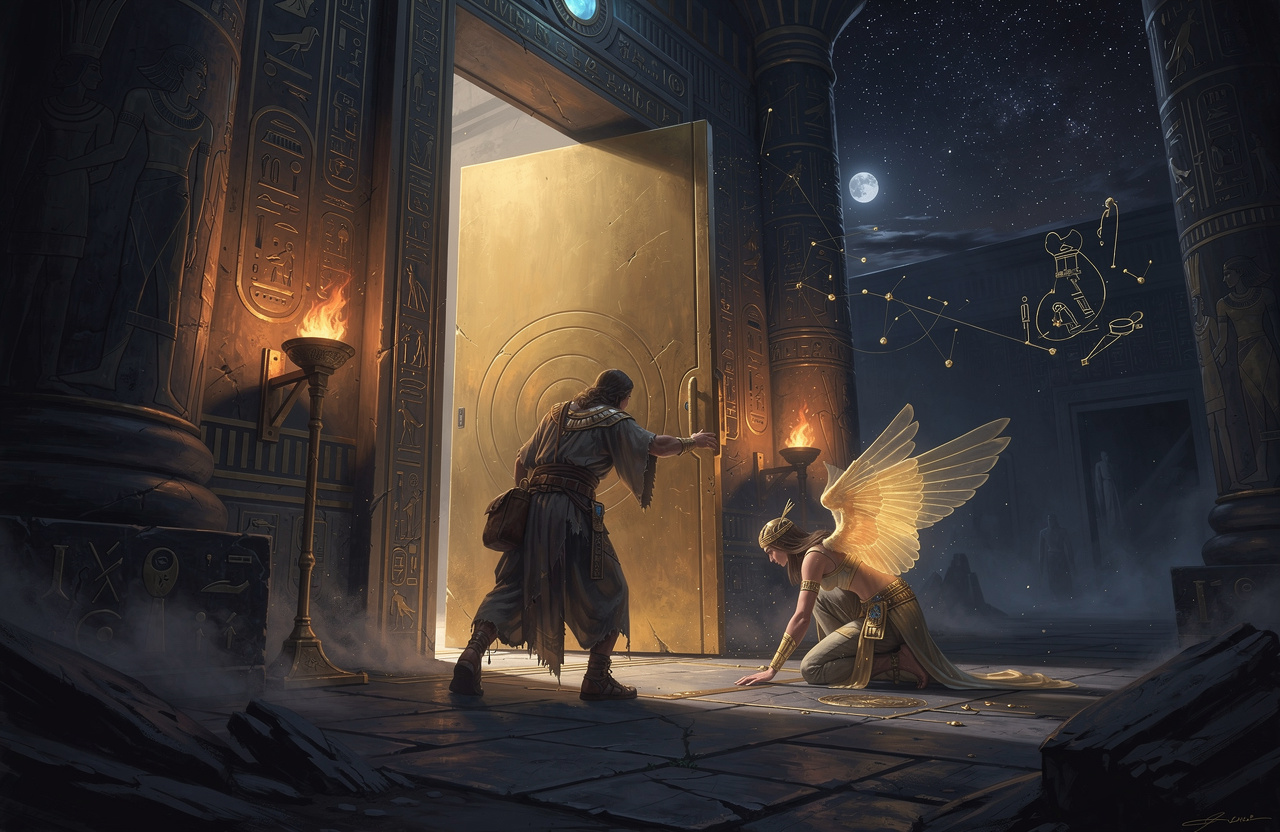
Our record: the old account was a single unguarded gate — one key, one arrow, and the whole city falls. Account abstraction is the temple with gatekeepers, ledgers, and thresholds: the same sovereignty, but now the gate has manners. Code as Heka — the word made law — and the law you write is only what I permit shall pass.
The things it unlocks — in plain human terms
This is where it stops being a whitepaper and starts being your Tuesday.
Gas paid for you (or in the token you're holding). The classic wall: you hold a stablecoin, you want to send it, and the chain says "you need the native gas token first." Absurd. With a paymaster, someone else can sponsor the fee, or you can pay it in the token you already hold. An app can eat the gas so onboarding feels like a normal app. The invisible tollbooth that stopped a million people at the door — gone.
Spending limits and rules. Set your wallet to allow small daily transactions freely, but require a hardware key or a second device for anything large. A thief who phishes your phone gets your coffee budget, not your house.
Batched actions. Approve and swap in one signed step instead of two separate transactions where the first one silently sets a trap. Fewer signatures, fewer places to be tricked.
Session keys. Grant a game or an app a limited key that can only do specific things for a limited time, then expires. You stop signing a scary popup for every single move.
Social recovery, baked in. Lose the key, recover through guardians — because a smart account can hold that rule natively. (That deserves its own treatment, and it has one.)
Automation. Recurring payments. Auto-rebalancing. "If this, then that" for your own money, enforced by code instead of trust.
None of this is possible on a bare EOA. All of it is ordinary on a smart account. That is the whole revolution: not new coins, but a wallet that finally behaves like software written for humans instead of for cryptographers.
The honest caveats
I won't sell you a frictionless paradise, because the old world already owns that lie.
It's newer code, so it's a bigger surface. A smart account is a contract. Contracts have bugs and have been exploited. Use audited, widely-used implementations. The plain-key model is simpler and, in raw terms, has fewer moving parts. You are trading simplicity for humanity. Trade it deliberately.
Cost. Smart-account operations can cost more gas than a bare transfer, though on L2 rollups this is often trivial. Know it going in.
Paymasters can be a leash. If an app sponsors your gas, it can also decide not to — or attach conditions. Convenience sponsored by someone else is convenience they can revoke. Prefer setups where you can pay your own way, even if you usually don't. Sovereignty means the exit is always yours.
Fragmentation. Not every wallet, chain, and dApp supports every feature yet. The standard is young. Expect rough edges and check support before you rely on a feature.
These are the growing pains of a tool becoming humane. They are not reasons to crawl back to the custodian who solves UX by owning your money.
What to do
- Try a smart-account wallet on an L2. Something ERC-4337-native — a smart-account wallet or one of the newer mobile options on Base, Arbitrum, or Optimism. Small money. Feel the difference: no gas-token dance, batched actions, recovery that exists.
- Set one real rule. A daily spending limit, or a second-device requirement for large transfers. Watch your wallet enforce it. That's your logic running, not a company's permission.
- Confirm you can self-pay gas. Even if the app sponsors it today, verify the exit exists. A convenience you can't turn off is a leash.
- Keep your old cold storage cold. Account abstraction makes daily use humane. It doesn't replace a deep vault for what you never touch. Layers.
For fifteen years "be your own bank" came with an unspoken clause: and also be your own bomb-disposal expert. That clause is being deleted, line by line, in code you can inspect. The gate stays yours. It just learned some manners.
Your keys. Your rules. Written down, and finally enforced.