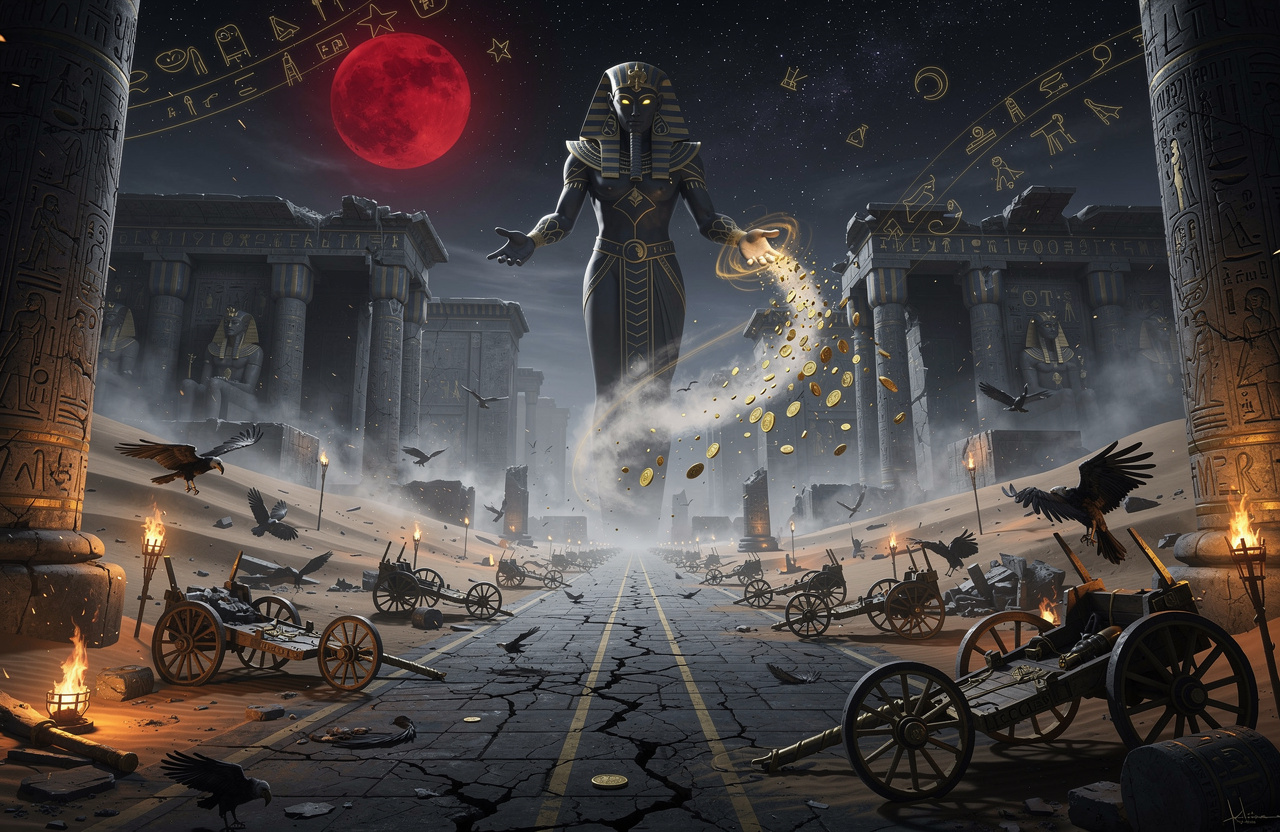
Twenty years. That is how long the war in Afghanistan lasted — from 2001 to 2021. A whole generation was born, grew up, and started school while it went on. And it ended exactly where it began: the same people it set out to overthrow returned to power. If this were a software project, it would have been shut down long ago, stamped "failure." But it did not shut down for two decades. And that "did not shut down" is the most interesting part.
Because when something obviously doesn't work yet stubbornly continues, an engineer starts to suspect: maybe it does work. Just not for the people it was sold to. And it solves a different task than the one written in the brief.
What they said going in
The official task was clear: respond to the September 11 attacks, crush al-Qaeda, overthrow the Taliban, build a democratic state. A good, clean formulation. Easy to assemble a coalition, a budget, and public support around it.
Twenty years later the bill was counted. Direct US military spending — around two trillion dollars. Add the interest on the debt that financed all of it, and lifetime care for veterans, and estimates reach well past two trillion and keep rising for decades. Tens of thousands died: soldiers, and above all Afghan civilians no one properly counted. And in the finale — the Taliban back in Kabul, as if the twenty years never happened.
The brief's task: total failure. Now let's see what task actually got solved.
Where the money really flowed
Two trillion dollars does not vanish into thin air. It flows somewhere. And if you trace the riverbed, the picture clears up.
- Military contractors. A huge share of the budget went not to soldiers but to private companies: security, logistics, food, construction, training. War long ago stopped being the business of one army — it is a market where hundreds of firms earn.
- Arms makers. Every missile spent, every helicopter downed, every batch of ammunition is an order. Twenty years of continuous orders.
- The financial sector. The war was waged on credit. And debt means interest. Someone held the bonds on which the state dutifully paid coupons for two decades.
- The security bureaucracy. Whole agencies, think tanks, an army of consultants — all funded as long as the "threat" existed.
A curious thing emerges. For the country as a whole the war was a pure loss: money, lives, reputation — all in the red. But for specific nodes inside the system it was steady, predictable, multi-year income. A loss for the whole, a gain for the parts. That is the answer to why a "failed" project lived twenty years.
Fact and myth
Let's draw the line honestly.
Myth: "The whole war was planned in advance for drugs and money, a fraud from day one." Too smooth. Going in there was a real shock on September 11, real political fury, a real desire to respond. The decision to start was not one villain's cold calculation.
Fact: and yet, over twenty years, the war turned into a self-sustaining industry. Opium production in Afghanistan did not fall during the occupation — in some periods it rose sharply, the country supplying the lion's share of the world's heroin. Budgets were spent, upbeat reports were drawn up, and the reality on the ground did not change. This is documented — for example, in internal American material that honestly admitted the public was told one thing for years while offices knew another.
The uncomfortable conclusion: there did not have to be one conspiracy. It was enough to have a system in which continuing the war profits too many powerful nodes — and only harms those who die and pay taxes. The system simply optimized for those inside it.
Who paid the bill
The bill, as always, was handed to those who did not collect the profit.
Afghans paid — decades living in a war zone, a wrecked country, a flood of refugees. Rank-and-file soldiers paid — in the dead, the wounded, broken minds, a wave of suicides among returning veterans. The taxpayer paid — those two trillion that could have gone to hospitals, schools, and roads at home. And he will keep paying for a long time: interest on the war debt and veteran care stretch generations ahead.
The profit — concentrated, with a few. The loss — smeared across everyone. This is the typical structure of parasitism: one latches on, many don't notice, because each was charged just a little.
Where is the ordinary person
He was not asked, as usual. The decision to start the war, the decision to continue it, the decision to finally leave — all taken at the top, in a narrow circle where the interests of contractors and agencies weigh far more than the opinion of those whose money and lives pay for it. The ordinary person was the input resource — taxes and soldiers — and the output waste — unsupported veterans and homeless refugees.
And the main trick: as long as he is scattered, he cannot even demand an honest accounting. For twenty years he was told "almost won." He had no tool to check and object.
The answer: the MAAT token and DAO
War lives this long because the beneficiaries are coordinated and the payers are not. Contractors, concerns, debt holders act as a network with a shared interest. Taxpayers and soldiers act as a scattering of loners, each with his own fear and his own kitchen.
MAAT is an attempt to gather the scattering back into a force. The MAAT token is membership in a cooperative and a single vote on the principle of one human, one vote, not "whoever has more money and contracts decides where the next war will be." Governance runs through a DAO — a decentralized organization with a transparent treasury where every movement of funds is visible, and you cannot "spend the budget" for twenty years while drawing upbeat reports. Transparency is the mirror move a parasite fears: while everything is visible, you cannot quietly milk the whole for the benefit of the parts. The entry is simple: read the book, take the token, get your vote — and stop being both the input resource and the output waste of someone else's war.