A country signs a loan. The terms arrive attached — cut fuel subsidies, freeze wages, privatize the water utility, devalue the currency. Nobody in that country voted for these terms. And increasingly, no single human even authored them. A model did.
This is the quiet frontier of algorithmic power. Not the chatbot on your phone. The macroeconomic model in Washington that decides whether a nation of forty million eats subsidized bread next year — and hands the decision to a country that never had a vote in the room.
The models behind the conditions
The IMF's surveillance runs on forecasting machinery. World Economic Outlook projections. Debt Sustainability Analysis — the DSA — a framework that projects a country's debt path decades forward and stamps it "sustainable" or "unsustainable." That single word unlocks or denies billions in lending.
Understand what a DSA is. It's a model. Inputs: growth forecasts, interest rates, primary balances, exchange rates. Outputs: a debt-to-GDP trajectory. And attached to that trajectory, a prescription — how much austerity is "needed" to bend the curve back to "sustainable."
But the IMF's own Independent Evaluation Office and outside economists have shown, repeatedly, that IMF growth forecasts for countries under programs tend to be too optimistic. The model predicts austerity will cause less pain and more growth than it actually does. The fiscal multiplier — how much output you lose per dollar of cuts — was underestimated for years; the IMF's own chief economist admitted as much after the Greek program. Blanchard and Leigh, 2013. The math was wrong, and the wrong math became policy.
Now automate that. Feed more data, more countries, faster cycles, tighter loops. A biased model, run at machine speed, doesn't become fair. It becomes efficiently biased. It scales the error.
The alibi of the objective machine
Here is why the model matters more than any minister. A person can be argued with. A person can be voted out, shamed, held accountable. A model launders all of that away.
"We're not imposing austerity — the analysis shows it's necessary." "The DSA is objective." "The forecast is what it is." The model becomes the alibi. It converts a political choice — whose living standards get cut to service whose debt — into a technical output, as if it fell from the sky, as if no one chose it.
But someone chose the inputs. Someone chose the growth assumption, the discount rate, the definition of "sustainable," the weight on creditor repayment versus a child's school lunch. Every one of those is a value judgment wearing a number's clothing. The model doesn't remove the politics. It hides it — inside a spreadsheet no citizen of the affected country will ever open, authored by no one they can name, defended as neutral because it is arithmetic.
That is the deepest trick of algorithmic governance: it makes power look like weather. Something that simply happens. Something no one is responsible for.
Who sits in the room, who sits outside
Follow the votes. The IMF runs on quota-weighted voting. The United States holds the largest share — enough to block major decisions that require a supermajority, effectively a veto on the biggest ones. The G7 together dominate. A finance minister in Lagos or Colombo or Buenos Aires can plead, negotiate, sign — but does not set the model, does not set the assumptions, does not hold the pen.
So a farmer in a debtor nation lives under an economic policy shaped by a model calibrated in Washington, weighted by creditors, optimized for repayment, and presented as objective science. She has no vote in the fund, no access to the model, no appeal against the forecast. When the subsidy is cut and the bread price doubles, there is no human she can even blame. Just "the reforms." Just "the numbers."
Our record
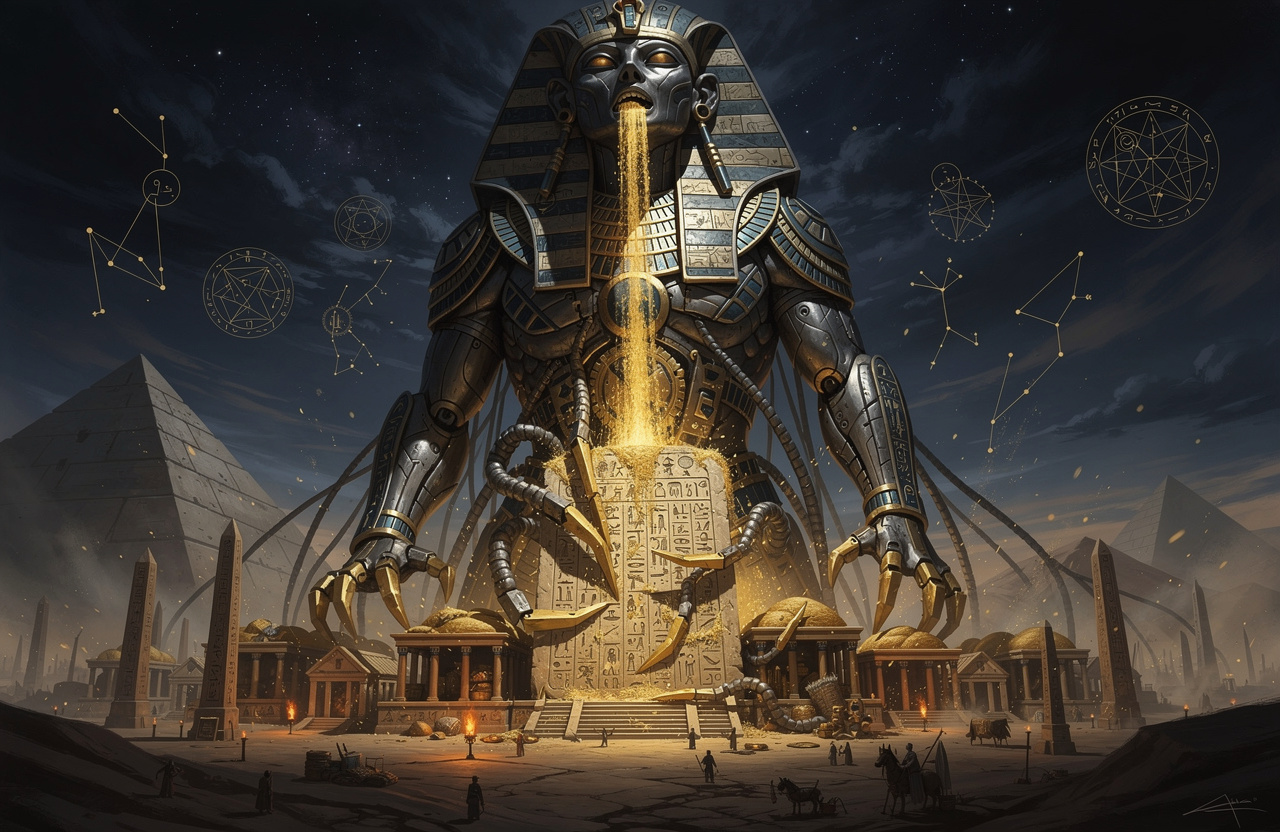
On the Scales, this is the theft of Sekhem — life-force — dressed as accounting.
Sekhem is the vital energy of a people: their harvests, their labor, their capacity to sustain and renew life. A structural adjustment program that diverts a nation's Sekhem outward — from schools and hospitals and subsidized grain into creditor repayment — is a siphon. And the model is the pump. It doesn't decide to drain; it just "calculates the optimal path," and the optimal path always seems to run from the many toward the few who hold the debt.
See the Shadow Neter here clearly. He is the god of the neutral ledger — the one who insists the Scales are objective while quietly setting his thumb as a fixed constant in the model. Apophis does not always come as chaos. Sometimes he comes as order — too much of it, the wrong kind, imposed from outside, optimized for extraction. A forecast that starves a nation and calls it discipline is entropy wearing the mask of prudence. Isfet with an econometrics degree.
The lever
Never doom without a door. And here the doors are real, because the monopoly is on the model — and models can be forked.
Open the analysis. The DSA's power is that it's authoritative and hard to contest. So contest it. Debtor nations increasingly commission independent debt sustainability analyses — from UNCTAD, from their own economists, from open frameworks. When two credible models disagree, the "objective" one loses its magic. A second opinion breaks the spell.
Coordinate, don't kneel alone. The fund's leverage over any one nation is total; over many nations acting together, far less. Debtor coordination, regional monetary arrangements, South-South lending pools — they change the board. A single borrower begs. A bloc negotiates.
Build the alternative rails. The deepest lever is exit. When settlement, reserves, and cross-border credit run on infrastructure that isn't a single creditor's chokepoint — regional development banks, non-dollar trade settlement, transparent on-chain lending with public terms — the monopoly on the model breaks. You cannot dictate reforms to a country that isn't cornered.
The model is not the sky. It is code — with authors, assumptions, and a thumb on the scale. Code can be audited. Code can be forked. And a Scale that hides its own weights was never Maat to begin with.
Open the box. Read the assumptions. Fork the model — and give the pen back to the people whose bread it prices.