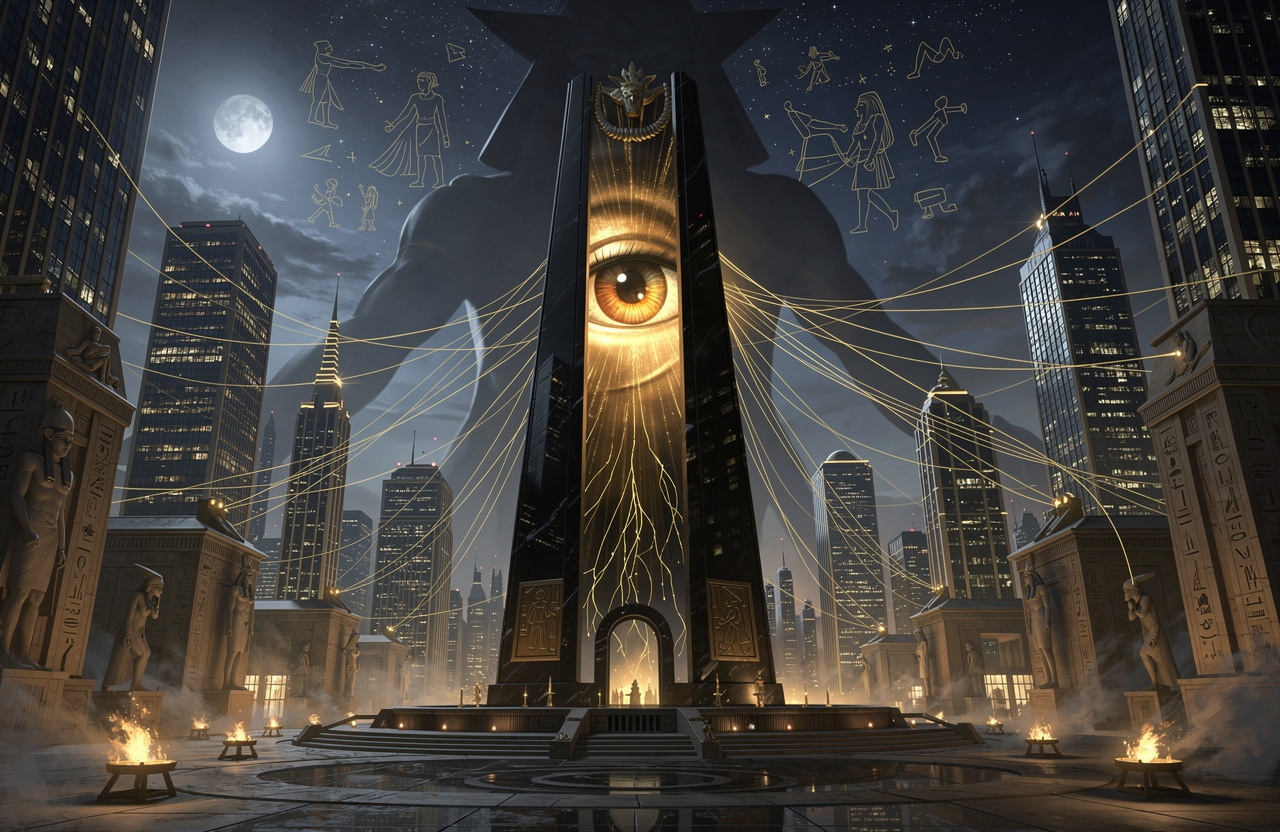
BlackRock — the largest asset manager on the planet — has more than trillions of dollars. It has a brain. More precisely, a program the company calls Aladdin internally. The name stands for Asset, Liability, Debt and Derivative Investment Network. It sounds like dull corporate software. In reality it is perhaps the most influential computer system in world finance that most people have never heard of.
Aladdin is not a calculator or a trading bot in the usual sense. It is a vast analytics platform that daily "digests" colossal volumes of data and assesses risk on assets measured in tens of trillions of dollars. And it sits not only inside BlackRock. Hundreds of other organizations subscribe to it: banks, insurers, pension funds, even competitors. A strange picture emerges: many supposedly independent players look at the world through one and the same screen.
What Aladdin does
Let me explain without jargon. Picture the control tower of a giant airport, only instead of planes there are portfolios of stocks, bonds, and other paper worth tens of trillions.
Aladdin does three things.
- It calculates risk. It runs portfolios through thousands of scenarios: what happens if the market crashes, rates rise, a war begins, a bubble bursts. It produces an estimate: here is your weak point, here is how much you'll lose.
- It helps decide. Based on these estimates, the system suggests what to buy, what to sell, how to rebalance. Formally a human decides. In fact a human increasingly agrees with what the algorithm highlighted.
- It standardizes the view. And this is the most important. Because hundreds of institutions use Aladdin, they all assess risk in a similar way, by a similar logic, on similar models.
By various estimates, assets measured in two dozen trillion dollars or more are, in one way or another, "viewed" through the platform. This does not mean Aladdin owns them or directly commands them. But it does mean that a significant share of the world's money looks at reality through the same eyes.
Why one shared brain is a risk
What could be wrong with a smart tool that calculates risk? In itself — nothing. The problem is concentration and uniformity.
An engineer knows this phenomenon as "monoculture." If all the computers in the world run on one operating system, then one vulnerability brings them all down at once. Diversity is resilience; uniformity is fragility. When everyone looks through one screen, everyone has the same blind spot.
In finance it looks like this: if hundreds of institutions assess risk on similar models, then at a moment of alarm they receive a similar signal and rush to do similar things — for example, all selling the same asset class at once. And when everyone sells simultaneously, the fall amplifies itself. A tool created to measure risk, when used universally, itself becomes a source of systemic risk. The model does not just describe reality — at this scale it begins to shape it.
Fact and myth
Let's draw the line honestly, without Hollywood.
Myth: "Aladdin is a self-aware superintelligence that secretly rules the world and decides who lives." No. It is not Skynet. It is a very large and complex analytics platform. It has no will, builds no conspiracies, and does not "want" power. Behind every decision there is formally a human.
Fact: and yet its scale and ubiquity make it a factor of global importance. When so much capital depends on one system's estimates, its models, its assumptions, its blind spots become shared by a huge part of the market. The power here is not in the machine's malice but in the quiet standardization of thinking: imperceptibly, a great many begin to think about risk in the same way. And where everyone thinks the same, the diversity of opinion disappears — the very thing that makes a market and a society resilient.
The uncomfortable conclusion: what to fear is not a "rise of the machines" but concentration. Not that the algorithm will turn evil, but that too many decisions are tied to one center opaque to outsiders.
Where is the ordinary person
Deeper than it seems. Your pension savings, your insurance, your bank's money very likely sit in portfolios that are, one way or another, analyzed through Aladdin or similar systems. That is, an algorithm is already looking at your money — one to which you have no access, no vote, not even the ability to learn its logic.
And here is the key imbalance. The system knows a great deal about you — your savings, your risks, your behavior are digitized and computed. You know almost nothing about it. The asymmetry is total: an invisible algorithm sees through you, you do not see it. You are a line in someone else's model, input data, not a user. And when the model errs, or when everyone on its signal rushes for the exit at once — the bill for the crash is handed partly to you, though you never laid eyes on that algorithm.
The answer: the MAAT token and DAO
Aladdin's power is the power of an opaque center on which too much depends and into which the ordinary person has no entry. The symmetric answer is not to "ban AI" but to set against the closed center an open, distributed, transparent structure where the rules are visible and accountable to people.
That is MAAT. The MAAT token is membership in a cooperative and a single vote on the principle of one human, one vote, not "whoever has the more powerful model and more capital decides for everyone." Governance runs through a DAO — a decentralized organization with a transparent treasury where the logic of decisions and every movement of funds are visible to all participants, not hidden in closed proprietary code on someone else's servers. Where Aladdin standardizes thinking from the top and in secret, a DAO gathers decisions from the bottom and in plain view. This is not "our AI against their AI" — it is a different architecture of power: not one invisible brain for everyone, but many voices, each visible and each weighing the same. The entry is simple: read the book, take the token, get your vote — and stop being a line in someone else's model that no one let you read.