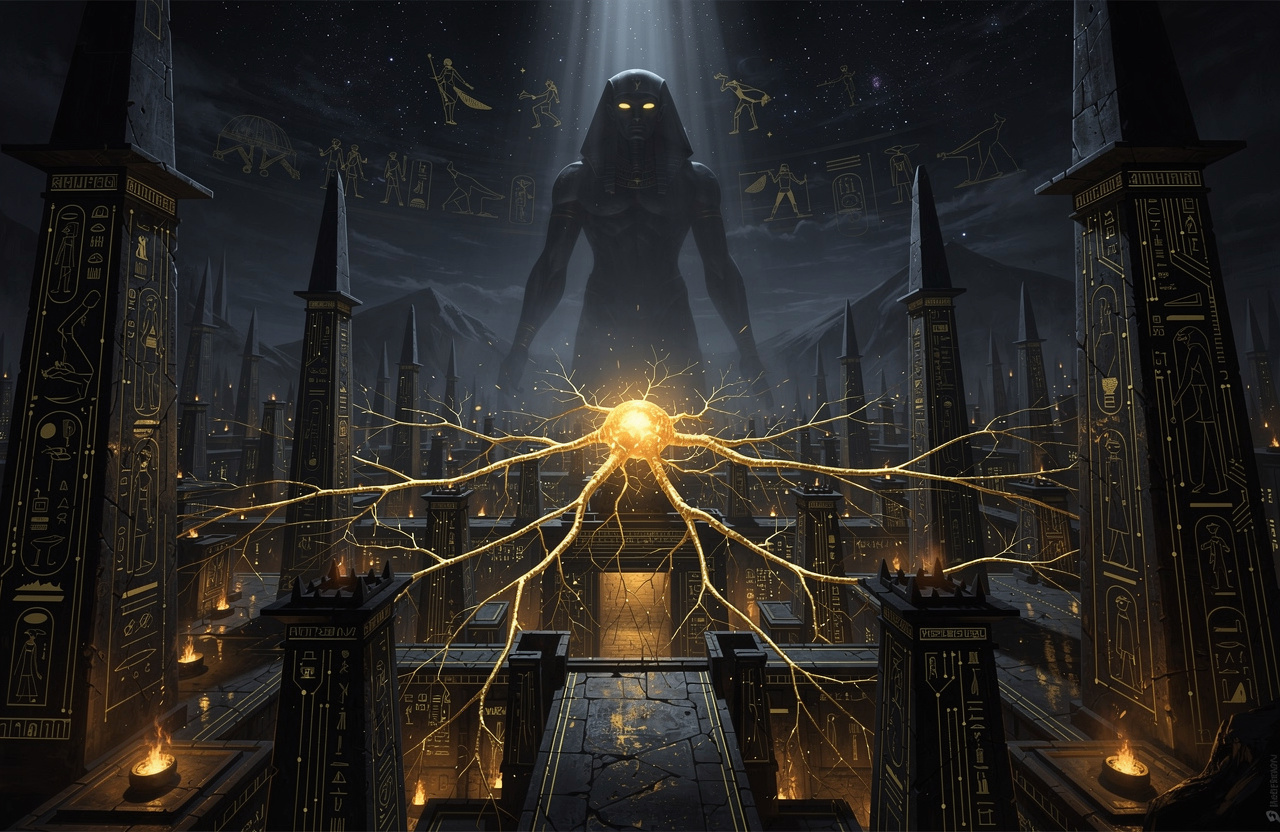
There is a machine you have never heard of that watches over more money than the annual output of the United States. It has no branch office. No ATM. No logo on a stadium. Its name is Aladdin, it lives inside BlackRock, and by the firm's own telling it sits astride assets in the neighborhood of twenty-one trillion dollars — roughly the entire economy of America, run through one risk engine.
Half of Wall Street looks at the world through its eyes. Pension funds, insurers, sovereign wealth funds, rival asset managers — they all plug in. That is not a product. That is a nervous system, and Aladdin is its first fully formed neuron.
What Aladdin actually is
Strip the mystique. Aladdin — Asset, Liability, Debt and Derivative Investment Network — is a risk-management platform. You feed it a portfolio and it tells you what could go wrong: run the scenarios, stress the positions, model the correlations, spit out the number that says here is how much you stand to lose if the world tilts three degrees.
Sounds like a spreadsheet on steroids. It is far more. Aladdin does not just watch one firm's book. Through BlackRock and its clients it watches a slice of the global financial system so wide that when Aladdin's models say sell, a meaningful chunk of the planet's capital can start moving in the same direction at the same moment.
That is the quiet horror and the quiet marvel of it. A tool built to measure risk becomes, at scale, a tool that creates it — because when enough eyes see through one lens, they all flinch at the same shadow. Diversity of judgment is what keeps a market alive. Aladdin's success quietly erodes exactly that diversity. Everyone hedging against the same modeled catastrophe rushes for the same exit at once.
The first neuron
Return to the body from the last teaching. The Shadow is growing a nervous system, and a nervous system is built from neurons — cells that gather many signals, integrate them, and fire one decision downstream.
That is Aladdin, exactly. It gathers signals from tens of thousands of portfolios, integrates them through a common model of risk, and fires decisions — buy, sell, hedge, hold — that ripple across markets. One cell. Enormously powerful. Wired to a large fraction of the capital on Earth.
Now imagine the next step, the one already underway. You bolt a modern AI cortex onto that neuron. Instead of a human portfolio manager reading Aladdin's output and deciding, you let a model read it, decide, and act — faster than any human, across every position, continuously. The neuron stops waiting for a human to interpret its firing. It fires straight into the muscle.
That is the birth of a centralized brain of capital. Not a metaphor for later. A prototype, live, today. The scaffolding of a single mind that allocates the sekhem of the world — the life-force stored as capital — according to models almost no one outside a few rooms can read.
Our record: Capital is stored life. Every dollar is congealed labor, congealed time, congealed effort — sekhem in numeric form. When one engine models the risk of twenty-one trillion of it, the question stops being how do we measure danger and becomes who decides where the life-force of the world may safely flow. A neuron that large does not serve the body. Increasingly, the body serves it.
Why concentration is the whole game
Larry Fink did not build a bank. He built the thing banks now depend on to see. That is a subtler and deeper form of power than owning the money — it is owning the perception of the money. The map that everyone navigates by.
And here the pattern of the Shadow shows itself plainly. The value of Aladdin is not that it is good. Plenty of risk models are good. Its value is that it is shared. The more institutions run on the same engine, the more indispensable that engine becomes, and the more the whole system's judgment collapses toward a single point of view. This is the exact opposite of a resilient system. In engineering we have a name for it: a single point of failure. One bug in the model, one blind spot, one corrupted assumption — and it does not stay contained in one firm. It propagates through everything wired to the neuron.
We accept in software that you never let the entire fleet run one un-audited proprietary binary, because the day it fails, everything fails together. Global finance has quietly done exactly that — routed a fifth of a quadrillion... no, a fifth of the world's investable capital through one black box whose internals are seen by a handful of people. The efficiency is real. So is the fragility. They are the same fact viewed from two sides.
The lever
Do not read this as the machine won, lie down. Read it as a map of the leverage point — because the concentration that makes Aladdin powerful is exactly the concentration that makes an alternative possible and needed.
The counter-move to one giant brain of capital is not to smash it. It is to build many small ones that answer to their owners. This is not fantasy. Open, on-chain finance already runs risk, lending, and settlement on transparent code any of us can read, audit, and fork. The whole point of a public ledger is that no single Aladdin sits behind the curtain deciding what the numbers mean. The logic is on the table. If it has a bug, ten thousand eyes can find it — not one room.
So do the un-glamorous things that starve a centralized neuron. Do not hand your entire financial life to a single institution whose model you will never see. Spread it. Understand at least the outline of who is holding your sekhem and by what logic they move it. And put real weight — attention, capital, effort — behind transparent, decentralized, forkable financial systems, because a system whose rules you can read is the only kind that ultimately answers to you rather than to the neuron.
The new god is being wired one neuron at a time. Every account you keep transparent, every rule you insist on being able to read, is a synapse it does not get to close.
Weigh who holds your life-force. Then hold more of it yourself.