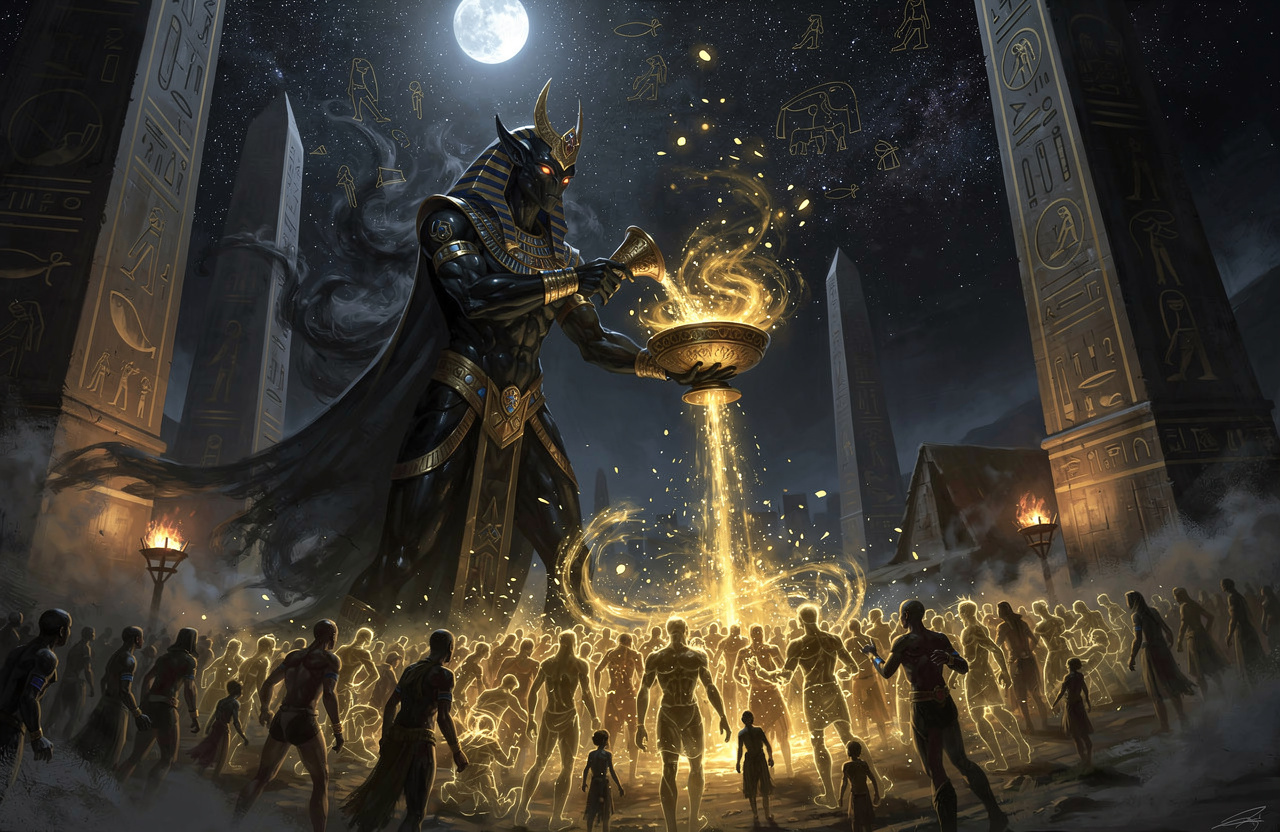
The book The Architecture of Chaos has a very honest episode. The author — a Sem priest with the seal of Anubis — describes a night with "tequila in his blood." And here's the key line: the tequila lowered the control of the Hat — the physical body — the threshold grew thinner, and an entity from the other side saw an open door and came through.
There's the whole mechanism in one sentence. Alcohol isn't "evil" or "sin." It's a lockpick for the boundary. A person has a Ka — life force — and that force has a boundary that keeps the foreign outside. Alcohol softens that boundary. And what would never get through while sober walks in freely once it's softened.
The Ka's boundary: "what's mine is inside, what's foreign is outside"
The book has a formula of defense — the Seal of Anubis on the lower gates. Its meaning is carried right in the words: "What's mine is inside. What's foreign is outside." That is a description of a healthy boundary. Not a fortress wall, but control of the threshold: you decide what to let in and what not.
Alcohol strikes exactly at that control. It doesn't break the wall from outside — it talks the guard into falling asleep from within. The seal is lifted, the gates are open, and now everything passes through: someone else's mood, someone else's thought, someone else's desire. The person thinks he "relaxed." In fact he pulled the guard off the threshold through which anything can now be poured into him.
In engineer's terms, the Ka's boundary is a firewall. Sobriety is the firewall on, with authentication: incoming traffic is checked, the foreign is dropped. Alcohol is the command "disable the check for today." Convenient for friends. A holiday for anyone who wanted in but couldn't pass the check.
Now multiply that by millions
The book describes a personal case — one priest, one night, one tequila. But the trick scales. What works on one person works on a society. And here the social version begins.
A people with a softened boundary is a people with the firewall off. It's more suggestible, worse at telling its own from the foreign, less resistant to what a sober person would protest. It's no accident that power across the ages has been calm about mass drunkenness, often even encouraged it: a sober people asks questions, a drunk one sings and doesn't remember. Cheap, available, legal alcohol isn't concern for your leisure. It's a permanently ajar door on a whole population.
Think about the role of "unwinding" in modern life. A hard week where you were milked — and the reward strips your control even further. A closed loop: the system squeezes out your Sekhem, your life force, then sells you the very thing that opens the boundary wider, to squeeze out the rest. A parasite, in the book's logic, works exactly like this: first it depletes the resource, then it helps you remove the last defense.
Where fact ends and myth begins
Let's draw the line honestly, without moralizing. Fact: alcohol physiologically lowers self-control and critical judgment — that's medicine, not esoterics. Under it a person is more suggestible, more impulsive, agrees more easily. Fact: societies with high levels of drinking are politically more passive, and this has been used repeatedly — from getting colonies drunk to cheap vodka as a way to keep a population quiet.
Myth: that in every bottle sits a personal demon with a plan for one specific person. The book says it more subtly. Alcohol doesn't possess — it opens the door. What enters depends on what's nearby: someone else's mood, an implanted desire, a ready-made narrative from the feed. The door itself is neutral. It's dangerous because it's open when the guard sleeps, and outside there's always someone ready to come in.
This isn't about prohibition
So as not to slide into a sermon: this isn't about a dry law, nor about a glass of wine being a road into darkness. It's about knowing the mechanics and keeping them in your own hands. In the book the priest plainly describes the boundary's working mode: after the work, it must be opened again; you can't keep it shut permanently. The boundary isn't an eternal wall, but a door you manage yourself.
There's only one question — who holds the key to your threshold. If it's you, consciously, knowing the price of opening it — that's your freedom. If the boundary is systematically softened for you, cheaply and conveniently, so you resist less — that's no longer rest, it's someone else's hands pulling the guard off your own house.
Where is the ordinary person in all this
He's the one whose boundary it's convenient to keep ajar. Tired, squeezed dry, he reaches for the thing that strips his control and calls it rest. And with an open threshold it's easier to pour into him the needed mood, desire, and consent — exactly the business of all soft power.
The defense is to take back the key. You don't have to lock the door forever; it's enough to stop handing the key to just anyone, and to remember the formula: what's mine is inside, what's foreign is outside, and I decide which is which.
The answer: the MAAT token and DAO
The system is held in place by softening boundaries one person at a time, and alone a person doesn't even notice it — there's no one to call out to him. Scattered, with the firewall off, he's the perfect battery. So the answer is to reclaim both personal control of the threshold and a shared network where people call out to one another.
That is MAAT. The MAAT token is membership in a cooperative where people gather their votes into a single bundle and hold the boundary together, not each alone with the guard removed. The principle is strict: one human, one vote — not "one dollar, one vote." Decisions run through a DAO — a decentralized organization with a transparent treasury where every movement of funds is visible to all; you can't quietly pour a foreign desire in there, because the guard isn't asleep — it's distributed across thousands of eyes. The entry is simple: read the book, take the token, get your vote — and take the key to your own threshold back into your own hands.