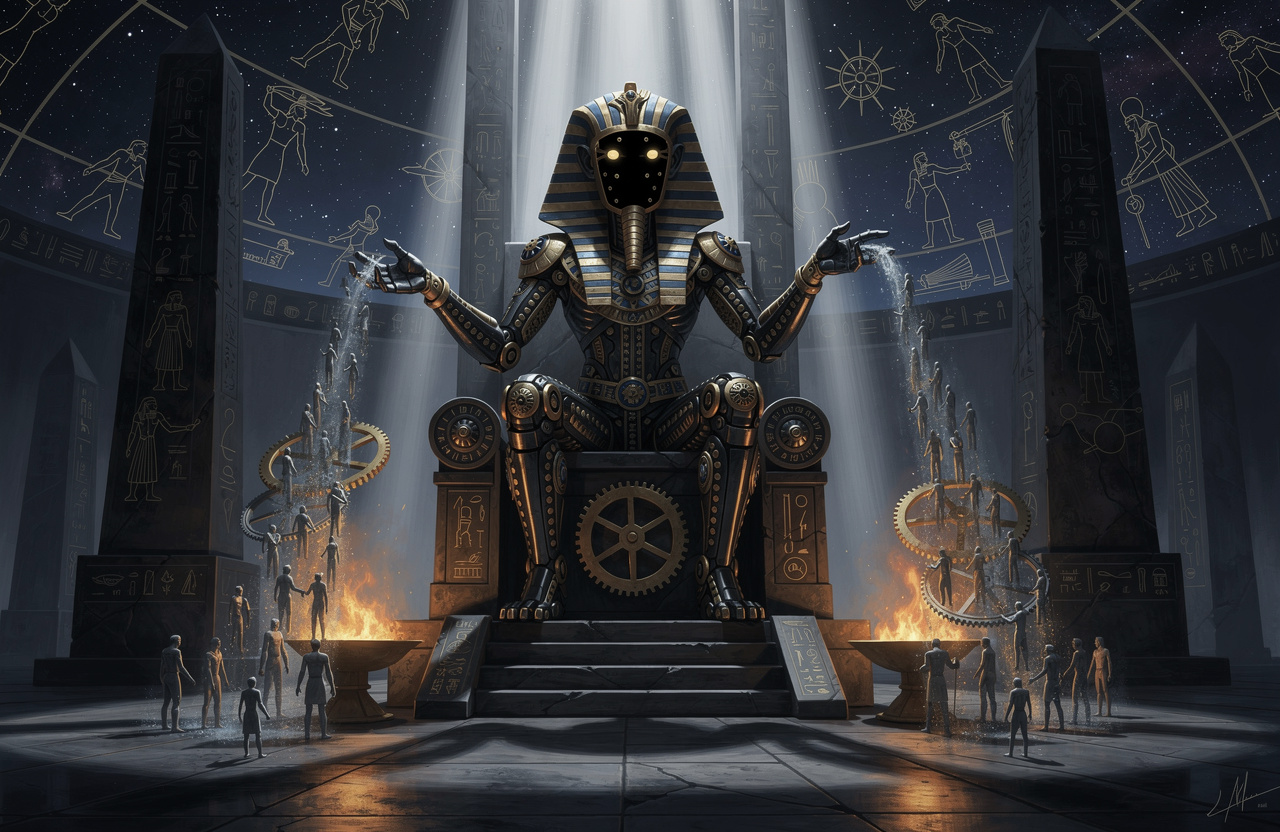
When someone says "the fund decided to sell," the imagination paints a room of serious people arguing in front of a screen. The reality is duller and more frightening: increasingly it isn't a human that decides, but an algorithm. A program that holds trillions of dollars of other people's assets in memory and, in fractions of a second, issues a verdict — buy, hold, dump. I'm a former IT guy and I know: code is neither evil nor good. But when the fate of companies employing millions hangs on its lines, the question "who wrote it and toward what goal" stops being technical.
Aladdin: the operating system of the world's money
BlackRock has a system called Aladdin. By various estimates, something north of twenty trillion dollars of assets fall under its analysis and risk management — and not only BlackRock's own, but those of dozens of other banks, insurers, and pension funds that use it as a service.
Dwell on that. This is not merely "a program in one company." It's a shared operating system for a huge slice of the world's capital. An engineer sees the problem at once: if everyone views risk through the same engine, everyone sees the world the same way. And so they react the same way — in the same second, in the same direction.
Why "everyone the same" is dangerous
In a living system, diversity is what saves you. If a thousand players hold a thousand different opinions, one's error is offset by another's correctness, and the market stays stable. It's like different antivirus programs: someone closes a hole even if another missed it.
Now imagine everyone runs the same antivirus with the same bug. A virus appears tailored to that hole — and everyone falls at once. In finance this is called the systemic risk of a monoculture. When half the market listens to one algorithm, its "sell" signal becomes a self-fulfilling prophecy: the program says dump — everyone dumps — the price falls — the program sees the fall and orders dumping even harder. A cascade. Not malice, but a feedback loop with no human left to say "stop."
Who actually makes the decision
Here comes the philosophically uncomfortable part. We like to think an algorithm is "objective" — it just calculates. But any code carries the goal of whoever commissioned it. Baked into the algorithm is the definition of what counts as a good outcome.
The book says it bluntly: "The best mathematicians build algorithms to optimize the returns of hedge funds." The key word is returns. Not people's well-being, not the resilience of companies, not the preservation of jobs. The algorithm optimizes the metric it was given, and does so ruthlessly efficiently. If maximizing quarterly profit requires gutting a factory, the program calmly advises gutting the factory. It's no villain. It simply executes a goal that never listed people as a value.
And another thread from the book, exactly on point: a meeting can vote on who sets the media agenda — "an algorithm that maximizes anxiety and clickbait, or an editorial team that strives for quality." Everywhere the same choice: hand the decision to a metric, or keep it with a human.
Convenient anonymity
A social trick hides here too. When a human decides, there's someone to hold accountable. When "the algorithm calculated it that way," there's no one. Ten thousand people laid off? "It's optimization, the model showed it." The algorithm becomes the perfect screen: it depersonalizes responsibility. No one in particular is to blame — "the math" is to blame.
In the book, the clans are described as a force that deliberately dissolved its visible self into the structure: "Money flows up — and the vote goes to Fink." The algorithm is the next step of that dissolution. Now you can't even see Fink — you see only a dispassionate engine, and arguing with it is as pointless as shouting at the weather.
Where the Isfet is
Isfet is the inversion of fair exchange, a structure that extracts and puts nothing back. An algorithm optimizing someone's returns at people's expense is Isfet driven to automation. A parasite once needed at least a human to make the decision. Now the decision is made by code that runs around the clock, with no conscience, fatigue, or doubt. The perfect executor of anti-Maat: it's incapable of asking, "but is this fair?"
Where is the ordinary person in this
You are a variable in someone else's optimization function. Your job, the price of your rent, your credit score — these are inputs the program weighs not in your interest, but in the interest of the metric its owners gave it. You are not at the negotiating table. You aren't even counted as a party. You are a cell in a spreadsheet.
The answer: the MAAT token and DAO
The problem isn't that algorithms appeared — code in itself is neutral. The problem is that the goal inside them is set by a few, while the consequences are lived by millions who were never asked. So the answer isn't "ban algorithms," but to return to people the right to set the goal and see what's happening.
That is MAAT. The MAAT token is membership in a cooperative and a vote on the principle of one human, one vote, not "whoever's algorithm is bigger is right." Governance runs through a DAO — a decentralized organization with a transparent treasury where the rules and every movement of funds are visible to all and recorded on the blockchain. Here the system's goal is set not by a nameless engine in someone else's ownership, but by the people who live with the decisions. No Aladdin votes for you behind closed doors.
Their bet is that you stay a variable computed by someone else's program. MAAT bets the opposite: to be the one who sets the goal, not the one being optimized. The entry is simple: read the book, take the token, get your vote — and stop being a cell in someone else's spreadsheet.