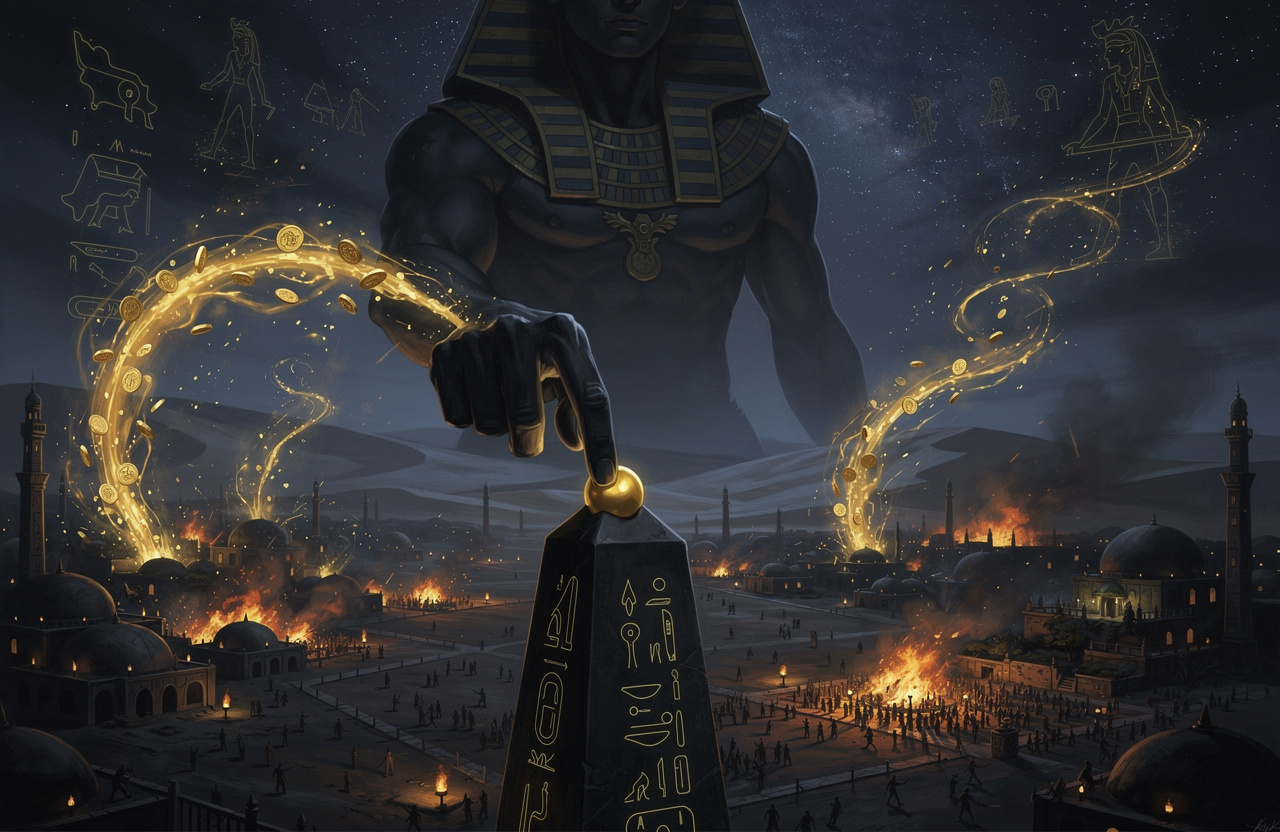
In December 2010, in a small Tunisian town, a street vendor named Mohamed Bouazizi set himself on fire — after the police seized his vegetable cart yet again and there was nowhere to complain. One desperate man. Within weeks the entire Arab world was ablaze: Tunisia, Egypt, Libya, Syria, Yemen, Bahrain. Presidents fled, regimes fell, the squares boiled over. Journalists called it the "Arab Spring" and spoke of the dawn of freedom.
Fifteen years have passed. Let's look at what morning actually followed that "spring." And let's ask the engineer's question: one burning cart does not set a whole region on fire. What amplified the signal? Who pressed the button, and where?
The dry fuel was real
Let's be honest right away: the anger was genuine. Decades of dictatorship, corruption, unemployed youth, rising bread prices, humiliation at the hands of police. A whole generation of educated young people with no jobs and no future. That's combustible material, and it was genuinely dry — nobody invented it.
This is worth repeating, because both extremes lie. It was not the case that "the CIA staged it all and the people had nothing to do with it." The popular despair was real to the last drop.
But the opposite extreme — "it was a pure spontaneous storm, nobody steered anything" — is also untrue. Between a spark and a fire across half a region there's an amplifier. And that's the thing worth seeing.
The amplifier: social media and satellite TV
The "Arab Spring" was called the "Facebook and Twitter revolution" for a reason. For the first time, protest coordination ran through platforms owned not by local authorities but by Western corporations. Hashtags, pages, clips that flew instantly across the region. The satellite channel Al Jazeera broadcast the squares around the clock, turning a local protest into a pan-Arab event.
An engineer sees two things here. First: the communication channel was not in the protesters' hands — it was in the hands of those who own the platform. What gets shown, what the algorithm promotes, what gets blocked — that wasn't decided in the square. Second: for years beforehand, Western foundations and programs trained local bloggers, activists, and "opinion leaders" in exactly the same nonviolent-resistance playbooks as in Serbia and Georgia. The infrastructure slept and waited for a trigger.
The trigger arrived on its own — Bouazizi. After that the amplifier did its job: local pain was cranked up into a regional fire.
What came after the "spring"
Now — a cold look at the result. Where is the promised freedom?
- Tunisia — where it all began — is the only one that kept any semblance of civil order, and even that wobbles.
- Egypt — after brief elections, returned to military rule. The circle closed.
- Libya — once the country with the highest living standard in Africa. After Gaddafi's overthrow and killing, it fell apart into warring factions, slave markets, and chaos that continues to this day.
- Syria — years of civil war, hundreds of thousands dead, millions of refugees pouring into Europe.
- Yemen — humanitarian catastrophe, famine.
That's not a "spring." It's a winter that doesn't end. The region didn't get freedom — it got chaos. And here the main question kicks in: who benefits from chaos?
Chaos as a product, not a malfunction
The book states it plainly: chaos is not an accident, it's an architecture. The ancient Egyptians would have called what happened Isfet — not fairy-tale "evil," but the inversion of just order, a state in which structure breaks down while someone feeds on the breakdown.
A wrecked country means:
- a flow of refugees that destabilizes neighbors and Europe;
- an open market for weapons (the military-industrial complex isn't complaining);
- resources — Libya's oil, routes, territories — that are easy to redistribute amid chaos;
- a weakened competitor that no longer runs an independent policy.
You don't have to believe someone drew the whole plan in advance. It's enough to see that the architecture is built so that turning a working country into rubble systematically benefits someone. A strong state controls its resources. A state in chaos controls nothing — and into that hole step those with capital, weapons, and patience.
Where the ordinary person stands
Bouazizi just wanted to sell vegetables and feed his family. His despair was real. But his pain was turned into the match for a fire that consumed millions like him. The youth who came out to the squares for dignity got war, poverty, or a new dictatorship. The people's energy was real — and the result went to someone else.
The same scheme as everywhere: the scattered individual gives his strength, and whoever holds the amplifier — the platform, the media, the weapons, the capital — collects the result.
The answer: the MAAT token and DAO
The "Arab Spring" revealed something frightening: when people have no network of their own, their genuine pain can be amplified through someone else's platform and steered toward someone else's goal — up to the self-destruction of entire countries. A communication channel in someone else's hands is precisely the button that the people do not press.
MAAT is an attempt to give people their own channel and their own coordination, one that can't be quietly redirected. The MAAT token is membership in a cooperative and a vote on the principle of one human, one vote, not "whoever owns the platform and the money decides." Governance runs through a DAO — a decentralized organization with a transparent treasury where every movement of funds is visible to all. No outside foundation can secretly finance the "right spring": everything is open, and any attempt to buy a vote or an agenda is visible.
The difference is simple. Chaos thrives where people are scattered and plugged into someone else's amplifier. MAAT gathers people into their own transparent network, where the amplifier belongs to them. The entry is simple: read the book, take the token, get your vote. And stop being a match in someone else's fire.