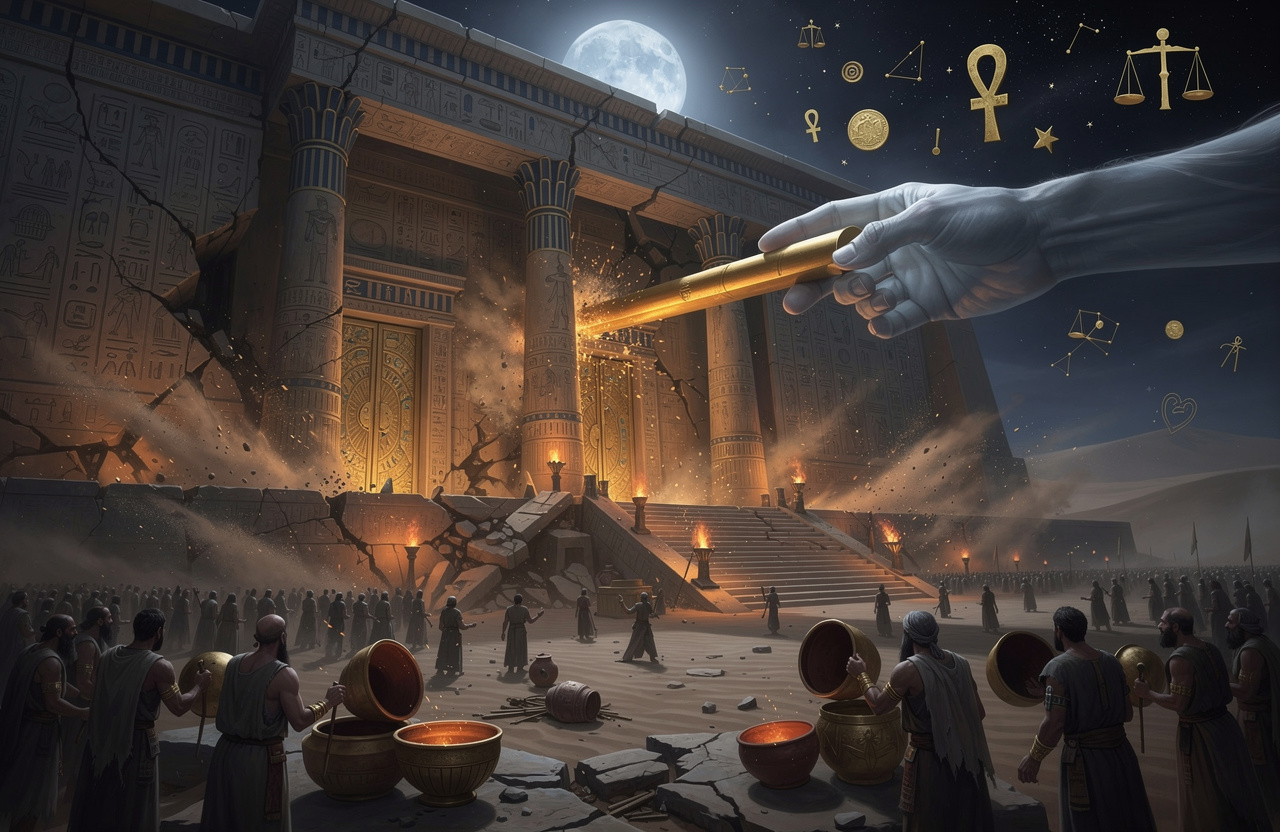
December 2001. Buenos Aires. In two weeks the country went through five presidents. The banks froze accounts — people couldn't withdraw their own money. In the streets, pots banged instead of drums, shop windows shattered, people died. Argentina, which a century earlier had ranked among the ten richest countries on earth, declared the largest sovereign default in history at the time — around 80 billion dollars. The question few asked aloud back then: was this an accident, bad luck, "bad Argentines" — or the result of a perfectly comprehensible machine?
What the road to the cliff looked like
The story didn't begin in 2001. It began earlier — with a familiar "reform" package. In the 1990s Argentina did exactly what the standard script prescribes: it pegged the peso to the dollar one-to-one, threw its markets open, and began selling off the state.
Take one episode that shows everything else. The Buenos Aires water utility was handed to French conglomerates — effectively for free, a 30-year concession for a symbolic sum. They promised what they always promise: private is more efficient than public. The result: water tariffs roughly doubled, the promised connections for poor neighborhoods were never delivered, and the profit was repatriated abroad. Water — a basic resource of life — was turned into a pump for draining money out of the country.
There were dozens of such episodes. Each was sold on its own as "modernization." Together they added up to one thing: the country lost assets and revenue while its dollar debt grew.
The trap of a foreign currency
Here is the core technical bug wired into the very design. By pegging the peso to the dollar and piling up dollar debt, Argentina lost control of its own money. The country earned in pesos but owed in dollars. As long as the dollar behaved, the scheme held. Let it strengthen and capital get nervous, and the debt automatically became impossible to carry.
The book calls this remote code execution at the level of a state: decisions made outside Buenos Aires remotely ran the Argentine economy. The local government was no longer the operator of the system but a user with reduced privileges. And when there was no money left to service the debt, the IMF came, as always — with a new loan and new conditions. A loan to pay a loan. `while (true) { debt++; }`
The moment of collapse
By 2001 the structure was held together by a promise. Capital was fleeing, reserves were melting, and cash withdrawals were restricted — the famous "corralito," where your money is formally yours but you can't get it out. That tripped the spring. Default, panic, five presidents in two weeks, deaths in the streets.
And then comes the most instructive part. When the dust settled, the reverse cycle began. The state later renationalized some assets — for instance, the oil company YPF was bought back from Spain's Repsol for around 5 billion dollars. What had once been sold for pennies was repurchased for billions. The question "where did the difference go, and into whose pocket" answers itself.
Why it never ended
Argentina is sometimes called the eternal debtor, and that is not a figure of speech. For a century and a half the country has been kept drowning in debt on the same cycle: loan — crisis — default — new rescue program — loan again. After each "rescue" the country emerges poorer, more dependent, and more indebted. By 2024 inflation there exceeded a hundred percent a year: money in an account lost half its value over twelve months — simply for sitting still.
Who holds Argentina's government bonds and through them effectively runs its budget? The names are familiar: large hedge funds, investment banks, index ETFs — BlackRock, Pimco, Franklin Templeton and the like. An Argentine pensioner worked and paid taxes for forty years — and the result of his life sits in the portfolios of funds on other continents, trading his debt back and forth and profiting on every swing.
And here is the detail that demolishes the convenient myth that "it's because they're enemies of the West." Argentina is not a sanctioned country; it is "one of theirs" to the Western world. It didn't help. The parasite doesn't care whether you're one of its own: it has no "own," only what can be sucked out.
Where is the ordinary Argentine in all this
He is at the very bottom of the scheme and, at the same time, its main fuel. His savings burned in every default. His taxes went to service a debt the country will never clear. His water, his energy, his oil were once common — and became a line in someone's investment report. And nobody asked him anything: creditors, governments, and funds decided for him.
It's the same trouble a pensioner faces in any other country: you are the source of the capital, but not its owner. An intermediary casts your vote.
The answer: the MAAT token and DAO
Argentina was broken not because Argentines are dumber than others, but because on the other side of the table always sat a coordinated network of creditors and funds, and on this side scattered people, easy to grind down one at a time. The opponent's strength is concentration. So the answer is built through concentration too — only the reverse kind, and transparent.
That is MAAT. The MAAT token is membership in a cooperative and a single vote on the principle of one human, one vote — not "one dollar, one vote" like the bondholders. Decisions are made in a DAO, a decentralized organization with a transparent treasury where every movement of funds is visible to all. When such a cooperative gathers a million members from a hundred countries, its voice starts to be heard even at the meetings of the very funds that trade other people's debt. A Russian, a Greek, a Kenyan, and an Argentine suffer from one system — and can belong to one cooperative. The entry is simple: read the book, take the token, get your vote — and stop being a line in someone else's report.