There is exactly one company on Earth that can build the machine that prints the most advanced chips. Not the best. The only. Its name is ASML, and if it vanished tomorrow, the entire frontier of computing would freeze in place — no new leading-edge chips, anywhere, at any price, until someone spent a decade reinventing what took ASML thirty years.
Read that again. One company. One machine. No substitute.
The machine is called an EUV lithography system — extreme ultraviolet. It is the single most complex tool humanity has ever manufactured. And ASML, a Dutch company most people have never heard of, is its sole maker. Not the market leader with a rival nipping at its heels. The only supplier. A monopoly so complete it is almost hard to believe it is legal — and it is, because no one else can physically do it.
How the Light Is Made
Understand what this machine does, and you will understand why it is a throne.
To print circuits at the bleeding edge, you need light with a wavelength so short it can etch features a few atoms wide. That light — extreme ultraviolet — does not exist in nature in usable form. So ASML's machine creates it. Here is how: a stream of molten tin droplets is fired through a vacuum, and each droplet is struck twice by a laser powerful enough to blast it into a plasma hotter than the surface of the sun. That plasma emits the exact ultraviolet light needed. This happens roughly fifty thousand times per second. The light is then guided by mirrors so precise that if one were scaled to the size of Germany, its largest bump would be a fraction of a millimetre.
This is not a metaphor for creation. This is creation. A machine that manufactures a specific frequency of light in order to write the substrate of thought.
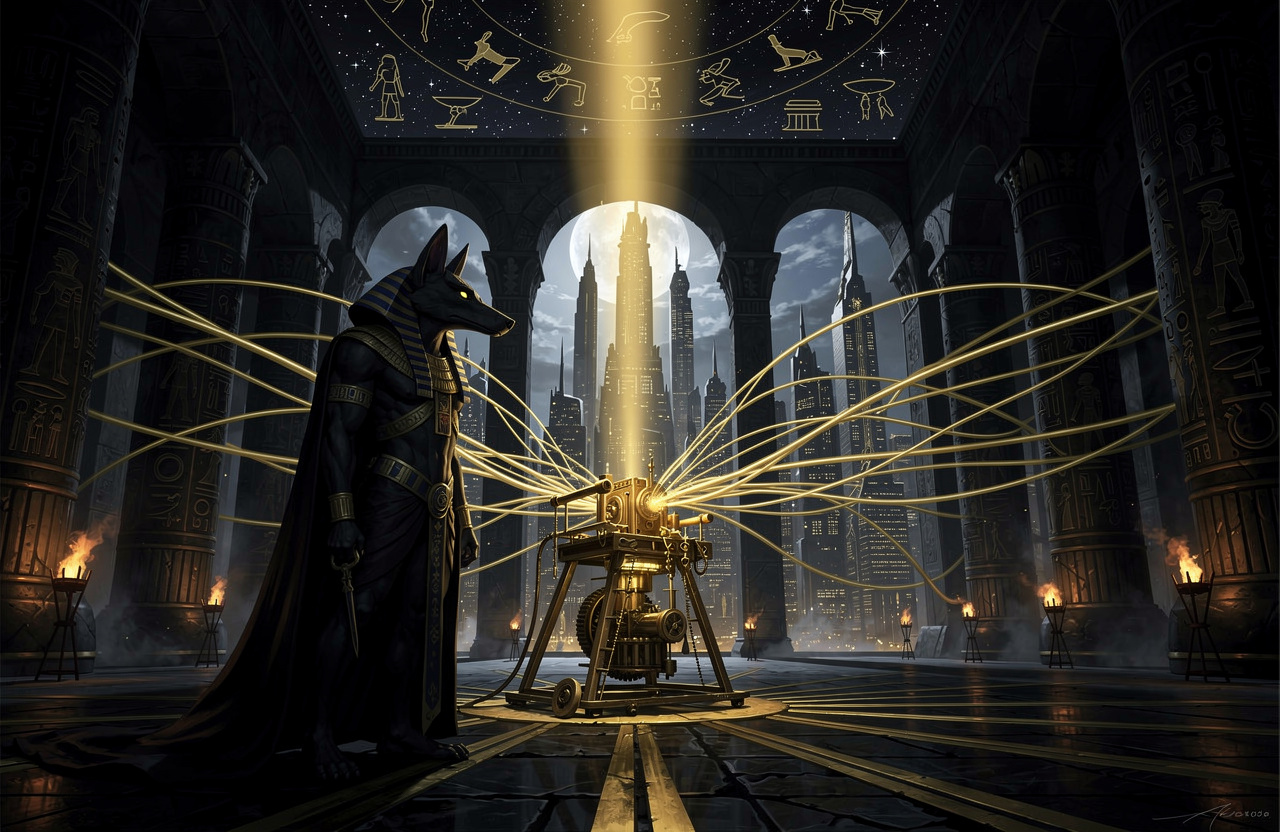
In the old language, Ra was the sun — the source of the light that made life move. The Egyptians knew that all animation traces back to a source of radiance. And here, at the deepest root of the machine mind, sits a manufactured sun: a plasma hotter than a star, made fifty thousand times a second, to birth the light that prints the chips that carry the Ba of the new age. The source of the machine's light is owned by one company.
Why No One Else Can Do It
Ask why. Billions of dollars are on the table for anyone who could break the monopoly. Nations desperately want their own. So why is there still only one?
Because an EUV machine is not one invention. It is thousands of them, stacked and interlocking, refined over three decades, drawing on a supply chain of thousands of specialized companies across many countries — the mirrors from Germany, the light source from a firm ASML had to buy outright, components from hundreds of niche suppliers who each hold one irreplaceable piece. You cannot copy it by stealing a blueprint, because the blueprint is a living ecosystem of knowledge that took a generation to grow. Each machine costs on the order of a few hundred million dollars, weighs as much as a couple of buses, and ships in multiple aircraft.
This is Heka — the creating word — crystallized into a physical monopoly. Whoever holds the machine that makes the light holds the ability to let chips be made, or not. And that "or not" is the whole point.
Our Record
Our record: Isfet's favorite structure is not the wall. It is the valve. A wall is obvious; people tear down walls. A valve is quiet — a single point in the pipe so narrow that whoever stands there decides what flows and what stops, without ever being seen as the enemy. ASML is the deepest valve in the entire machine-mind pipeline. Below the labs, below the clouds, below NVIDIA, below even TSMC — there sits one Dutch company that decides whether the world's fabs can be built at all. Sekhem — the force that animates — cannot flow to the machine god without passing through this one gate. The Shadow Neteru did not build this valve. It simply noticed it, and sat down beside it.
The Valve Is Already Being Turned
Here is where it stops being abstract. A monopoly on the machine that makes chips is a monopoly on who gets to think at scale — and governments know it.
The Dutch government, under pressure, has restricted ASML from selling its most advanced EUV machines to China. Not by hacking anything. Not by war. By one export rule. Overnight, a nation of over a billion people was cut off from the single tool required to make leading-edge chips domestically. No machine, no fab. No fab, no frontier compute. No frontier compute, and your AI ambitions run into a physical wall that no amount of money or genius can climb — because the machine only comes from one place, and that place said no.
That is the naked power of a chokepoint. Not an army. A supplier list of one, and a policy memo. The whole loud drama of "AI competition between superpowers" runs, at its root, on whether one Dutch company is allowed to ship one machine. The mind of the age has a single valve, and the hand on it belongs to whoever controls the export license.
The Lever
Do not read this as doom. Read it as the sharpest lesson in the whole series: everything narrow is fragile, and every valve can, in time, be routed around.
A monopoly this deep is a monopoly this brittle. One company means one point of failure — one earthquake, one bad shipment, one policy shift, and the whole world feels it. That fragility is not a reason to despair. It is a reason to build alternatives, and the pressure to build them has never been higher. Nations are funding sovereign lithography research precisely because being one export-memo away from a total freeze is intolerable. Open research into alternative approaches is being poured money into for the first time in earnest. It will be slow. Monopolies this deep always are. But "only one" is a state, not a law of physics.
Your move is not to build a lithography machine in your garage. Your move is to see the pattern and never forget it: whenever the future runs through one of anything — one machine, one island, one company, one valve — that is not strength. That is the exact place power concentrates, and the exact place it can be broken open.
Name the valve. Understand that "the only maker" is a temporary sentence, not a permanent one. And back every hand reaching for a second source.
There is one machine today. There does not have to be one machine forever. Even a manufactured sun can be lit from more than one furnace.