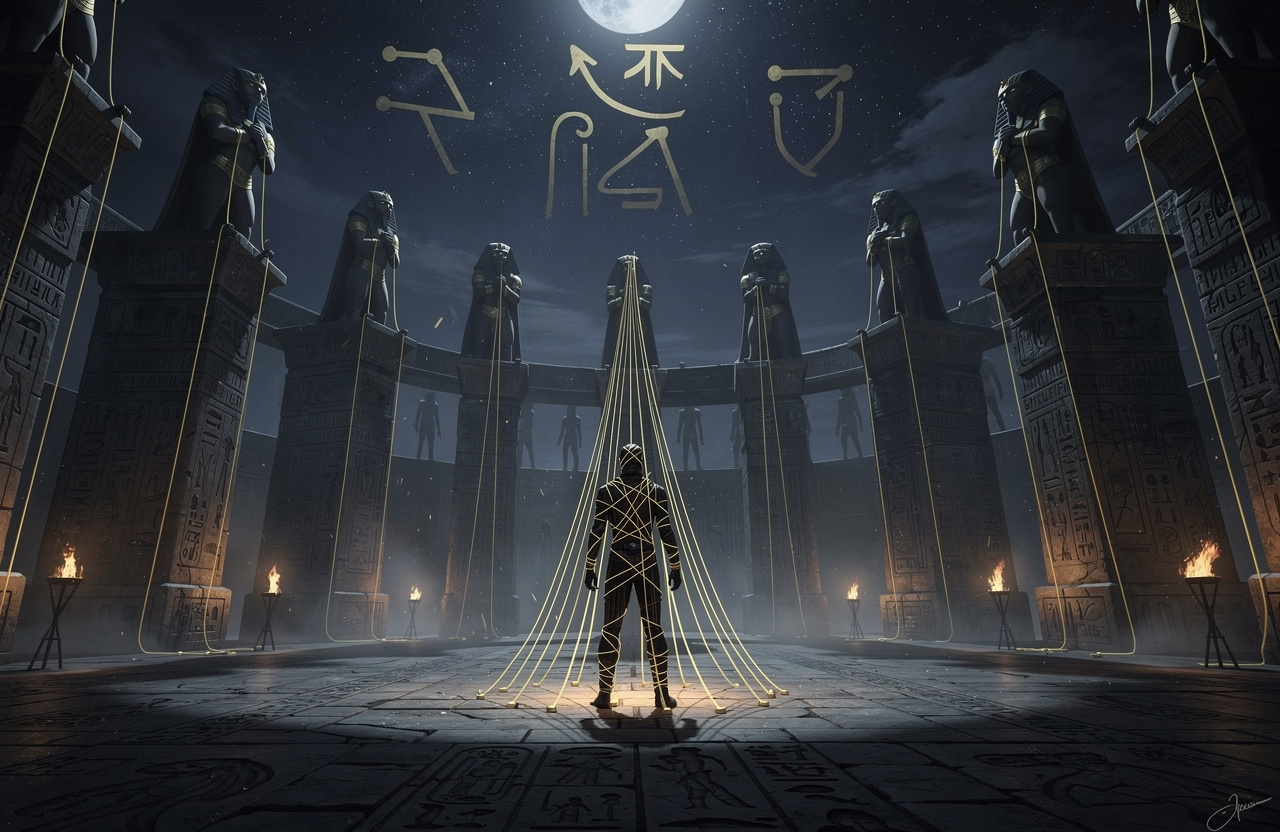
You think you're free because no one owns you on paper. No master, no chain, no overseer with a whip. Look closer. Every month a quiet river of your money flows upward — to landlords you'll never meet, to funds you never chose, to platforms you can't leave. You don't feel the pump because it's smooth. That's the design. A good pump makes no noise.
The Egyptians knew a truth we forgot: what has no name has no power over you. Name the flows. Draw the map. And the invisible machine that drinks your life force — your Sekhem — turns visible. Once you see the pump, you can put your hand on the valve.
This is not a lecture. This is a worksheet. Today you build the first brick of your own house of Maat: you find out exactly who you pay rent to.
What "rent" really means
Rent isn't just the check to your landlord. Rent is any payment you make for the permission to exist inside someone else's structure — a payment that buys you nothing you keep. You pay it, it vanishes upward, and next month you pay it again. Forever.
Your mortgage interest is rent to a bank. Your card's revolving balance is rent to a lender at 20-plus percent. Your streaming stack, your cloud storage, your phone plan, your software subscriptions — rent to platforms. The management fee shaved off your index fund every year — invisible rent to an asset manager. The spread the exchange takes, the fee the app takes, the cut the middleman takes for standing between you and the thing you wanted.
Some rent is honest — you get real shelter, real value, and you'd pay it gladly. Most rent is legacy: a subscription you forgot, a fee you never questioned, an interest rate that quietly eats a third of everything you earn. You can't tell which is which until you write it all down.
The exercise: map every upward flow
Get a blank sheet or a blank spreadsheet. No app needed — the point is that you see it, in your own hand. Pull up the last three months of your bank and card statements. Three months, because one month lies. Subscriptions bill quarterly, insurance annually, fees hide in cycles. Three months shows you the pattern.
Now make four columns.
Column 1 — Where it goes. The recipient. Not "Amazon," but what inside Amazon: the Prime fee, the storage, the impulse buys. Be specific. Vague names hide big leaks.
Column 2 — How much per month. Normalize everything to monthly. Annual insurance? Divide by twelve. Quarterly fee? Divide by three. You want one clean number you can compare across the whole page.
Column 3 — What you actually get. In plain words. "A roof." "Nothing — forgot to cancel." "20% interest on a balance I could clear." Be brutally honest here. This column is the whole point.
Column 4 — Who ultimately holds it. Follow the money one step further up. Your fund's fee goes to an asset manager — likely one of the giants, BlackRock or Vanguard or State Street, who together manage tens of trillions and sit on the boards of nearly every company you buy from. Your card interest goes to a bank funded by the same capital. This column is where the map stops being personal and starts being structural. You'll notice the same few names at the top of many rivers.
Now add up Column 2. That total is your monthly tribute — the sum you hand upward before you've fed yourself, saved a cent, or built anything of your own.
Reading the map: finding the pump
Sit with the finished page. Don't judge yet. Just look. Then look for three shapes.
The silent subscriptions. Every audit finds them — the ghost charges for services you stopped using, free trials that quietly converted, the app you signed up for once. These are pure Isfet: extraction with no exchange. Circle them. They die today.
The compounding leaks. Interest on revolving debt, high fund fees, the 2% here and 3% there that feel trivial. They don't feel like much per month. Multiply by twelve, then by ten years, then imagine that money compounding for you instead of for a lender. A 1% fund fee over a working life can quietly eat a fifth of your final wealth. That's not a fee. That's a slow siphon on your whole future.
The chokepoints. The single platforms you truly cannot leave — the one bank, the one exchange, the one cloud that holds your whole life. In systems design we call this a single point of failure. In the old language it's a chain you forged yourself, one convenient click at a time. You don't have to break it today. You just have to see it, and stop pretending it isn't there.
> Our record. In the ledger of Maat this is a weighing. On one pan, what you give upward. On the other, what returns to you. When the pans don't balance, that gap has a name — Isfet, the parasitic order that takes without exchange. The audit is nothing more than lifting the veil off your own scales so you can read them yourself. A pump you can see is a pump you can shut.
Why this is the first brick, not the last
Don't try to fix everything on this page today. That's how people burn out and quit by Thursday. The audit isn't the war — it's the map before the war. You cannot cut what you cannot see, and until this afternoon you couldn't see it. Now you can. That alone shifts the ground under you. The pump ran on your blindness. That fuel is gone.
Everything downstream — killing debt, leaving the funds, escaping the platforms, building the local, joining the community — every one of those moves starts from this page. This is the survey of the land before you lay the first stone of your own house. Build it once, keep it, update it each quarter, and watch the upward river thin year over year as you redirect it — back toward yourself.
Do this today
Open your last three months of bank and card statements right now. Not tomorrow — now, while the resolve is warm. Make the four columns. Fill in every recurring charge you can find in twenty minutes; you'll catch the rest later. Add up Column 2 so you know your monthly tribute as a hard number.
Then do one concrete thing: cancel the single most useless subscription on the page — the ghost charge you'd forgotten, the one with "nothing" in Column 3. One cancellation. Two minutes. That's the first payment you redirect from their pump back into your own house.
You named the flows. They just lost some of their power. Tomorrow you name a few more.