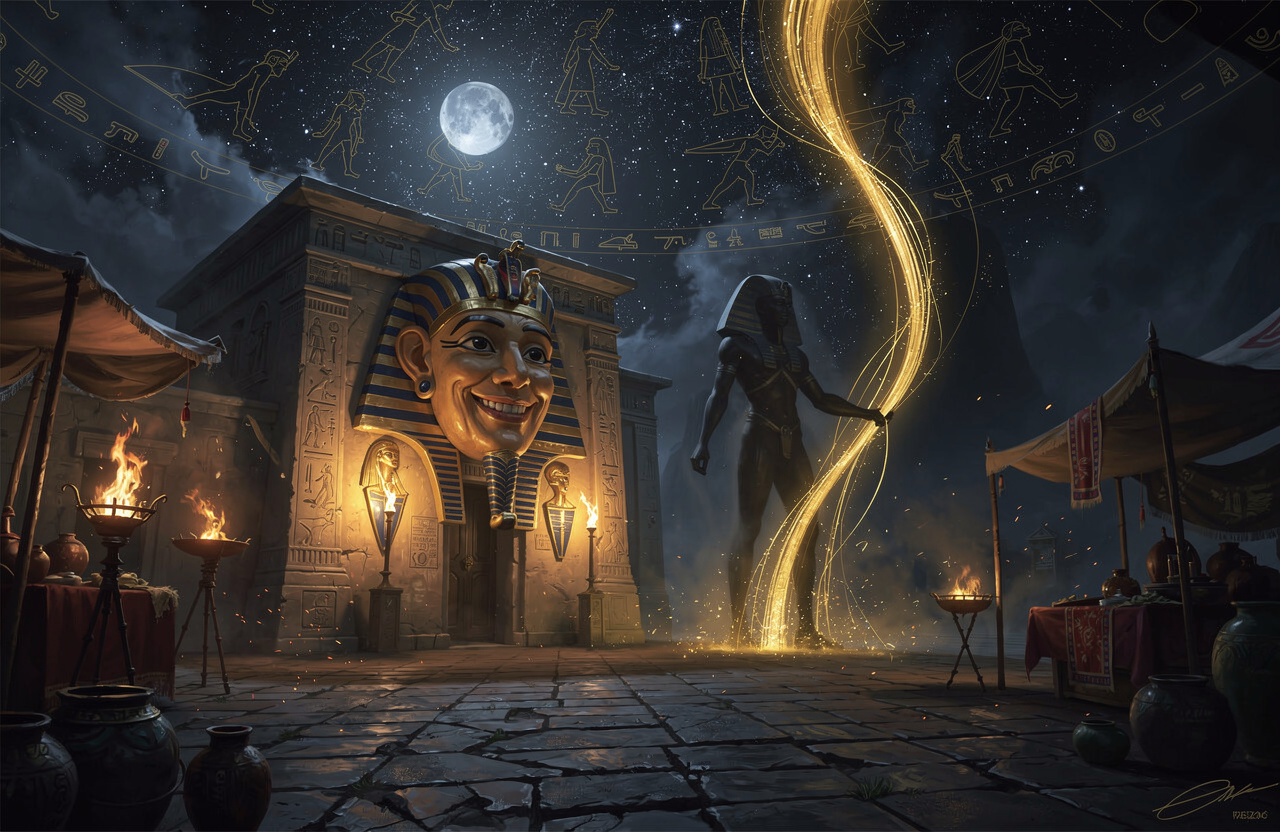
They gave you a grandfather so you'd stop looking at the coil.
Warren Buffett. Cherry Coke, a house he bought in 1958, a shareholder letter written like a fireside chat. The "Oracle of Omaha." The people's billionaire — proof, they say, that you can play the game clean, buy good companies, hold forever, and win without being one of them. Every profile leans on the same word: folksy. Plainspoken. The friendly face of capitalism.
Look at what the friendly face actually holds.
The Portfolio Is the System
Berkshire Hathaway isn't a maverick outside the ring. It's a concentrated bet on the ring.
For years Berkshire's single largest position wasn't a quirky candy company. It was Apple — a stake that at times ran past 100 billion dollars, the same trillion-dollar chokepoint the whole index-fund coil is built on. Below that: Bank of America, one of Berkshire's biggest holdings, tens of billions of dollars. American Express. Coca-Cola. Chevron, Occidental — the oil majors. And for a long stretch a wall of banks: Wells Fargo, U.S. Bancorp, the big financials.
Now recall who else owns those exact names. BlackRock. Vanguard. State Street. The Big Three index giants are top holders in Apple, in Bank of America, in Amex, in Chevron. Buffett didn't find a secret door out of the system. He walked through the front door and bought the same building — the systemic banks, the systemic energy, the trillion-dollar tech chokepoint. His portfolio is a photograph of the core.
Look closer and the overlap gets almost comic. The five or six positions that make up the bulk of Berkshire's equity book are, position for position, the very assets the index coil is most concentrated in. It's not that Buffett happens to share a few holdings with the ring. It's that his top holdings are the ring's top holdings, in roughly the same order. Two supposedly opposite strategies — the patient value picker and the mindless index machine — arrive at the identical set of names. When the maverick and the machine own the same building, the building was never optional. It's the core, and every serious pool of capital ends up parked in it.
Buffett is not the exception to the ring. He is the ring, wearing a cardigan.
The Insurance Float — Where the Serpent Stores Its Coils
Here's the mechanic almost nobody explains, and it's the whole trick.
Berkshire owns insurers — GEICO and reinsurance operations. Insurance takes premiums now and pays claims later. Between "now" and "later" sits a river of other people's money the insurer holds and invests. Buffett calls it the float, and Berkshire's float has run into the hundreds of billions of dollars. It's not his money. It's money he gets to deploy — for free, indefinitely — while it waits.
Sit with that. The "people's investor" is celebrated for buying great companies with patience. The engine underneath is a mountain of your premiums, held in trust, invested into the same systemic banks and energy majors that make up the coil. The folksy story is the storefront. The float is the vault behind it.
Our Record
In the temple grammar this is Sekhem — stored life-force. Not gold in a chest but the living, working energy of millions, pooled and directed by one hand. Buffett's genius, stripped of the cardigan, is a genius of pooling: gather everyone's small streams of premium and capital into one channel, and point that channel at the assets that already hold the world.
The mask matters as much as the mechanism. Apophis — the coil around the world — survives by not looking like a threat. The serpent that came at you fanged and hissing, you'd fight. The serpent that comes as a kindly old man buying Coca-Cola, you admire. You buy the book. You quote him at dinner. You aspire to be him. That's not a failure of the coil. That's its finest feature: a face so warm you forget to ask what it's wound around.
Name it, and the warmth stops hiding the winding.
Why This Isn't a Takedown of One Man
Don't misread this. Buffett broke no law you can point to. He is, by the ordinary rules, extraordinarily good at the game. That's exactly the point — and it's the uncomfortable one.
The problem was never a bad apple. If the best player, the cleanest reputation, the most patient hand, ends up holding the identical systemic banks, the identical energy majors, the identical trillion-dollar tech gate as the faceless index coil — then the game's outcome doesn't depend on the player's character. Play it well and you converge on the core. The ring isn't where the villains end up. It's where winning ends up. Character doesn't route you around the topology. It routes you deeper in.
That's why "just invest like Buffett" is not an exit. It's an on-ramp — a slower, more respectable lane into the same coil.
The Lever
So what do you do with a storefront?
- Separate the man from the method. The lesson isn't "be folksy." It's pooling and patience win. Fine — then pool and be patient into something the coil doesn't already own.
- Redirect the float principle. A cooperative pools members' capital and returns the gains to the members. A DAO pools contributors' stake and loops ownership back to contributors. Same engine — pooled life-force, deployed with patience — pointed at a graph that feeds you, not the 147.
- Stop confusing a friendly face with a friendly system. When something in finance is unusually warm, unusually plainspoken, unusually beloved — ask harder what it's wound around. Warmth is cheap. Ownership is the tell.
The old priests weren't afraid of the monster that looked like a monster. They watched for the one that came smiling. So watch the smile — and then follow the float.
The cardigan is the costume. The coil is the man.