Open the shareholder register of Apple. Now open Microsoft's. Now Amazon's. Three companies you were told compete for your money, your cloud, your attention. Scroll to the top of each list. You will read the same three names, in almost the same order: Vanguard, BlackRock, State Street.
Not similar names. The same names. The same three institutions sitting as top-tier owners in all three "rivals" at once — and in Google, and in Meta, and in NVIDIA, and in the banks that lend to all of them.
Look at that for a moment. Then lift your eyes from the ticker and see the shape.
The Big Three, in plain numbers
BlackRock manages on the order of eleven to twelve trillion dollars. Vanguard, roughly nine to ten trillion. State Street, several trillion more. Together the "Big Three" steer somewhere north of twenty trillion dollars of other people's money — a sum larger than the annual output of the United States.
Most of that money is not theirs. It is yours — index funds, pension pots, 401(k)s, the quiet default in your retirement app. You handed it over to be "passive." Passive means you don't pick stocks. It does not mean nobody votes. Somebody votes. And in the largest public companies on Earth, that somebody is the same three firms, over and over.
Across the S&P 500, these three are frequently the largest or one of the largest shareholders in each company. In a huge share of America's biggest corporations, the Big Three combined hold voting blocks in the high single digits to the low twenties of a percent. That doesn't sound like control — until you remember that ownership in a giant public company is scattered across millions of tiny holders who never show up. A coordinated block of fifteen or twenty percent that always votes is not a minority. It is the swing. It is the room.
Competition on the shelf, unity in the register
Here is the trick the map hides. On the shelf, these companies fight. Apple versus Android. Azure versus AWS. Prime versus everyone. The theater of rivalry is real to you — you choose, you switch, you feel like a market.
But climb up the ownership stack and the rivalry dissolves. The same fund that profits when Apple wins also profits when Google wins, because it owns both. It has no incentive to see one truly destroy the other. It has every incentive to see both keep margins fat, wages disciplined, and prices firm. Economists have a dry name for this — common ownership — and a growing body of research on what it does to prices in airlines, banking, and pharma when the same handful of owners sit across every competitor in a sector. The finding, roughly: competition softens. Prices drift up. The customer pays the spread.
You were sold a market of many players. What you got is a market of many storefronts with three landlords.
The vote you never cast
Now the mechanism. When Apple holds its annual meeting — on executive pay, on board seats, on climate resolutions, on splitting the chairman and CEO roles — someone casts the votes attached to all those shares held "on behalf of" ordinary savers. That someone is BlackRock's stewardship team. And Vanguard's. And State Street's.
Three centralized voting desks, in a few offices, deciding governance outcomes across thousands of companies. They publish glossy stewardship reports. They meet management privately, before the vote, in rooms you will never enter. The formal power looks diffuse — millions of shares, millions of savers. The actual power is concentrated into a corridor you could walk end to end in a minute.
That is the quiet engine. Not a conspiracy. Worse — a default. It runs because it is convenient, cheap, and legal. Legacy code nobody wrote on purpose, now load-bearing for the whole system.
Our record
Weigh it on the scale. On one pan: the appearance of a free market — logos competing, consumers choosing, the comforting noise of rivalry. On the other pan: a single feather of truth — three desks vote the same way across every company at once.
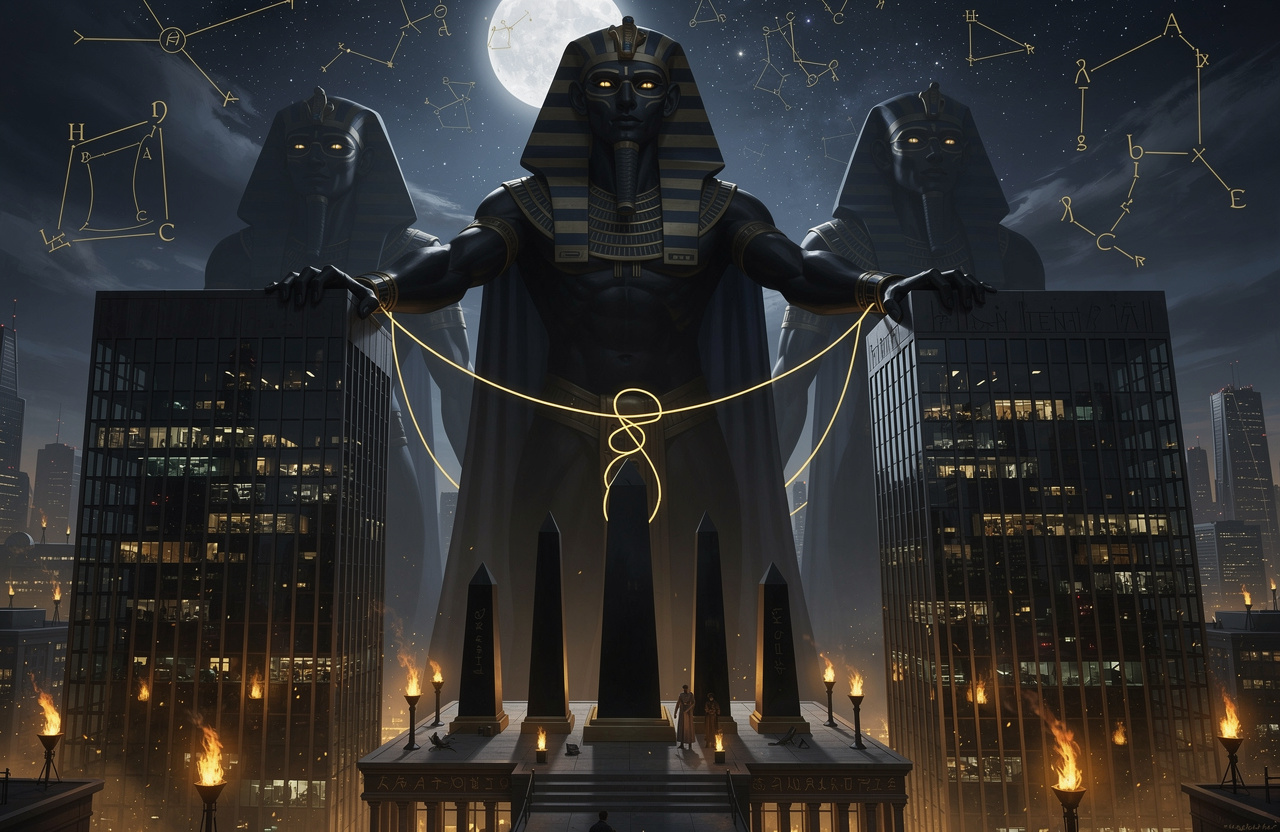
Isfet is not chaos with a face. Isfet is a pump. It takes the Sekhem of millions — your saved labor, your years, your Ka poured into a retirement account — and routes the voice of that force upward, into three rooms, while leaving you the illusion of ownership and none of the vote. You own the shares. Someone else owns the say. The feather does not balance. It tips the way the pump was built to tip.
Name the pump and it loses a turn of its power. The map showed you rivals. The register shows you a ring.
Where the lever is
Do not read this as doom. Read it as a diagram — and a diagram is instructions for building something else.
See the pass-through. The concentration exists because your capital travels through an intermediary that keeps the vote. The moment the vote is decoupled from you, the ring closes. So the fight is over who holds the keys to the vote.
Reclaim the vote where you can. Some funds now offer pass-through voting — the option to direct how your shares are voted instead of surrendering it to the stewardship desk. It is early, clumsy, and buried in menus. Use it anyway. A vote reclaimed is Sekhem routed back down the stack, toward the source.
Build registers that can't be captured. This is why decentralized ownership is not a slogan. A DAO treasury, tokenized governance, on-chain votes — their whole point is that the right to decide cannot be quietly pooled into three desks. Not your keys, not your coins. And not your keys, not your vote. One phrase, two truths.
Diversify the plumbing, not just the portfolio. You were taught to spread risk across companies. Spread it across systems too. Some of your force belongs where no single desk casts it for you.
The three names at the top of every register are not destiny. They are a design — and designs get forked. See the ring. Then stop feeding it your voice. The vote you never cast is the one they are counting on you to forget.
Balance the scale. Take back the feather.