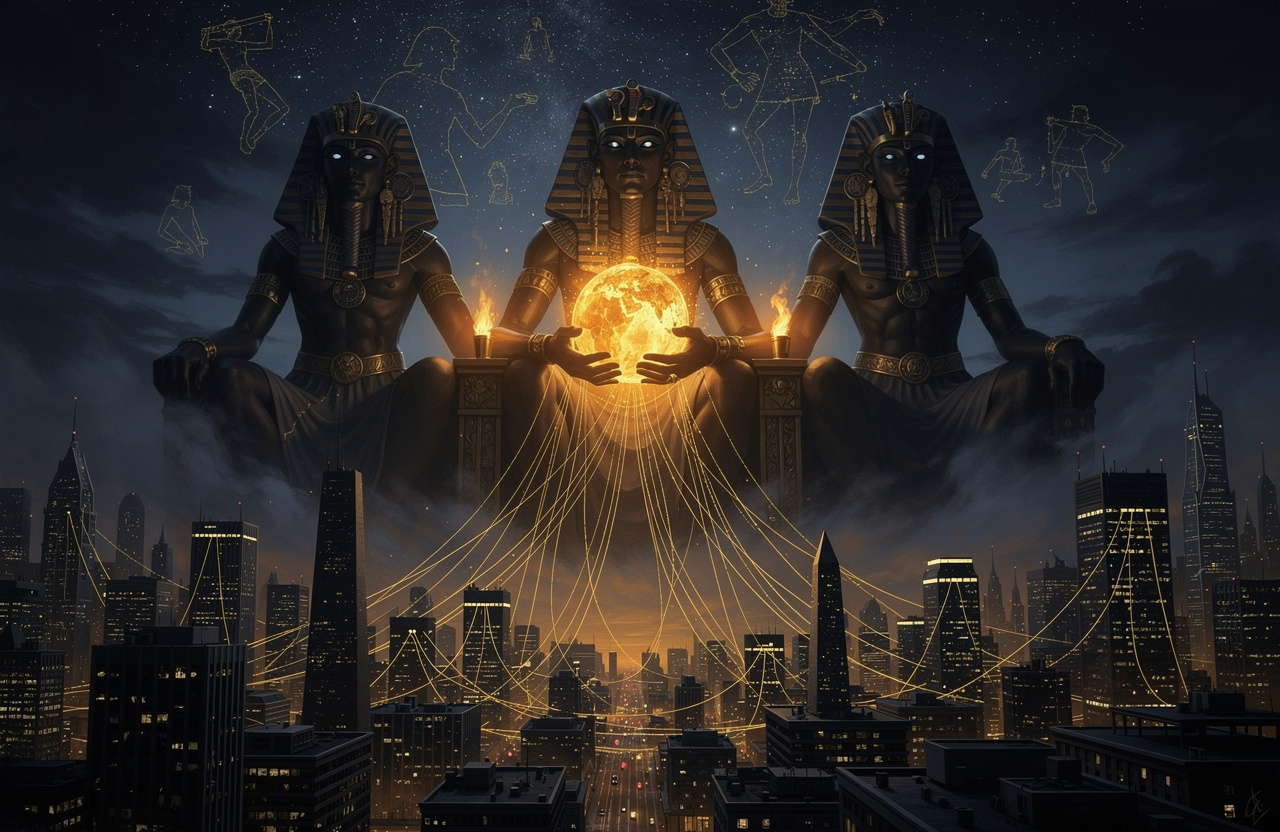
Imagine you open the list of the five hundred largest companies in America — the S&P 500. Coca-Cola, Apple, Pfizer, Exxon, banks, airlines, drug makers. Different industries, different cities, supposedly competitors who should be clawing for every customer. Now look at who is listed as the largest shareholder of almost every one of them. Line after line, three names repeat: BlackRock, Vanguard, State Street.
This is not a coincidence or a quirk of someone's portfolio. It is a structure. And it has a name — the "Big Three."
Three boring names that hold everything
Let's keep it simple, no finance jargon. Three American companies manage other people's money — pensions, insurance, savings. BlackRock has around eleven trillion dollars under management. Vanguard about nine. State Street about four. Add it up: twenty-four trillion in three pairs of hands.
To let the number land: eleven trillion is more than the annual GDP of Germany. More than Japan. More than Russia, Brazil, and Canada combined. And none of it is factories, oil, or algorithms. Just other people's money under management.
The funds spread that money thinly across every large company in the world. In any single company the stake looks modest: BlackRock holds around 7% of Apple, Vanguard another 6%, State Street about 4%. Separately, trivial. Together, 15–25% of nearly every major company in the Western world. The same in Apple, in Microsoft, in Pfizer, and in the bank that gave you your mortgage — all at once.
Why three, and not one
Here is the important engineering detail. If a single giant owned everything, it would be too obvious — antitrust regulators would show up the next morning. But three is "competition." On paper they fight for clients, undercut each other's fees, advertise against one another.
Then look at how they vote at shareholder meetings, and the illusion of competition melts. On the key corporate questions — executive bonuses, share buybacks, who sits on the board — the three usually vote the same way. It is like three internet providers pretending to compete while pushing all the traffic through the same backbone cable. From the outside, choice. Inside, one pipe.
The book puts it precisely: scattered pools of capital, on their own, get in each other's way, fight over slices, leave traces. Funneled into shared ownership through a few aggregators, they vote as a single bloc, save on scale, and stop fighting one another. The Big Three is not three forces. It is one force in three housings.
A ring instead of a summit
Usually, when we talk about power, we look for a figure at the top. A family. A name. "Tell me who's at the top." And here the Big Three is cleverer than any clan.
There is no family at the top. There is a ring. Vanguard is the largest shareholder of BlackRock. BlackRock's funds hold State Street. State Street holds both. They own each other cross-wise, in a closed circle — this has been studied academically (Fichtner, Heemskerk, Garcia-Bernardo, 2017). You ask "who is the beneficiary, who do we hold to account?" — and the arrow of responsibility runs around the ring and stops at no one.
It is the perfect architecture for someone who doesn't want to be found. In IT we call it a circular dependency: A depends on B, B on C, C on A. Impossible to untangle — the ends are hidden inside the loop itself. Instead of a loud family name on the door, a quiet faceless structure that you cannot hold to account, because there is supposedly no one to ask.
Where they came from
It's important not to fall into the fairy tale of "three geniuses out of nowhere." The Big Three was lifted up by old money. BlackRock found its feet inside Blackstone — men out of old Wall Street, out of Lehman. For years the bank PNC was a major co-owner of BlackRock. In 2006 it absorbed Merrill Lynch's asset management — a Wall Street legend. In 2009 BlackRock swallowed Barclays Global Investors along with iShares — a British banking giant.
So the new aggregator was raised not by garage geeks, but by a chain of old financial institutions, each with its own century-old DNA. The Rothschild architecture — five arrows, a network of nodes above borders — never disappeared. There are simply thousands of nodes now instead of five, and they no longer go by a family name but by a fund's brand.
Where is the ordinary person in this
The ordinary person is the fuel. You bring the money to the three: through a pension fund, through insurance, through savings. On that money the funds take a fee — say half a percent a year on thirteen trillion, which is sixty-five billion in near-automatic income. And the vote on your shares goes not to you, but to the fund. You are the source of the capital, but not its owner.
That split — your money, someone else's vote — is exactly the point on which the Big Three's whole structure of power is built. They gathered millions of scattered votes into a single fist. Their strength is not genius. It is concentration.
What to do about it: the MAAT token and DAO
If the strength of the three is the concentration of scattered votes, then the counterweight is built symmetrically: gather the votes back — but transparently, and without an intermediary who quietly wields them inside a ring.
That is MAAT. The MAAT token is membership in a cooperative and a single vote. Not "one dollar, one vote" like the funds, where whoever has more money decides, but one human, one vote. Governance runs through a DAO — a decentralized organization with a transparent treasury where every movement of funds is visible to all. No ring in which accountability dissolves: here everything sits in an open ledger.
The Big Three is built on the bet that you stay a lonely arrow — a scattered shareholder whose vote is easy to take. MAAT bets the opposite: millions of people with a shared token and a shared treasury, coordinating as tightly as the three, but in their own favor. The entry is simple: read the book, take the token, get your vote.