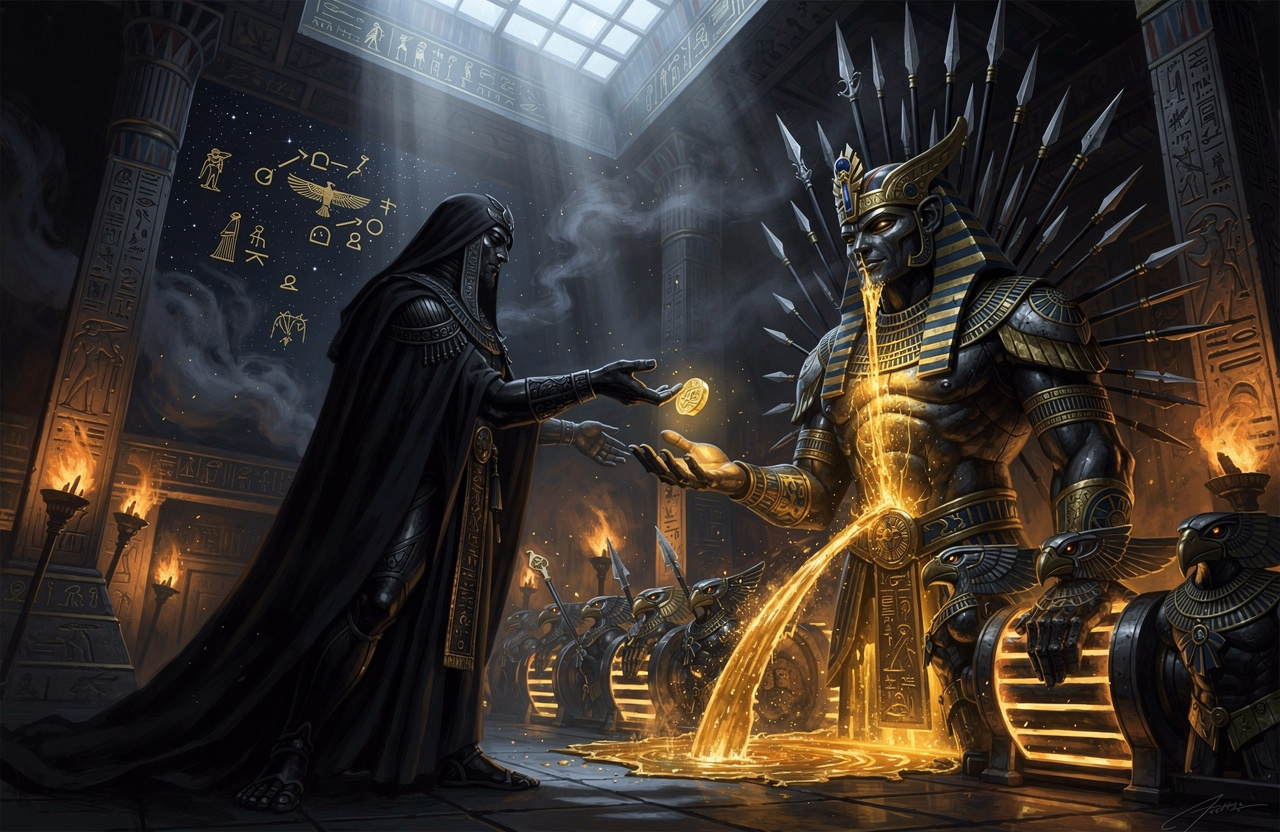
Here is a sentence that should not fit in one head, and yet it is simply true. The same firm that sells you a fund labeled "sustainable," "responsible," "ESG" — is among the largest shareholders in the companies that build the missiles.
Not metaphorically. Concretely. BlackRock — the world's largest asset manager, steering on the order of eleven to twelve trillion dollars — sits as one of the top institutional shareholders in Lockheed Martin, in RTX (the old Raytheon), in General Dynamics, in Northrop Grumman, in Boeing. Look up any of those tickers, scroll to the institutional owners, and you'll find the same name near the top, again and again — usually alongside Vanguard and State Street.
Look at that for a moment. The peace fund and the missile fund are managed under the same roof, by the same people, voting the same proxies.
Passive money, active power
The defense of this arrangement is always the same word: passive. BlackRock will tell you these are index holdings. It didn't choose Lockheed. Lockheed is in the S&P 500, the fund tracks the S&P 500, therefore the fund holds Lockheed. No opinion. No agency. Just math.
That's half true and completely misleading. Passive means BlackRock doesn't pick which stocks go in. It does not mean nobody votes the shares. Somebody always votes. And when you are the top or near-top institutional holder across the entire defense sector at once, the votes you cast — on boards, on executive pay, on whether a weapons program continues, on whether the company should even disclose certain risks — are among the loudest voices in every one of those companies' annual meetings.
So strip the euphemism. BlackRock does not merely own a slice of the arms industry as a passive accident. It is one of the most powerful voters in the arms industry. The Sekhem of millions of ordinary savers — pensions, 401(k)s, the quiet default in a retirement app — flows up into a stewardship desk that then casts the deciding voice inside the companies that manufacture war. You supplied the force. Someone else supplies the say.
The ESG magic trick
Now the part that should make you laugh, then stop laughing.
The same firm runs a giant line of ESG products — funds sold on the promise of environmental, social, and governance virtue. Larry Fink spent years writing annual CEO letters about stakeholder capitalism, climate, and long-term responsibility. The marketing is drenched in the language of conscience.
And here is how the trick works. The ESG fund can exclude or underweight the weapons makers — so its brochure looks clean. But the firm as a whole still holds the arms giants across its trillions in ordinary index funds. So BlackRock gets to sell you conscience in one aisle and hold Raytheon in the other, at the same time, with a straight face. The virtue is a product line, not a position. It's a config flag on a subset of funds, not a value in the codebase.
Meanwhile the "S" and "G" in ESG — social, governance — quietly do not seem to bar owning the companies whose entire business is munitions. The framework was elastic enough to let the largest holder of weapons stocks on Earth also be the loudest voice on responsibility. That's not hypocrisy as a bug. That's the framework working exactly as designed: virtue as branding, ownership as reality, and no contradiction ever forced to the surface because the two live in different brochures.
Our record
Weigh it on the scale. On one pan: the word — sustainable, responsible, stakeholder, ESG, the whole shimmering vocabulary of care. On the other pan: one feather of truth — the same desk votes the proxies of the missile makers.
The Egyptians had a name for a force that speaks the language of order while feeding on it. Not loud chaos — that's easy to see and fight. The subtler enemy wears the mask of Maat. It uses Heka, the creating word, in reverse: it speaks "responsibility," "sustainability," "peace" — and the spoken word builds a shield of good feeling around a portfolio that profits when the shells fly. The word says one thing. The vote says another. The feather does not balance while the mouth and the hand point in opposite directions.
This is the deepest work of Isfet: not to oppose the good openly, but to wear it. To route your care — your genuine wish to invest cleanly — into a fund whose parent firm sits atop the arms trade. Name the split between the word and the vote, and the shield of good feeling drops.
Where the lever is
Do not read this as everything is corrupt, give up. Read it as: the label is not the holding, and now you know to check the holding.
Read the holdings, not the name. Any fund must publish what it actually owns. The name is Heka — a spell of feeling. The holdings list is the truth. Two minutes with the actual list tells you more than two years of glossy letters. Make it a reflex: never trust the label over the ledger.
Separate the desk from the vote. Where pass-through voting exists, take it. If your capital is going to sit in these companies through an index, at least reclaim the voice attached to your shares instead of surrendering it to a stewardship desk that votes across the whole sector at once.
Build vehicles where the mandate is real code, not marketing. This is why on-chain, transparent, member-governed structures matter. In a DAO or a cooperative treasury, what the fund can and cannot hold is a rule everyone can read and everyone votes on — not a brochure written by the firm that also holds Lockheed. The mandate becomes verifiable instead of narrative.
Let your money's voice match your actual voice. The gap between what you believe and where your Sekhem flows is the exact gap the ESG trick lives in. Close it deliberately and the trick has nowhere to stand.
The peace fund and the missile fund do not have to share a roof. They share one now because you were sold the label and never asked for the ledger. Ask for the ledger. Match the vote to the value.
Balance the scale. Read what you actually own.