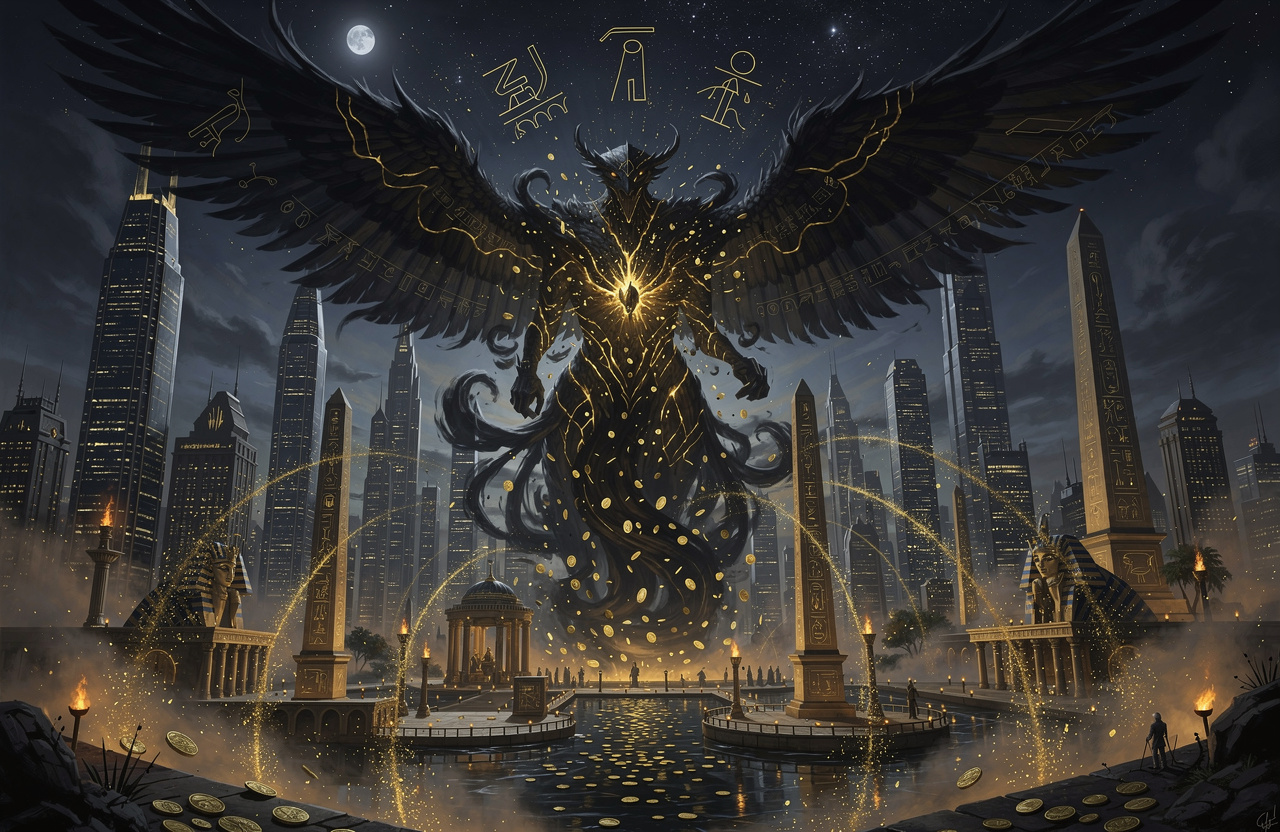
The book has a line that reads like a bridge between two worlds: the fifth book of the series is "when a Shadow Neteru suddenly deploys on Wall Street." It sounds like a metaphor. But if you take it apart calmly, without the mystical fog, it turns out to be a fairly precise technical description of what BlackRock is. Let's walk through it as a schematic.
What a Shadow Neteru is
First let's separate the concepts, as the book does. The Neteru are not "gods on thrones" but principles of reality: Maat is the structure of balance and fair exchange, Osiris is transformation. They don't sit on a throne — they are the throne.
A Shadow Neteru is not a god, nor its evil copy. It's a parasite that, having accumulated enough power, begins to act as an anti-principle. The book says it plainly: "these parasites, having accumulated enough power, begin to act as anti-principles… The term describes not the nature of these entities, but the scale of their impact." In other words, a Shadow Neteru isn't a "who" but a "how big and in what direction." Anti-Maat: the inversion of fair exchange grown to a scale at which it shapes the reality around it.
The power plant versus the vampire
The book's best analogy is about the difference in architecture: "like the difference between a power plant and a vampire. A power plant generates energy. A vampire consumes someone else's. You can become a very big vampire. Connect thousands of donors. Grow infrastructure. But it will never begin to generate energy. Never. Because its architecture is different."
Apply this to BlackRock. The fund builds no houses, heals no one, extracts nothing, produces nothing — it's no power plant. It holds what belongs to others: your pensions, savings, insurance premiums. Through it flows someone else's energy — the labor of millions, turned into capital. And from that stream it takes its cut. By architecture it is a vampire grown to the scale of a principle. Very large, very respectable, in a fine suit — but the architecture is the same.
A botnet pretending to be a supercomputer
The book has a second engineering metaphor, straight from the IT world: "Like a botnet of a million machines — not a supercomputer, but it can generate traffic comparable to a supercomputer."
This is about how a parasite imitates the scale of a real principle. BlackRock by itself is no source of value. But it has connected millions of donor "machines" to itself (pension accounts, index funds, other people's capital) and, through sheer reach, generates influence comparable to a state's. Not by force, but by reach. The book puts it exactly: "Without a single shot. This is exactly how Shadow Neteru work. Not by force — by reach. Not by prohibition — by inclusion. Not by destruction — by absorption."
Recognize it? No one forced you. You were offered "access to markets," a convenient app, care for your pension. Inclusion, not coercion. Absorption, not conquest. And now your vote is no longer yours — it's the fund's, which will cast it by its own metric.
The person is beside the point
An important honesty, and the book insists on it. Larry Fink is no Bond villain and no masked sorcerer. The book says outright: "Lawrence Fink does not perform rituals in a mask." BlackRock was founded in 1988, a former eight-person startup, a public company — no dynasty, no "bloodline," no secret order.
And this is the most important thing for understanding a Shadow Neteru. It requires no villain. It is a position, not a person. The anti-principle embodies itself through structure, and it doesn't matter which specific human sits in the chair: as long as the architecture is a vampire, it will behave like a vampire, whoever is at the helm. So hatred of Fink is a mistake (and itself Isfet). What you must see is not the person, but the architecture.
Why name it that at all
The book's tradition holds a principle that works "in Heka as in computer science": that which is named loses its hidden power. "The nameless is all-powerful. The named is governable." So the book says it directly: "We named them. The Shadow Neteru. BlackRock. JPMorgan. CME. BIS. We spoke their Ren."
To call BlackRock a Shadow Neteru is neither an insult nor conspiracy theory. It is diagnosis. As long as the structure is anonymous and seems like "just a dull financial service," it operates freely, in the dark, where Isfet lives. Named by its name and its function, it becomes visible — and so something can be done about it.
Where is the ordinary person in this
You are a donor in this scheme. Your labor, turned into pension and savings, is the very "someone else's energy" the vampire feeds on. You were included gently, through convenience, and your vote went upward. You aren't at the table — you're in the wires through which the current flows.
The answer: the MAAT token and DAO
If BlackRock is a vampire grown to the scale of an anti-principle by reaching millions of scattered donors, then the counterweight is built symmetrically: the same millions, but gathered consciously, transparently, and in their own favor. Not a new vampire — but, at last, a power plant owned by the people themselves.
That is MAAT. The MAAT token is membership in a cooperative and a vote on the principle of one human, one vote, not "one dollar, one vote." Governance runs through a DAO — a decentralized organization with a transparent treasury where every movement of funds is visible to all. Here Isfet cannot hide: open doors disarm it, because it lives only in the dark. The structure is built from the start as an antibody to the Shadow Neteru — not a firewall on top, but an alternative architecture from below.
The Shadow Neteru is strong while you are nameless and scattered, and it is named only in the book. MAAT is about naming it and ceasing to be its wires. The entry is simple: read the book, take the token, get your vote.