There is a company managing around eleven trillion dollars. Say it slowly. Trillion — not billion. That is more than the annual GDP of Germany. More than Japan. This company drills no oil, builds no phones, makes no homes. It simply holds other people's money. Its name is BlackRock.
Two others stand beside it: Vanguard, around nine trillion, and State Street, around four. Together they are the "Big Three" — roughly twenty-four trillion dollars under one roof. This is not a conspiracy theory. It is annual reports, sitting in the open.
Where the money comes from
From your pension. From savings. From insurance premiums. From people who set aside 500 dollars a month for forty years. The funds took that money and put it into stocks — not one company, but thousands at once. The principle is called "diversification," but you don't need the word. Simpler: they spread the money thinly across every large company on the planet.
And here is where it gets interesting. If you invest a little, into everything, for thirty years, and you hold eleven trillion dollars — you end up owning a small but meaningful slice of almost every major company in the world.
BlackRock today holds around 7% of Apple. 7% of Microsoft. 7% of Tesla. 7% of Pfizer. 7% of Coca-Cola. And so on — a few percent almost everywhere. Sounds small? It does. Except it is in every large company at the same time. Vanguard holds the next 6%. State Street another 4%.
Add it up: three American funds together own 15–25% of nearly every major company in the Western world.
Why this is power, not just money
When something is voted on at a shareholder meeting, those percentages are enough to decide the outcome — even if every other shareholder votes against. And here is the point most people miss.
When you buy a share of a fund, you do not get the remote control. The fund votes the stock, not you. Your pension money sits inside Apple and Exxon — but at the meeting, BlackRock wields it. Your vote technically exists, but it is not in your hands. An intermediary holds it.
And it does not vote in your favor. The decisions made with those votes sound familiar: cut jobs for a prettier quarterly report; push up the price of medicine; buy back shares instead of investing in wages; pay executives hundreds of millions for "optimization" — that is, for firing other people.
This is twenty-first-century corporate feudalism. Not kings with crowns, not billionaires with yachts — three dull grey buildings in New York where people stare at spreadsheets. And those spreadsheets decide the fate of companies employing millions.
The word "parasite" is technical, not emotional
Modern etiquette says: speak softly, don't demonize anyone, everyone has their reasons. In finance, that politeness works as anesthesia — while you speak softly, they keep milking you.
Larry Fink, who runs BlackRock, really doesn't look like a Bond villain. A calm older man in a suit, speaks about sustainability, does philanthropy. And that is the most dangerous thing about a parasite: it mimics one of your own.
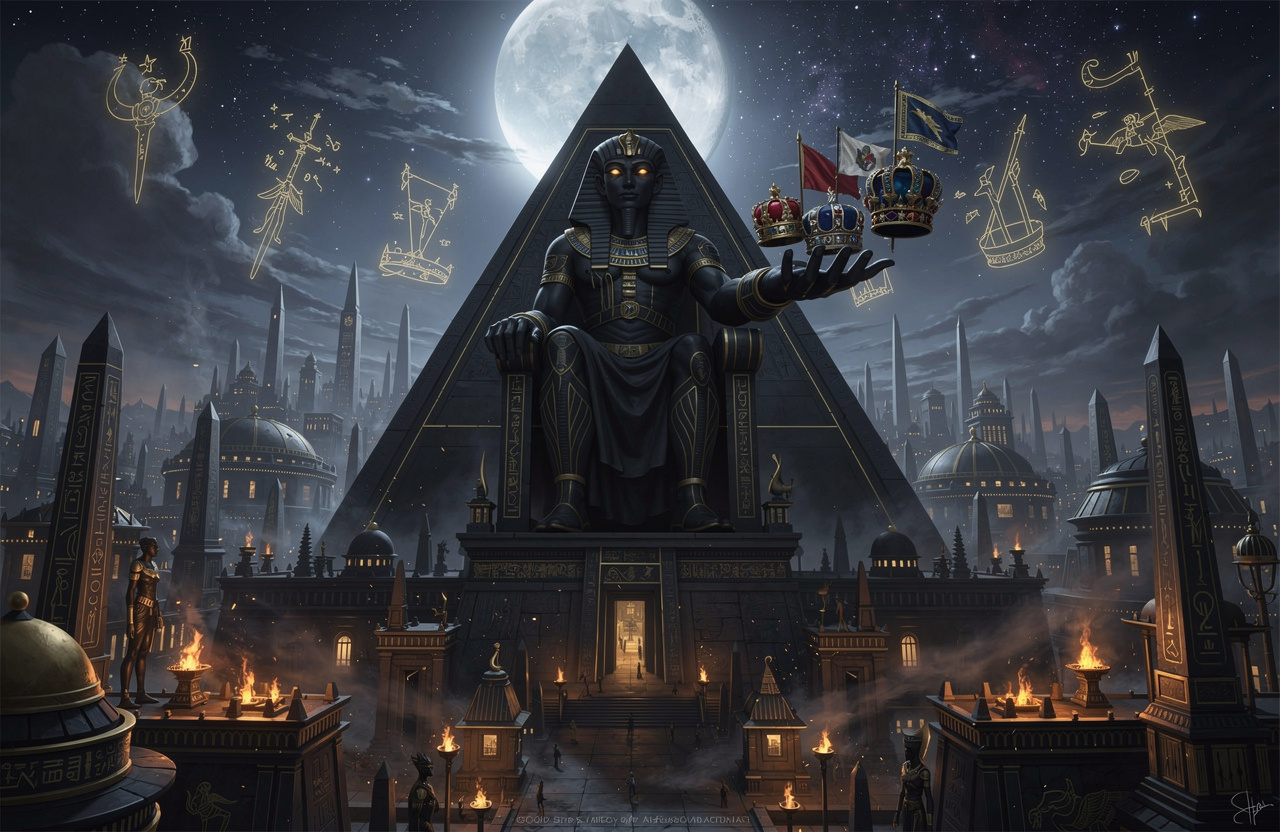
It is not about the person. It is about the position. The ancient Egyptians would have called it Isfet — not fairy-tale "evil," but the inversion of fair exchange. A structure that extracts from the system and puts nothing back. In plain speech, that is a parasite. A parasite does not "choose to be evil" — it simply latches onto a working organism and takes the resource.
Half a percent a year on thirteen trillion is sixty-five billion in near-automatic profit. Grandma gets her pennies of growth. BlackRock gets a lever over half the world. And it advertises this as "ordinary people's access to markets."
Where is the ordinary person in all this
Nowhere. That is the problem. You are the source of the capital, but not its owner. Your vote was collected, packaged, and cast against your own interests. You pay a fee for having your right to decide taken away.
And this is where a different story begins.
What to do about it: the MAAT token and DAO
The Big Three's power is not genius — it is concentration. They gathered millions of scattered votes into a single fist. So the counterweight is built the same way: gather the votes back — but transparently, and without an intermediary.
That is MAAT. The MAAT token is membership in a cooperative and a single vote. Not "one dollar, one vote" like the funds, but one human, one vote. Decisions are made in a DAO — a decentralized organization with a transparent treasury where every movement of funds is visible. No Fink votes for you behind closed doors.
In 2021, a tiny fund holding just 0.02% put three of its directors onto the board of ExxonMobil — not through size, but through coordination. Now imagine not lone activists coordinating, but millions of people with a shared token and a shared treasury. That is simply scaling up the one move that actually works against the Big Three.
BlackRock is betting that you stay scattered. MAAT bets the opposite. Read the book, buy the token, get your vote — the entry is simple. And then begins the thing the clans never prepared to face.