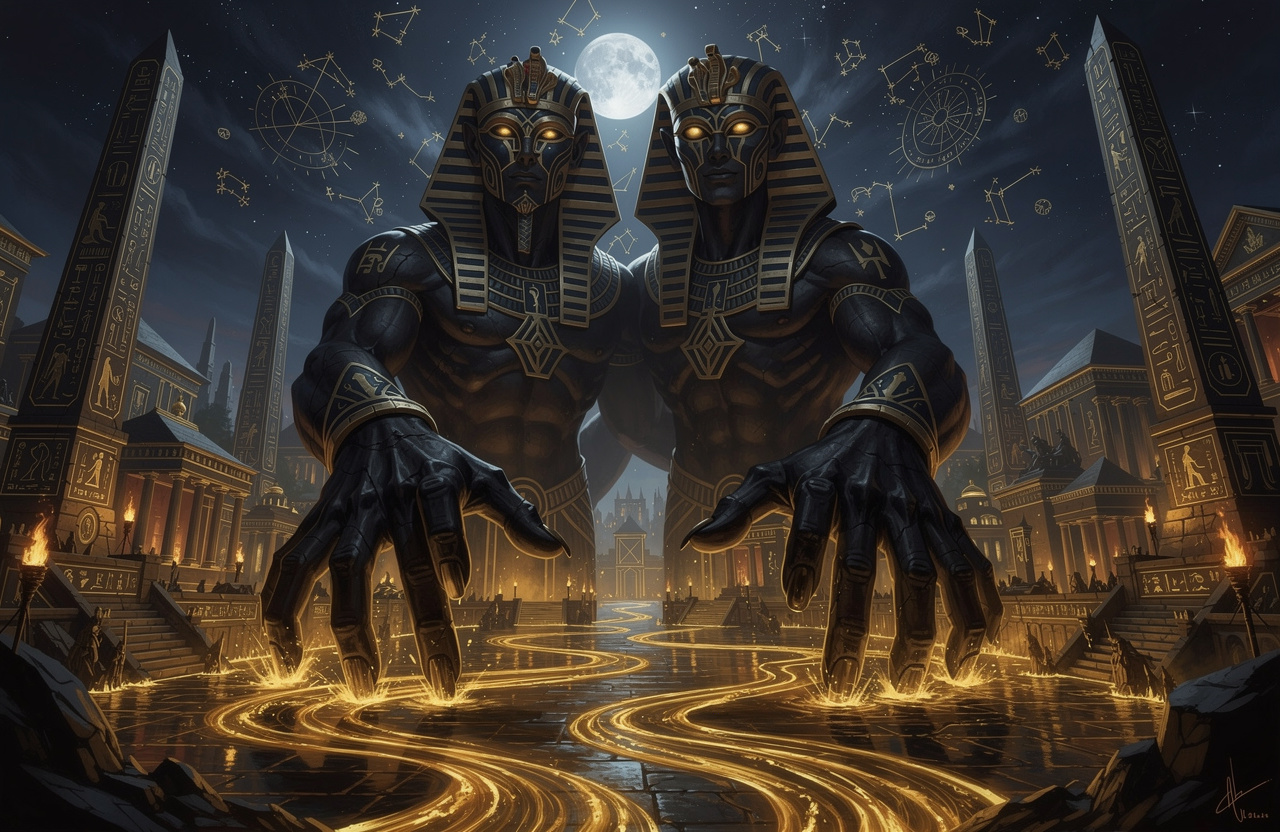
Two names. Almost the same word. One vowel and one syllable of difference. Say them fast and they blur into a single grey giant. That blur is not an accident — it's a feature.
BlackRock. Blackstone. You hear both, you nod, you file them under "the big money people," and you move on. And moving on is exactly what they want. Because a name you can't hold onto is a name you can't fight. So let's hold onto both. Let's pull them apart until you can never confuse them again.
One root, two branches
Here's the part almost nobody tells you: they came from the same tree.
In 1985, two men — Stephen Schwarzman and Pete Peterson — founded Blackstone. A boutique. Mergers, advice, then buyouts. A few years in, Blackstone spun off a bond-management arm and handed it to a sharp young man named Larry Fink. That arm got a name meant to nod at the mothership: BlackRock. "Black" for Blackstone. Same DNA on purpose.
Then the child grew larger than the parent. By 1994 Fink's team split off entirely, took the name, and walked out the door. BlackRock became the world's largest asset manager — the machine that holds your index funds, roughly ten-plus trillion dollars of other people's stock and bonds, steered by the risk engine called Aladdin.
Blackstone stayed home and became the world's largest alternative asset manager — private equity, credit, and above all, real estate. Around a trillion under management, but a different kind of trillion.
So no, they're not the same company. They're not even rivals in the same arena most days. They're two heads facing opposite directions, grown from one neck.
What each one actually eats
Feel the difference in your gut, not your notes.
BlackRock touches things you can sell in a second. A share of Apple. A slice of a Treasury bond. Liquid, public, priced every millisecond. BlackRock mostly doesn't own these for itself — it holds them for you, through iShares ETFs and pension mandates, and votes the shares while you sleep. Its power is the power of the proxy: it decides how millions of shares vote at Apple, at Exxon, at your bank — without spending a dollar of its own on those companies.
Blackstone touches things you can't move at all. An apartment tower in Atlanta. A logistics warehouse outside Madrid. A data center. A student-housing block. A pile of private corporate debt no exchange will ever quote. Blackstone doesn't hold these for you — it owns them, or owns the funds that own them, and you pay it rent, or interest, or both.
Read that line again. BlackRock votes on the companies you already own. Blackstone owns the roof over your head.
One rules the paper. The other rules the ground.
Different power, same shape
Here's why the confusion serves them. When you blur the two into one villain, you fight a cartoon and miss both real mechanisms.
BlackRock's lever is voting weight without ownership — the quiet superpower of the index. It doesn't need to love a company to control its board. It just needs to be the largest holder of everyone.
Blackstone's lever is hard-asset control with borrowed money — buy the thing, load it with debt, extract the cash flow, sell it richer. When rates were near zero, this was a printing press pointed at physical space. Homes. Offices. Whole neighborhoods, bought in bulk and turned into monthly bills sent to people who used to think they'd own a house one day.
Two levers. Two chokepoints. If you only name one, the other keeps working in the dark.
Our record
On the Scales of Maat, name is weight.
The Shadow Netjeru — the concentrated will behind the Ring — does not hide behind darkness. It hides behind similarity. Two near-identical sigils, "Black-" and "Black-," so close that your eye slides off before it focuses. This is Apep's oldest trick: not to blind you, but to make everything look like one indistinct grey so nothing has an edge you can grip.
Hu, the creative word, works by precision. To name a thing exactly is to give it a shape, and a thing with a shape can be measured, weighed, opposed. So we split the twins. BlackRock: the voter of your shares. Blackstone: the landlord of your streets. Now each one has an edge. Now each one can be laid on the Scales alone.
The Ring feeds on the blur. The blur just lost.
The lever
You don't beat a system by hating a fog. You beat it by drawing the map so sharp that every node has a name and a function.
So here's your move. Whenever you see "the big money people," stop and split them:
- Who votes my shares? — That's the BlackRock layer. Asset managers, index funds, proxy power. The fix lives in governance: who really controls the ballots inside the funds you already hold.
- Who owns the ground I stand on? — That's the Blackstone layer. Private equity, hard assets, rent and debt. The fix lives in ownership: co-ops, land trusts, and any structure where the cash flow comes home instead of flying to a fund.
Two problems. Two doors. A DAO can hold title to real assets the way Blackstone holds towers — but the rent comes back to the members, not the fund. A cooperative can vote its own shares the way BlackRock votes yours — but the ballot is yours again.
The twins were built so you'd see one grey giant and give up. You just saw two. And two things with names and edges are two things you can weigh, one at a time, on Scales that don't lie.
Say them separately. Blackstone. BlackRock. Feel how the fog burns off.