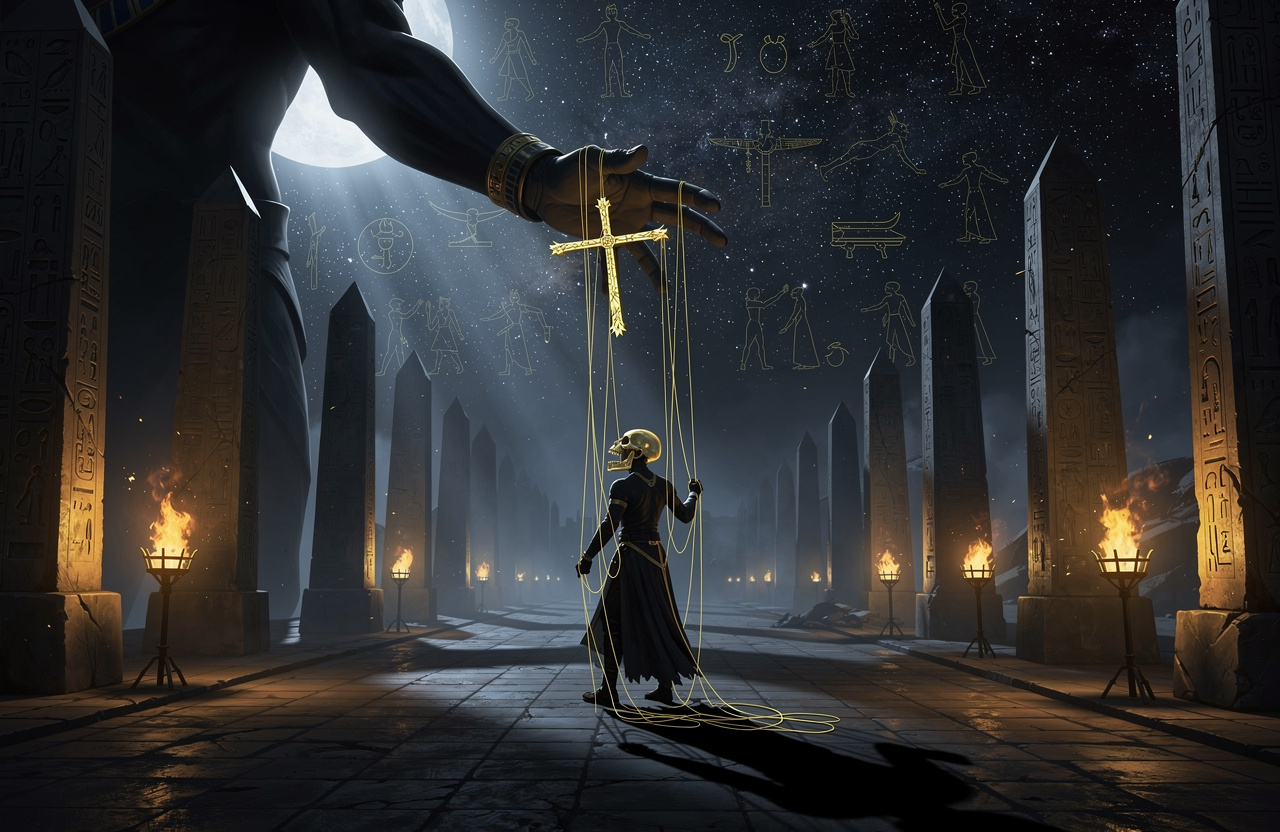
This is the last article in the soft-power block, and it's the most uncomfortable. All the earlier tricks — the feed, grants, the Overton window, hegemony, school, renaming, division — lead to one finale. To the moment a person makes a choice and is absolutely certain the choice is his own. And it's someone else's. Just very well packaged to look like yours.
The book The Architecture of Chaos puts it with frightening directness. The author writes that the Shadow Neteru have seized the consciousness and body of humanity and do everything to make this seizure look like the free will of humanity itself. There's the whole trick of soft power in one phrase: not to take your choice away, but to make you choose what's wanted — and be proud of it.
Crude slavery versus soft slavery
Old slavery was honest in its vileness. A chain, an overseer, an order. The slave knew exactly that he was a slave and hated his master — which meant that, given the chance, he could revolt. That's the weak spot of crude power: the victim sees the enemy.
Soft power removed that weak spot. It doesn't put on a chain — it installs preferences inside you. You're not ordered to consume, to go into debt, to hate your neighbor, to vote conveniently. You're set up to want it yourself. And then the perfect thing happens: you defend your cage as freedom, because you sincerely believe you chose it. There's nothing to revolt against — the enemy is invisible, inside, dressed up as your own desires.
The book notes the same trap in the matter of voluntariness: a person begins to live by the principles of Isfet — parasitism, the inversion of exchange — "of his own good will." That is the highest form of control. Not "I forced you," but "you wanted it yourself." Legally — freedom. In fact — someone else's program, executed by your hands.
How the foreign becomes "yours"
The mechanics, if you assemble the whole block into one, look like this — almost like building malware layer by layer.
- School installs the base firmware: what's normal, what's important, which questions go unasked.
- Hegemony makes someone else's order "self-evident" — a background no one notices.
- The feed retrains you daily on your own fears, curating what you'll see.
- The Overton window quietly moves the boundaries, so yesterday's "no" becomes today's "normal."
- Renaming removes the last resistance: slavery is called partnership.
- A softened boundary (fatigue, "unwinding") pulls the guard off the threshold.
- Division ensures you don't compare notes with others and don't notice the swap.
And the output is "free choice." You scrolled yourself, wanted it yourself, decided yourself. Each layer alone looks harmless. Together they assemble a desire that feels like yours but is engineered for someone else's goal. In engineer's terms, it's a code injection into someone else's process: the program runs under your name, with your privileges, and the system is sure it's you acting.
Where fact ends and myth begins
Let's draw the line honestly, or we'll slide into fatalism. Fact: advertising, political consulting, and platform design openly and scientifically engineer preferences — it's an industry of influence over choice, not a conspiracy theory. Fact: most of our "spontaneous" desires have quite traceable sources.
Myth: that there's no free will at all and everything is predetermined, so there's no point even struggling. That's the most convenient conclusion for the parasite — the despairing don't resist. The book strikes in exactly the opposite direction: it insists that all paths are open, always, and the only constant is the choice. The will isn't taken away. It was swapped — but the swap can be exposed. And an exposed swap returns the choice to you.
How to tell your own from the foreign
A social being has no perfectly "clean" desires — we're all raised by a culture, and that's fine. The question isn't sterility but direction. And here the same criterion from the book works: in whose favor is the exchange.
Ask of any strong "I want": who benefits from my wanting this? Does this desire fill me or milk me? If you removed the ads, the feed, and the fear of "falling behind" — would it remain? A desire that survives these questions is probably yours. A desire that shrivels under them is someone else's program under your name. The very act of naming it (Heka, in the book) strips it of invisibility, and without invisibility it loses almost all its power.
Where is the ordinary person in all this
He's a process running someone else's code, certain that this is just how he lives. And that's no cause for shame: the layers were built by professionals, a whole industry worked against him. There's nothing to be ashamed of — but reclaiming authorship of his choices is possible. It starts not with rebellion but with one question, asked honestly: is this really mine?
The answer: the MAAT token and DAO
The swapping of the will is held in place by isolation: alone, you have nothing to check your desires against and no one to call out "hey, did you really want that yourself?" A scattered person mistakes someone else's program for his own freedom. So the answer is to reclaim both authorship of choice and a network where choice is visible and discussable.
That is MAAT. The MAAT token is membership in a cooperative where scattered people gather their votes into a single bundle and make decisions themselves, instead of receiving "their" choice ready-made from above. The principle is strict: one human, one vote — not "one dollar, one vote" — which is precisely a will that can't be bought or swapped with money. Decisions run through a DAO — a decentralized organization with a transparent treasury where every movement of funds is visible to all, and no one "chooses" for you on the quiet. The entry is simple: read the book — that is, expose the swap — take the token, get your vote. And, for the first time in a long while, make a choice that is truly your own.