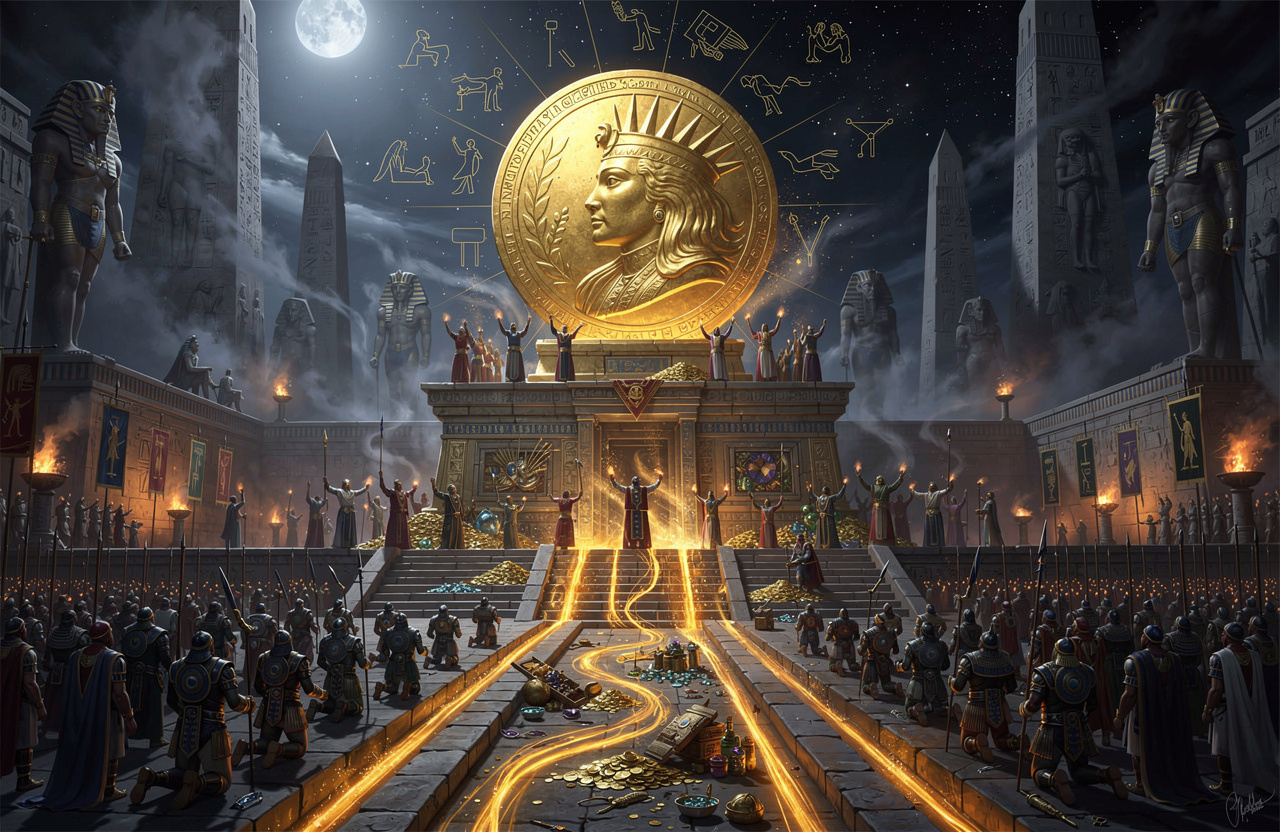
In software there's the notion of a "de facto standard": a format or protocol that isn't inherently better than the others, but everyone uses it because everyone uses it. Whoever owns such a standard gains power without firing a shot — simply because the world is wired to their technology. In July 1944, in a hotel in the mountains of New Hampshire, the U.S. dollar was made exactly that kind of standard for the entire planet. And that may matter more than any war won.
The resort where the postwar world was divided
In the summer of 1944, while World War II still raged, delegates from 44 countries gathered at the resort of Bretton Woods. The task: to design how the world economy would work after the war, so the chaos of the 1930s — competitive devaluations and trade wars — wouldn't repeat.
Two plans were on the table. The British one, presented by economist John Maynard Keynes, proposed a neutral supranational unit of account ("bancor"), tied to no single country. The American plan (Harry Dexter White) proposed something simpler for the U.S.: let the world revolve around the dollar.
The American one won, of course. Not because it was more elegant economically, but because by 1944 the U.S. held most of the world's gold and was the only major economy not ruined by the war. Whoever pays, orders the architecture.
How the dollar standard was built
The Bretton Woods scheme was beautiful in its simplicity. The dollar was pegged to gold at a fixed rate — 35 dollars an ounce. And every other currency was pegged to the dollar. The result was a pyramid: gold at the base, the dollar above it as the only currency directly convertible into gold, and atop that all the world's other money, pegged in turn to the dollar.
Formally, gold remained the anchor. In fact, the dollar became the anchor of the world, because everything was counted through it and reserves were held in it. At the same time, two institutions were created to maintain the system: the International Monetary Fund (IMF) and the World Bank. Remember them — they are the managing layer that will reappear in other stories about debt traps.
The moment the mask came off: 1971
And here is the turn everyone should know. The system worked as long as American gold was enough to back the promise "dollar equals gold." But the U.S. kept printing more dollars (wars, spending, Vietnam), and gold does not physically multiply. Trust in the promise eroded, countries began presenting dollars for gold and shipping the metal out.
On August 15, 1971, President Richard Nixon went on the air and announced that the U.S. would "temporarily" suspend the convertibility of dollars into gold. The "temporarily" has lasted to this day. The golden support was simply pulled out from under the pyramid.
And here's the astonishing part: the pyramid did not collapse. The dollar remained the world standard — now tied to nothing at all, backed only by faith in it and by the fact that everyone uses it. From that moment the dollar became, fully, what it essentially already was — a symbol resting on collective belief. Put bluntly, a world monetary religion: value not from metal, not from a commodity, but from a shared agreement to believe.
Why this is power, not just convenience
When your currency is the world standard, you get what economists politely call an "exorbitant privilege." You can print money the whole world is obliged to accept. Your debt is denominated in a currency you yourself issue. Oil, grain, and metals trade in your money. And that means you can cut adversaries off from the dollar settlement system — and that works as a weapon stronger than an army.
Let's separate fact from myth. Fact: Bretton Woods and its legacy made the dollar an instrument of global power for the U.S. and the financial structures tied to it. Myth: that it was a pre-scripted diabolical scheme of one clan. The truth is more mundane: the side that had the gold and the strength at the time won, and it cemented its advantage in rules that outlived even the abolition of the gold anchor.
Where is the ordinary person in this
Everywhere and nowhere. He uses money whose value rests on someone else's faith and someone else's printing presses. When the issuer of the world currency prints it by the trillions, inflation spreads across the whole planet, and the bill for that decision is paid, among others, by a person who never saw Bretton Woods and never voted for Nixon. He's inside a religion he was never asked whether to join.
The answer: the MAAT token and DAO
The lesson of Bretton Woods: whoever owns the shared standard of value owns everyone who uses it — especially when the standard rests only on faith and opaque issuance. The answer is not to topple the dollar with a slogan, but to build instruments where the rules of issuance and the treasury are transparent and do not depend on a single issuer.
That is MAAT. The MAAT token is membership in a cooperative and a vote under the principle of one human, one vote, not "one dollar, one vote" (note the irony: the whole world in fact lives by "one dollar, one vote"). Governance runs through a DAO — a decentralized organization with a transparent treasury, where issuance and every movement of funds are written into open code and an open ledger, not announced on television with the word "temporarily." Bretton Woods turned what benefits the issuer into an article of faith. MAAT offers not faith but verifiability. The entry is simple: read the book, take the token, get your vote — and stop being a parishioner of someone else's monetary religion.