You pay tax when you earn. That's the deal you were raised on: money comes in, the government takes a slice, you keep the rest. Simple, and it feels fair. Now watch the people at the very top play a completely different game — one where the earning never officially happens, so the tax never officially triggers.
It has a name, three words, almost a mantra: Buy, Borrow, Die.
It is not a loophole hidden in a footnote. It is the front door. And once you see it, you can't unsee how the whole tax system quietly bends around the largest fortunes.
Step one: Buy
You don't get rich from salary. Salary is the most heavily taxed money there is — income tax hits it hard, every year, on the way in. The genuinely wealthy don't live on salary. They own assets: shares in companies, real estate, whole businesses.
So step one is simple: acquire assets and hold them. As those assets rise in value, you get richer on paper — much richer. A founder whose stock climbs from millions to billions has gained billions.
Here's the first magic word: unrealized. A gain you haven't "realized" — meaning you haven't sold — is not taxed. In most systems, capital gains tax only fires when you sell. Hold and never sell, and by the letter of the law, you have earned nothing to tax, even as your net worth explodes into the stratosphere. On paper you are one of the richest humans alive. On the tax return, in a good year, you barely register.
Step two: Borrow
"But," you say, "they still need cash to live. Yachts, houses, jets — that takes money, and to get money you have to sell, and selling is taxed."
No. This is the hinge the whole thing turns on.
They don't sell. They borrow — against the assets they never sold. A bank looks at a billion dollars in stock and happily lends against it, at low interest, because the collateral is enormous and safe. The billionaire gets millions in cash to spend on anything.
And a loan is not income. You don't pay income tax on borrowed money — you never do, because it's a debt, not a gain. So the wealth is spent, the lifestyle is funded, and no taxable event has occurred. The asset was never sold. The gain was never realized. The tax was never triggered. The money is in their hands and the tax bill is zero.
Interest? Small — often smaller than the rate at which the underlying assets keep compounding. The asset grows faster than the loan costs. They are, quite literally, getting richer by borrowing against themselves. The debt is the plumbing that turns untaxed paper wealth into untaxed spendable cash.
Step three: Die
Now the darkest, most elegant move — the one that closes the loop and erases the debt to the tax office forever.
They die.
Under U.S. law there's a provision called step-up in basis. When you die, the "cost basis" of your assets — the original price used to calculate the taxable gain — is reset to their value on the day of death. That lifetime of gains, all those billions that grew and were never taxed because never sold? The basis steps up, and the built-in gain is wiped. Erased. As if it never happened.
The heirs inherit the assets at the new, stepped-up value. They can sell the next day and owe capital gains tax on essentially nothing — because on paper, the gain that accumulated over a whole life has been zeroed out at death. The outstanding loans are cleared from the estate, and the fortune passes on, having generated a lifetime of spending and near-zero tax.
Buy — and never trigger the tax. Borrow — and spend without triggering it. Die — and delete the tax base entirely. The loop is closed. The gain has passed through three generations of hands and never once met the taxman.
Our record
Set it on the scale. On one pan: the nurse, the coder, the driver — every wage taxed on the way in, no "unrealized" shelter, no borrow-against-yourself trick, the feather pressing down on earned income every single year. On the other pan: a fortune that grew into the billions and, by law, correctly filed, paid a rate near zero.
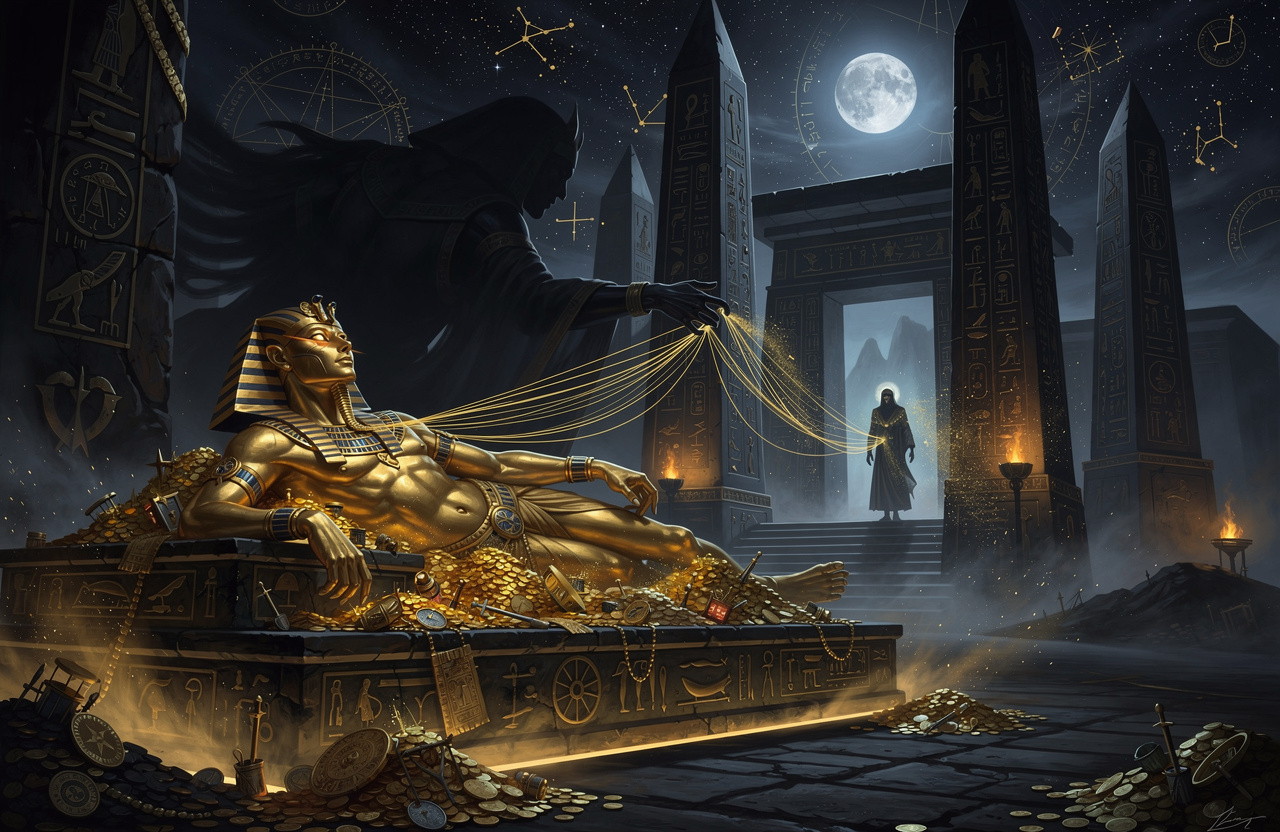
This is Isfet in its most refined form — not theft, not fraud, but architecture. The pump doesn't break the rules; it was handed a system where the rules for the largest fortunes route around the tax entirely, while the rules for your labor route straight through it. Sekhem flows out of the working many in taxed wages and pools among the owning few in untaxed gains. The scale isn't cheated. The scale was built to tip. Same law, two doors — and only one of them has a toll booth.
Name it. This is not "smart accounting." This is a tax system with an off-ramp reserved for people who own instead of earn.
Where the lever is
No doom. A door — several.
Understand the game before you resent it. The lesson underneath the outrage is real and usable: taxes are triggered by events, not by wealth. Selling is an event. Earning wages is an event. Holding is not. The rich organize their lives around not triggering events. You can borrow the logic even at small scale — think in assets held, not just income earned.
Own, don't just earn. The entire structure rewards ownership over labor. The single most system-aligned move you can make is to stop being purely a wage-earner and start being, even slightly, an owner — of shares, of a business, of productive assets. Cross the line from taxed-on-the-way-in to taxed-only-if-you-choose.
Back the fix loudly. Proposals exist — taxing unrealized gains above vast thresholds, closing the step-up basis, mark-to-market for the ultra-wealthy. They're fought hard for a reason: they'd re-level the scale. Knowing the mechanism by name is what lets you argue for the fix instead of vague "tax the rich" noise.
Build outside the loop. Cooperative and DAO-based ownership lets ordinary people hold productive assets together — the ownership side of the ledger, opened to those who were only ever meant to be on the wage side.
Buy, Borrow, Die isn't a secret. It's a blueprint left in plain sight. Read the blueprint. Then decide which side of the tax line you're going to organize your life on.
The scale can be re-leveled. First you have to see which door you were sent through.