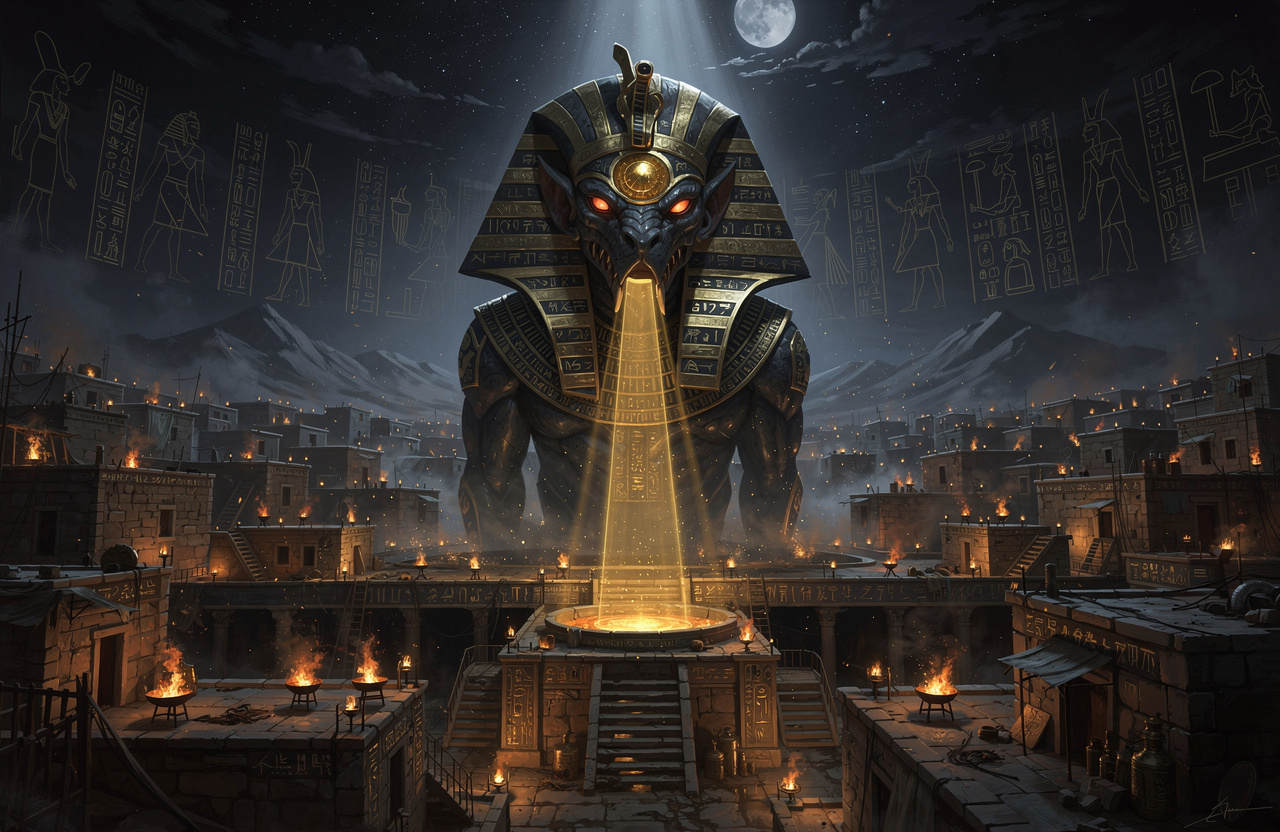
Ask why the powerful want AI in the cloud and not on your device, and you've found the whole game in a single question. The answer isn't technical. It's architectural. And architecture is control frozen into shape.
There are two ways to build intelligence into the world. One: a few giant models in a handful of data centers, and everyone rents access through a pipe. Two: many small models running on the devices people already own, answering to their owners. Both work. Only one of them puts a chokepoint between you and your own thoughts.
Guess which one gets the marketing budget.
The cloud is a control architecture
Strip away the convenience story and look at the wiring. When your AI lives in someone else's data center, that someone holds four levers over you at once — and every one of them is the kind of leverage the Shadow Neteru is built to exploit.
They see every query. Every question you ask the cloud model is logged, on their servers, under their policy. Your curiosities, your fears, your half-formed ideas — the most intimate data stream you produce — flows straight into their ledger. On your device, the query dies where it was born.
They hold the kill switch. Access can be revoked, throttled, or priced out from a console you'll never see. What you rely on today can vanish tomorrow by someone else's decision. Not your keys, not your model. Single point of failure, by design.
They control the outputs. The same model can be quietly tuned — to refuse this, to nudge that, to shade an answer toward the house view. Centralized intelligence is centralized editorial power over what a billion people are allowed to think with.
They meter the pipe. Rent, forever. The subscription that never ends, on the tool you can no longer work without.
That's not a bug list. That's the product, from the owner's side. The cloud isn't where AI happens to live. The cloud is where control is easiest to hold.
Our Record
On the Scales of Maat, the deepest asymmetry is between Sekhem that is distributed and Sekhem that is pooled. Life-force spread across many vessels balances itself — no single hand can seize it. Life-force funneled into one reservoir becomes a throne. Whoever sits on the reservoir rules everything downstream of it.
The Shadow Neteru is, at bottom, a centralization pattern. It doesn't invent new evil — it simply arranges for all the Sekhem to flow to one point, then sits there. Feudal land. The central bank. The single big model everyone must ask permission to think with. Same shape, new century. Concentrate the force, own the ones who depend on it.
Here is the counter-law: distribution is Maat's native defense. Power spread to the edges cannot be usurped from the center, because there is no center to seize. This is not a policy preference. It's the structural reason the balance holds. Push intelligence to the edge and you don't just gain privacy — you dissolve the throne.
The edge is already viable — that's the secret
The lie holding the cloud model up is "real AI is too big to run locally." That lie is aging badly, fast.
Open-weight models — Llama, Mistral, and a growing field — now run useful inference on a laptop, a phone, a modest box on your desk. Quantization shrinks them further. The gap between "cloud-only frontier" and "good enough on my own hardware" narrows every single quarter. For a large and growing share of real tasks — drafting, summarizing, translating, coding, private reasoning — the local model is already there.
So the centralization case was never really about capability. It was about dependence. A model on your device asks no permission, logs to no server, can't be revoked, can't be metered, can't be quietly re-tuned against you. It answers to one authority: you. That is precisely why the architecture of power prefers you never taste it.
Follow the incentive. When someone insists the only "safe," "responsible," "real" AI is the one you must access through their pipe — ask who keeps the chokepoint. The safety story is often the moat story wearing a nicer coat.
The counterargument — handled
"Centralization gives us the biggest, smartest models. The edge will always lag." Partly true, and it doesn't rescue the argument.
Yes, the absolute frontier will live in big clusters for a while — some tasks genuinely need the mega-model. But most of your life doesn't run at the frontier. It runs on tasks a local model already handles, privately, for free, forever. The right architecture is hybrid by default and local by preference: keep the ordinary at the edge under your control, and reach for the cloud only for the rare heavy lift, eyes open about the cost.
And "safety through centralization" cuts the other way. One big model everyone depends on isn't safe — it's the ultimate single point of failure, one console away from becoming the ultimate instrument of control. Distributed intelligence has no such throne to capture. Resilience lives at the edge.
The lever
Here's what you do with all of this.
Run local. Now, not someday. Put an open model on your own hardware and use it. The moment you feel a capable AI answering only to you — no login, no log, no meter — the cloud's spell breaks. You stop asking permission to think.
Back the open-weight ecosystem. Every open model released, every quantization that fits it on smaller hardware, every tool that makes local easy is a brick pulled from the chokepoint. Distributed AI is Maat's architecture; help build it.
Reject the frame that big = safe. When you hear that only the centralized model can be trusted, translate it: only the chokepoint they control can be trusted — to serve them. Name the move and it loses its power.
Power needs one big AI because one throat is easy to hold. The edge gives it a thousand throats it can never grip at once.
Keep your intelligence at home. The reservoir is a throne — refuse to fill it.