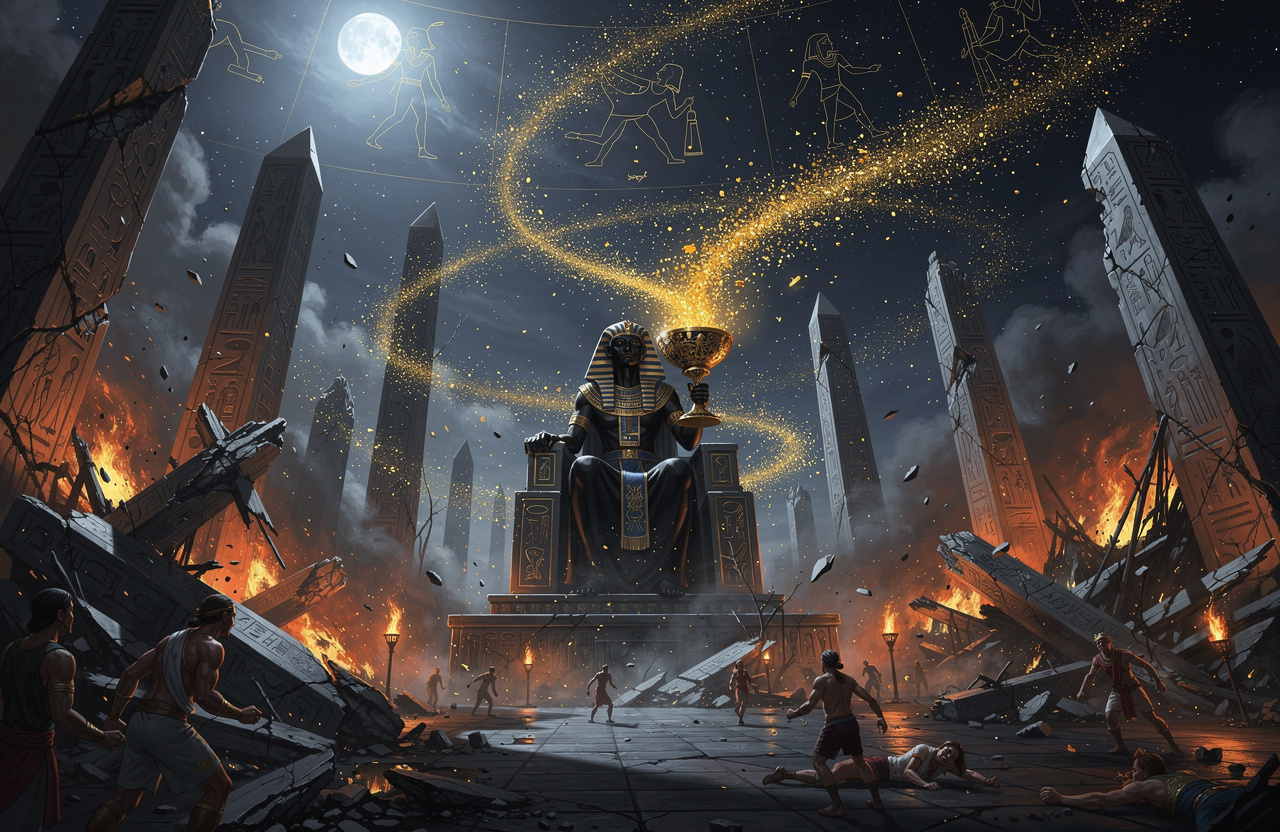
From childhood we were taught to believe that everyone wants peace, order, and stability. That chaos is a glitch, an accident, an undesirable state that all normal forces jointly try to eliminate. It sounds logical. And it is almost always wrong.
Because there is a whole class of players for whom stability is the death of the business, and chaos is a nutrient medium. Not because they love suffering, but because their earnings model works like this: they extract profit from movement, spread, panic, and urgency. And all of that is supplied precisely by instability. In a calm world they have nothing to catch. In a shaking one — open range.
Who earns on instability
Let's list the nodes for whom shaking is directly profitable.
- Volatility speculators. In a calm market, where prices barely move, you cannot earn on swings. But when everything jumps — currencies, stocks, oil — room opens up: buy in panic, sell on the bounce. The harder it rocks, the bigger the gain. Sharp market moves are their harvest.
- Lenders of last resort. A crisis ruins people — and to the ruined come those with money at a harsh rate and against collateral. Panic drives asset prices to the floor, and they are bought for a song from those who urgently need cash. "Buy when there's blood in the streets" is not a metaphor, it's a business strategy.
- The arms and security industry. Instability equals demand for protection, weapons, security. The scarier the world, the higher the sales.
- Political manipulators. A frightened society is easier to rule. A frightened person is ready to surrender freedoms in exchange for a promise of protection. Chaos is the best salesman of control.
Notice the common pattern. None of these players produce or build. They extract — from spread, from fear, from urgency. And the maximum of spread, fear, and urgency is supplied precisely by instability.
Why it is not necessarily a conspiracy
It matters not to fall into a conspiracy theory where a villain sits and turns a chaos dial. Reality is subtler and therefore more unpleasant.
Most often no one "arranges" chaos on purpose. It is simply that the system has nodes for which chaos is profit and nodes for which chaos is loss. And the first, naturally, pull the system their way: they lobby for decisions that sharpen conflicts, inflate fears, slow down whatever brings calm, because calm strips them of income. This is not one person's evil will — it is the sum of the incentives of many players, for each of whom instability is personally profitable.
In the book on which the MAAT project stands, this is stated plainly: the financial clans think they control the system, but their actions — wars, debts, destruction — feed the anti-principles whether they want it or not. Each level is sure it is the master. In fact it is a battery for the level above. Chaos is not a bug in the system. It is its way of feeding. A parasite does not "choose evil" — it is simply built to thrive on the decay of the living.
Maat against Isfet: order against inversion
The ancient Egyptians distinguished two states of the world. Maat — just order, balance, fair exchange. Isfet — chaos, inversion, parasitism. And here is the key thought easy to miss: Isfet is not the opposite of life for the sake of being opposite. Isfet feeds on life. It needs a working organism to milk. A fully destroyed world is no use to it either — it needs a world that is constantly feverish but never quite dies.
That is why the goal of those who live off chaos is not the apocalypse but managed instability. Enough anxiety for people to be afraid, borrow, sell in panic, and ask for protection. But not so much that everything collapses for good and there is no one left to milk. That is the "architecture of chaos": not a fire down to ash, but an eternally smoldering ember, convenient for warming your hands over.
Where is the ordinary person
He is the fuel. Literally. His fear is the demand for protection. His panic sell-off is someone else's profitable buy. His readiness to trade freedoms for safety is power for the manipulator. His savings, melting in a crisis, flow to whoever sat the crisis out with cash ready.
And the bitterest part: it is nearly impossible for the scattered person even to realize he is the fuel. Chaos is shown to him as an element, like the weather — "that's how it turned out, such are the times." To see that instability has beneficiaries, you have to rise above your own kitchen and look at the whole scheme. And alone people don't do that — they have no time, they're scared, and there's no one to do it with.
The answer: the MAAT token and DAO
If chaos is a parasite's way of feeding, then the antidote is Maat: order, transparency, and coordination of those being milked. The strength of the chaos-lovers is that they are organized and see the scheme, while their fuel — ordinary people — is scattered and sees no scheme.
MAAT changes the lineup. The MAAT token is membership in a cooperative and a single vote on the principle of one human, one vote, not "whoever has more money to sit out the crisis collects the harvest." Governance runs through a DAO — a decentralized organization with a transparent treasury where every movement of funds is visible to all. Transparency is the light in which a parasite is uncomfortable: you can warm your hands over the smoldering ember of chaos conveniently only in the dark. When people are gathered into a network with a shared vote and see the whole scheme, they are harder to rule through fear, and their panic is harder to milk. The entry is simple: read the book, take the token, get your vote — and stop being the fuel for someone else's eternally smoldering fire.