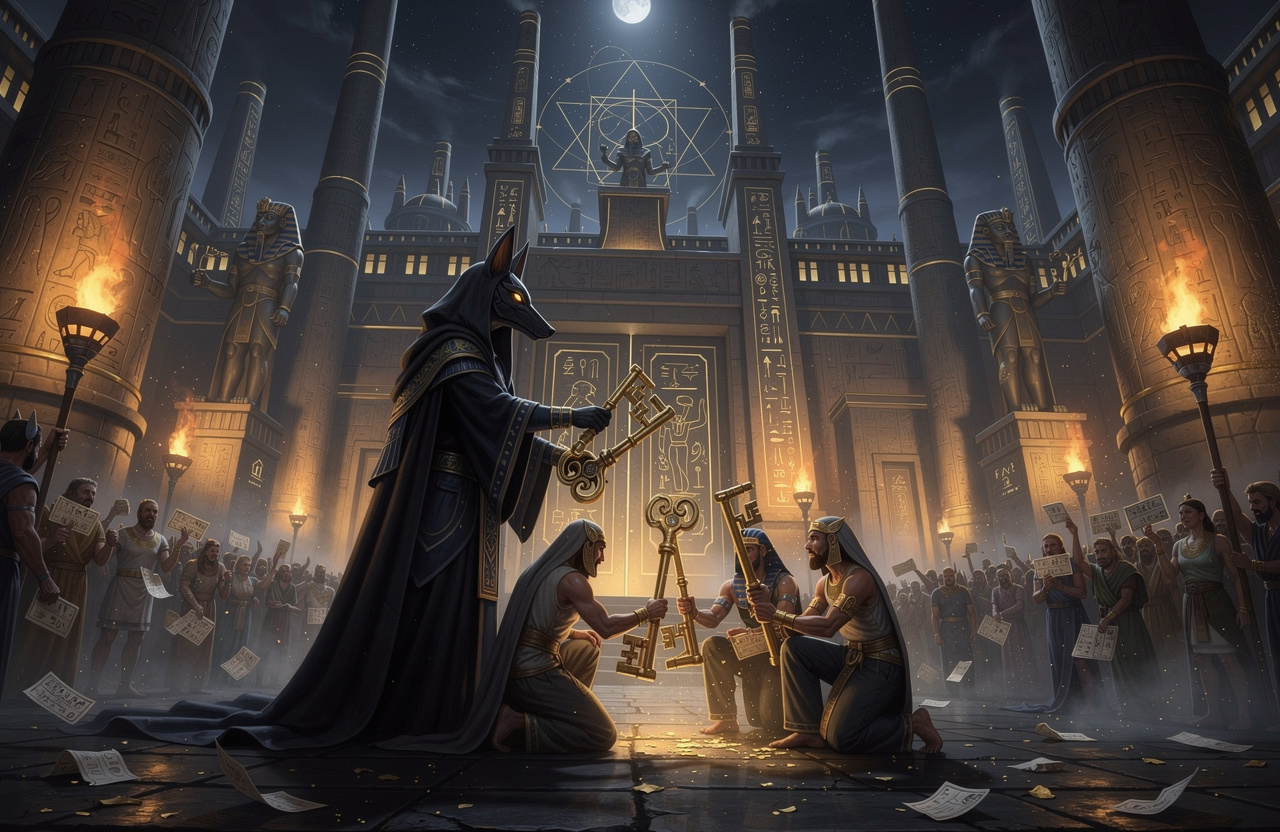
If shock therapy is the diagnosis, then privatization is the specific operation in which the patient's kidneys were carried out. And in Russia that operation had a face and a name: the Chubais model of privatization. Today, not about personalities, but about the engineering of the scheme. The main question is simple and uncomfortable: the state property of an enormous country went somewhere — so who, exactly, received it?
I'll take this apart calmly, the way you read the logs after a breach. Not "who's a bad person," but "how the transfer mechanism was built." Because the mechanism matters more than the names: names change, the construction is reproduced all over the world.
The promise versus the reality
Privatization was sold to the people beautifully. The idea went like this: state property belongs to everyone, so let's divide it equally among all citizens. A voucher for each — a "privatization check," a piece of the common property. Become owners, ladies and gentlemen. People's capitalism.
It sounded fair. On paper, every citizen got a slice of the plants and factories. In practice — here's where the engineering begins.
Stage one: the vouchers
Everyone was issued a voucher with a face value of 10,000 rubles. Only, while it was being printed and handed out, hyperinflation (up to 2,500%) turned those 10,000 into the price of a loaf of bread. The citizen's share of the national wealth shrank to the cost of a baguette.
Then comes simple human logic. The ordinary person in 1992–1993 didn't understand what to do with this slip of paper, and didn't believe in it. Wages unpaid, prices flying up, just survive. So he did the obvious thing: sold the voucher for cash. Or took it to a "voucher fund," many of which later simply vanished.
And someone bought up those vouchers by the sackful — for a pittance, from millions of bewildered people. And out of those sacks assembled controlling stakes in real factories. The people's share flowed to those who had capital and an understanding of the scheme. Entirely "legally."
Stage two: the loans-for-shares auctions of 1995
But the biggest prizes didn't come through vouchers. The choicest assets — oil, metals, mining — went through the loans-for-shares auctions of 1995. The scheme was almost mockingly simple:
- the state has no money;
- a few banks give the state a loan;
- as collateral, the state hands over shares of its largest enterprises;
- the loan is "not repaid" — and the factories stay with the banks.
And often the banks themselves lent the state money they had earlier received from the state. In effect, the country handed over its main enterprises for its own money. The auctions were held within a narrow circle, with winners known in advance, for sums laughable against the real value of the assets. So in a couple of years, fortunes on a planetary scale appeared out of nothing.
Who ended up with the assets
Let's balance the books coldly, the way an engineer tallies who got access to which resource:
- A narrow circle of bankers and insiders got the oil, metals, and mining giants — the things that yield rent for decades.
- Foreign funds got an entry: the book states plainly that every major IPO of the 1990s was a transfer of part of the shares to Western funds. A share of Russian assets flowed abroad from the very start.
- The state got short-term money and a long-term loss of control over its own economy.
- The people got a voucher worth a loaf of bread and the word "owner" in the passport, behind which stood nothing.
There's the answer to the headline's question. The assets went to those who had access to the rules and to the lever. Everyone else got a receipt of participation.
Fact and myth
Fact: during the 1990s privatization, the country's main assets concentrated in the hands of a narrow group, while the majority of citizens received no real share, despite the formal "equal distribution through vouchers." That's a sequence of events, not an opinion.
Myth: that there was no other way, "no alternative existed." The path was defined by speed and rules, and those were chosen by people — the very reformers and their outside advisors. It could have been slower, more transparent, with protection for citizens. They chose fast and for insiders. That was a choice, not a law of nature.
Where the ordinary person stands
He is the formal "co-owner" of the country whose real share was squeezed out by a law written not for him. He was made an owner on paper just enough not to object, and just so that he'd lose that property right away. He wasn't crudely cheated — he was carefully eased out of the ranks of real owners, left holding a slip of paper. He had no vote, no access to the auction, no transparency.
The answer: the MAAT token and DAO
Chubais-style privatization is the perfect illustration of what happens when common property is "divided among everyone" but without transparency, without a real vote, and without protection against concentration. Formally, everyone has a share. In fact, it drains to those with access. To prevent that, you need exactly three things that weren't there then: a shared vote, a visible treasury, and protection against capture.
That is exactly what MAAT builds in. The MAAT token is membership in a cooperative where common property isn't "handed out as slips of paper" but held together, and decisions are made on the principle of one human, one vote, not "whoever has access to the auction takes it." Governance runs through a DAO — a decentralized organization with a transparent treasury where every movement of funds and every asset bought is visible to all. No closed auctions for insiders: an attempt to quietly siphon off what's shared is visible at once, and the community stops it.
In the 1990s the ordinary person had a share only on paper. MAAT makes the share real — protected by a vote, by visibility, and by a rule against concentration. The entry is simple: read the book, take the token, get your vote. And this time stay a real co-owner, not the holder of a receipt.