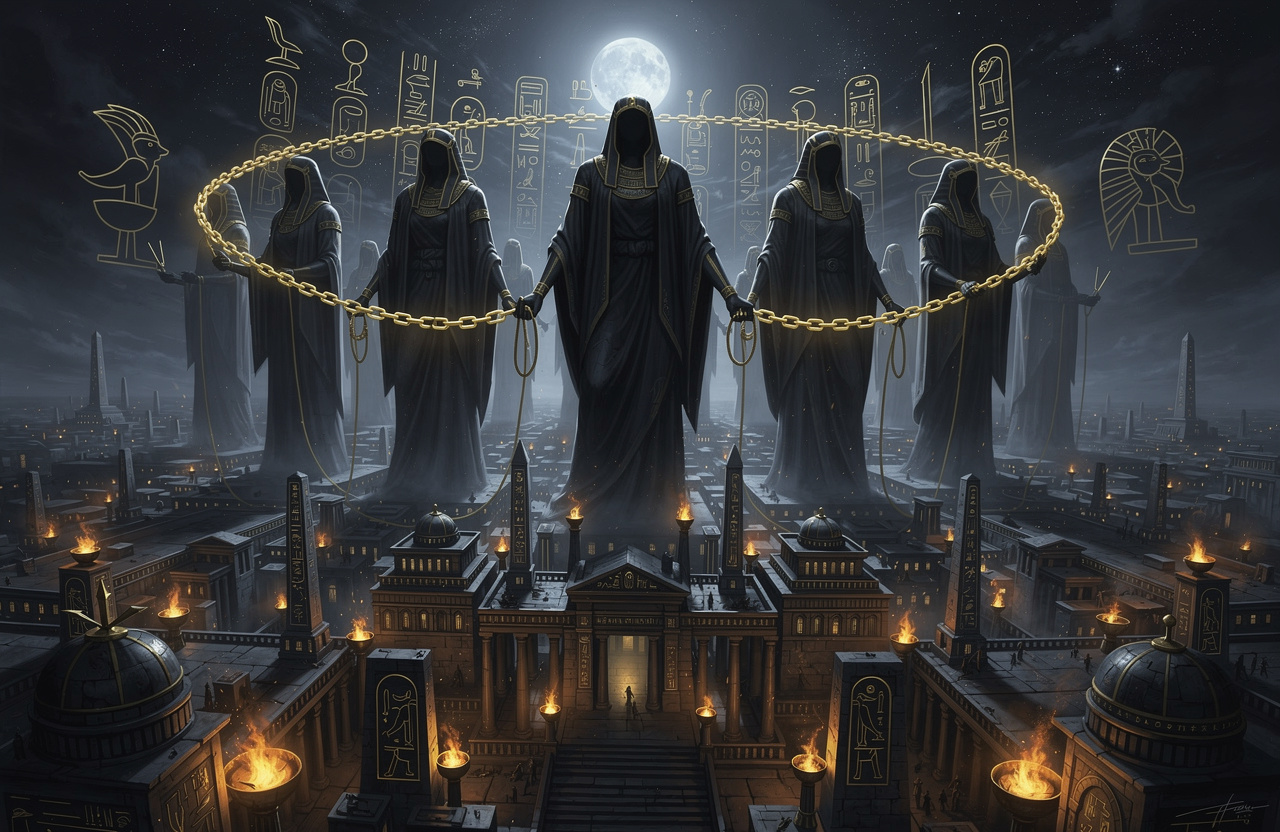
You keep looking for a face. There isn't one. There's a shape.
In 2011 three researchers at ETH Zurich — Stefania Vitali, James Glattfelder, Stefano Battiston — did something almost nobody had done before. They took a database of 37 million companies and investors, pulled out the 43,000 transnational corporations, and mapped who owns whom. Not opinions. Not a theory over beers. A directed graph of share ownership, run through the same math physicists use for networks. And out of that tangle fell a number that should have rewired how you see the world.
147. A core of 147 tightly knit companies controlled, through a dense web of cross-holdings, roughly 40% of the total economic value of all 43,000. A super-entity. Nearly three-quarters of them were financial institutions — banks, funds, insurers. Barclays sat near the center. So did the names you already know.
Read that again. Not 147 men in a room. 147 nodes. Power turned out to be a topology.
The Map Is Not a Pyramid
You were taught to imagine wealth as a pyramid. A wide base of workers, a narrowing middle, a point at the top where some name — a Rockefeller, a Rothschild, a Musk — sits and decides. It's a comforting picture, because a point can be named. Named, and one day removed.
The ETH map is not a pyramid. It's a knot.
In the core, ownership loops. Company A owns a slice of B, B owns a slice of C, and C — follow it far enough — owns a slice back into A. The arrows don't climb to a summit and stop. They circle. Draw the diagram honestly and your pen never lifts from the page. There is no apex node that owns without being owned. There is a ring that owns itself.
That's why the search for "the owner of everything" always fails. You go looking for a king and you find a circuit. The 147 don't sit above the economy giving orders. They are a self-referential clot of mutual holdings, and that clot behaves as one because the math makes it behave as one — no meeting required.
Our Record
In the old texts the enemy of order is not a person. It's Apophis — the serpent that coils around the world at night, ring upon ring, and squeezes. Apophis has no face because Apophis is not a being; it is a pattern of constriction. You cannot assassinate a pattern. You cannot vote it out. You can only fail to feed it.
The 147 are a coil. Each ring — a cross-holding, an interlocked board, a fund that owns the bank that owns the fund — tightens the grip. The core hoards Sekhem, stored life-force, the productive capacity of the whole living economy, and stores it not in a treasury with a door but in a structure with none. That's the trick the serpent learned: don't be a thing that can be slain. Be a shape that reconstitutes.
Name the shape. A named thing loses power.
Why This Is Worse Than a Conspiracy — and Also Better
Worse, because a conspiracy can be exposed. You leak the minutes, you name the men, the public recoils, the thing breaks. A topology has no minutes. Nobody in the core needs to conspire. Each institution rationally protects its holdings; the collective behavior — concentration, control, self-preservation — emerges from ten thousand individually reasonable decisions. It's not a cabal. It's an incentive gradient with a shape. That's harder to fight because there's no villain to unmask.
But also better — and here's the door.
A network's power lives in its connectivity, not in any single node. The ETH team said it plainly: this structure is fragile precisely because it's dense. Densely interconnected systems propagate shocks. One node in distress pulls its neighbors down — see 2008, where a coil that shared everything also shared the fall. Concentration is control on a calm day and a single point of failure on a bad one. The ring that squeezes is also the ring that can't isolate a fire.
And connectivity cuts the other way for you, too. You don't have to slay the serpent. You have to stop being one of its rings.
The Lever
Here is the part they'd rather you skipped. The 147-node core is made of financial institutions — and financial institutions are made of your money. Your pension routes through a fund that feeds the core. Your checking account funds a bank in the coil. Your index fund, bought for "safe diversification," is a fresh ring the serpent didn't have to grow itself. The topology isn't sustained from above. It's fed from below. By us.
So the move isn't to find the owner and remove him — there's no him. The move is topological. Change the graph.
- Audit your own edges. Where does your money actually sit at rest? Trace one account up its ownership chain until you hit a name in the core. You'll hit one faster than you'd like.
- Reroute what you can. A credit union instead of a systemic bank. Self-custodied assets instead of a custodian in the coil. Every rerouted edge is one ring the serpent loses.
- Build parallel structure. A DAO, a cooperative, an open network is a different graph — one where ownership loops back to the people inside it, not to a 147-node clot. Not "you against the ring." A ring of your own, wound the other way.
The old priests knew you don't defeat Apophis once. You hold him off each night, together, with the right words and the sun at your back. Power is a shape. Shapes can be rebuilt.
Stop feeding the coil. Start winding your own.