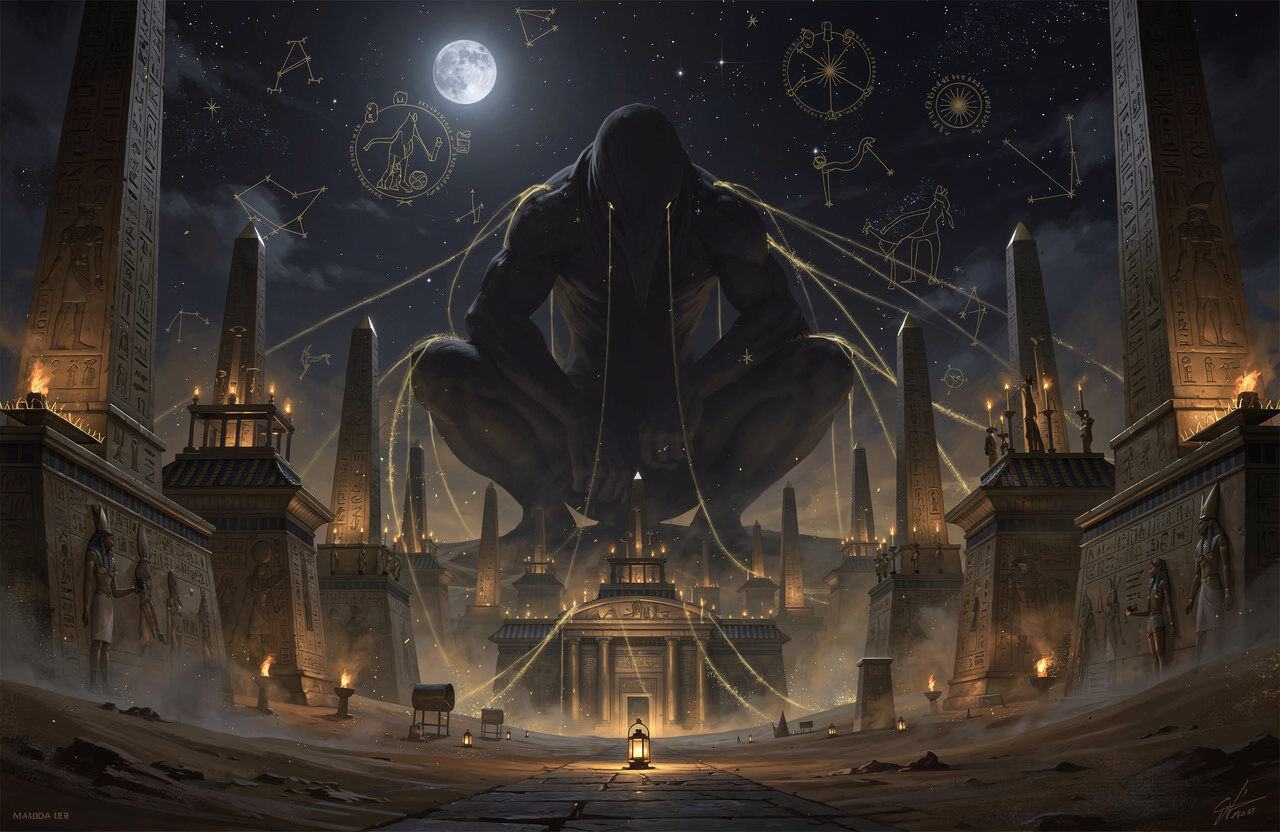
The richest people in the world are not the ones you see on the Forbes list. The visible ones are the storefront: flashy billionaires with yachts and Twitter accounts, convenient targets for envy and the tax office. Real old power is built differently. Its core skill is not earning (many can do that) but staying out of the light (few can). A clan that has survived five, ten, twenty generations didn't survive because it was the richest at every moment, but because at the right moment it knew how to become invisible.
The name as a vulnerability
Start with something the book this project rests on lays out in detail: a name is power, but a name is also a target. To name something is to make it manageable. The nameless is all-powerful; the named is vulnerable.
For a clan, that's not a metaphor but a survival manual. A loud surname brings prestige, but it turns you into coordinates for a strike. The named can be pointed at, hated, legislated against, stripped of property by a court, and in the worst times sent to the guillotine. History knows dozens of houses whose only crime was that everyone knew their name and where they kept their money.
The old clans learned this lesson in blood. And from it they drew an iron rule: real power loves silence. The more power you hold, the less should be heard of it.
Three techniques of invisibility
How does "staying out of the light" work in practice? Break it down and you get three recurring techniques.
First — hide ownership in faceless structures. Not "an account in the family head's name," but a trust, a foundation, a chain of offshore companies, a stake in an index giant. Legally, the clan "owns" nothing anymore — the structure owns it, and the clan is merely a "beneficiary." No owner, no target. The Rockefellers set up irrevocable trusts back in 1934; such structures run for a century and a half on rules written by people long dead.
Second — don't be number one. The most advantageous position is not at the top of the list but just below and to the side, where the money works and the attention doesn't. When a family puts its capital into a fund like BlackRock, it becomes just one client among thousands — the influence stays, the surname dissolves into a faceless ring of funds. Capital pooled, ends hidden, no target.
Third — change the signboard while keeping the substance. Over the centuries the carriers of "real power" have changed many costumes: priests, soldiers, administrators, financiers. The faces and the signs on the doors changed; the method did not. That's clan-style fault tolerance: remove a specific person and another picks up the function, and the structure doesn't flinch.
Why it sped up precisely now
Here's an important detail worth stating plainly. The "stay invisible" principle always worked, but in recent decades it has switched to full power — and not by accident.
The more knowledge people carry, the faster information spreads, the more exposing books come out — the more dangerous it is to be a visible beneficiary. In an age when anyone can Google your lineage and your assets, a loud surname turns from an asset into a liability. So the old open structure deliberately hides deeper: instead of a surname on the signboard, a quiet stake in a ring of nameless funds. Put metaphorically: the brighter the light of universal awareness shines, the deeper into shadow goes the one with something to hide. More transparency for everyone turned into more camouflage for the few.
An honest line
So as not to slide into paranoia: fact — old clans really do use trusts, foundations, and anonymous structures, really do avoid publicity, and really do know how to carry capital across generations untouched. You can see it in leaks, registers, and the history of specific houses. Myth — that there's a single secret council of invisibles running every event from a bunker. The reality is subtler: not one headquarters but a honed skill — to dissolve, to split ownership, to keep your head down. A skill, not a conspiracy. And that's exactly why it's so durable: you can't arrest a skill.
Where the ordinary person stands
In the exact opposite position. He is maximally in the open: a salary taxed before it arrives; an account tied to his passport; every purchase leaving a digital trace. He's transparent and therefore vulnerable. The truly rich are invisible and therefore protected. An inverted logic: visible are those with nothing to take, and invisible are those who have it all.
The answer: the MAAT token and DAO
The obvious conclusion seems to be: if the clans' strength is invisibility, should we hide too? No. That's a trap. We don't have money for expensive lawyers and chains of offshores — in a game of hide-and-seek we always lose. Our strength is the opposite: not secrecy, but numbers. They are few, and silence suits them. We are millions, and openness suits us.
That is MAAT. The MAAT token is membership in a cooperative built on the principle opposite to the clan's: not to hide, but to gather in the open. Governance runs through a DAO — a decentralized organization with a transparent treasury, where every movement of funds is visible to anyone, and where the common pool can't be quietly siphoned into a hidden structure. Voting follows the principle of one human, one vote, not "one dollar, one vote": weight comes from membership, not the size of the wallet. A clan is strong as long as it isn't seen. A community is strong in exactly the opposite way — as long as it's seen by everyone. The entry is simple: read the book, take the token, get your vote — and trade the role of a lone visible victim for the role of a member of a visible but invulnerable network.