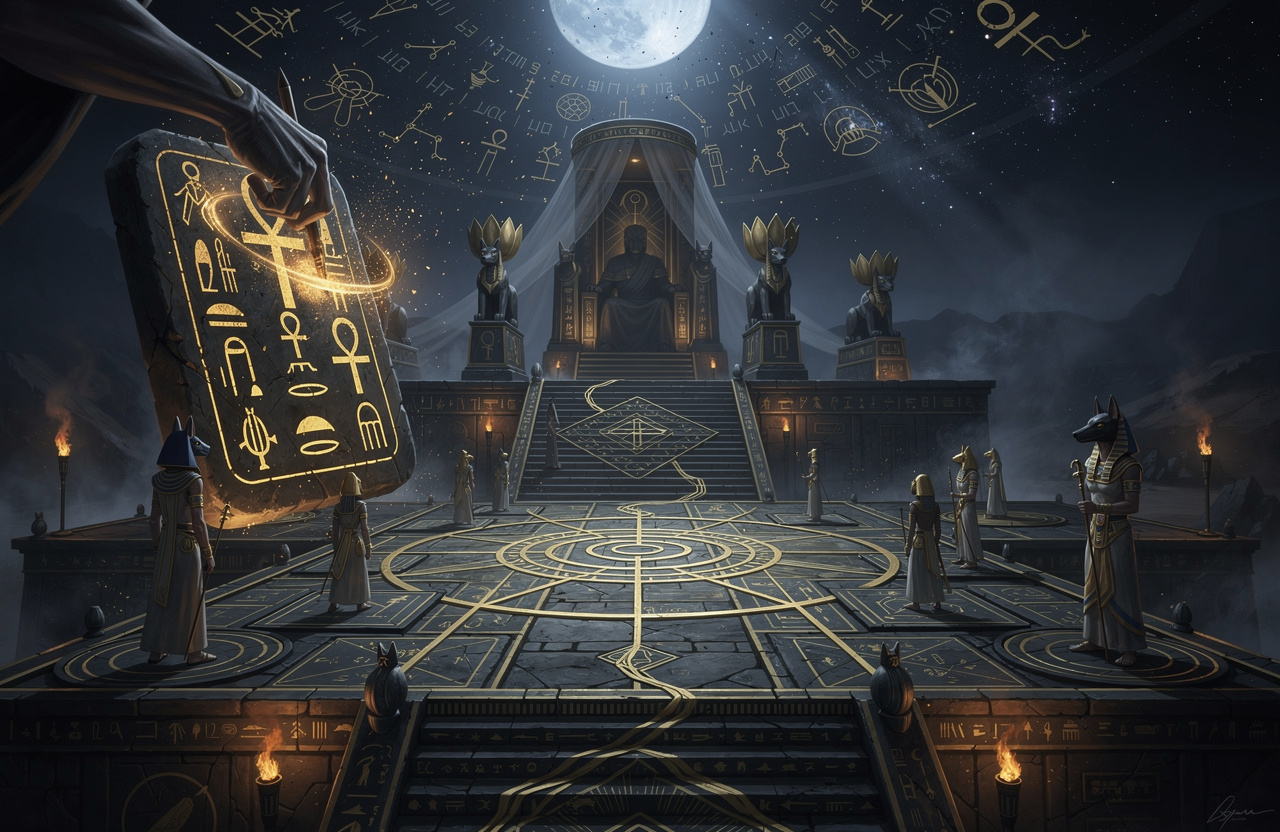
There is power you can see, and power you can't. The first sits in an office with a flag behind it, appears on the news, and can be voted out. The second never shows up anywhere, because it works one level higher: it doesn't decide who wins the election, it decides the rules by which elections happen at all. An engineer would put it this way: one power is the application, the other is the operating system the application runs on. Swapping the app is easy. Swapping the OS from inside the app is almost impossible.
This second power is sometimes called conceptual power. Before you wince at a phrase conspiracy theorists have worn out, let's take it apart like engineers.
Six levels of control
It helps to picture power as a stack. The crudest level is direct force: weapons, prisons, violence. Above it sits economics: who pays whom, who owes whom. Higher still is law: the rules we've agreed to obey. Above law is ideology: what counts as "normal," "progressive," "backward." Above ideology is history: how we remember the past, what's deemed "important," what's "forgotten." And at the very top sits worldview itself — the very concepts we think with.
The lower the level, the more visible it is and the slower it works. A tank is visible to everyone, but it only controls whoever it's pointed at. The higher you go, the quieter it gets and the wider it reaches. The one who sets the concepts gives no orders at all. He doesn't need to. People who think in his concepts arrive at the intended conclusions on their own — and call it their free choice.
Why meaning beats force
The book this project rests on lays out the formula of power plainly: soldiers hold the body of a civilization — land, resources, money — while priests hold its meaning: fear, hope, the sense of what's normal. The ruler between them is merely an interface, the figure through which all of this is presented as legitimacy. Pharaoh, emperor, pope, president, chairman of the board — the costumes change, the structure doesn't. And here's the key: in that pair, the stronger one is not the one with the army. The stronger one is the one who decides what the army may be used for without shame.
Because force can make people stay silent, but it cannot make them believe. Power held by fear alone is expensive and brittle: you have to feed the soldiers, build the prisons, crush the revolts. Power that people consider just out of their own conviction costs almost nothing. It holds itself up. So the real prize is neither the army nor the treasury. The real prize is the head. Whoever writes the rules of the game doesn't play on the board. He draws the board.
It's a protocol, not a headquarters
Here comes the usual temptation: if there's invisible power, then there must be a secret council, a list of surnames, a headquarters where the deciders sit. People spend their lives hunting for "who's behind it all" — and never find it, because they're looking for the wrong thing.
What gets transmitted is not an organization. It's a method. Think of the difference between a specific server and a network protocol. A server can be shut down, its owner jailed, its data center demolished. You can't kill a protocol that way: it isn't in one place, it's the way the connection itself is built. HTTP belongs to no one. It simply works wherever two machines agree to speak it.
Conceptual power is a protocol. Its three modules don't change from era to era — only the people executing them do: control of meaning (what counts as truth, norm, hope, fear), control of resource (who holds the land, the metal, the energy, the money), and the interface (the figure who presents all this as legitimate). Remove the specific people and the protocol installs new ones. It has happened before: soldiers replaced priests, administrators replaced soldiers, financiers replaced administrators. The carriers changed. The method stayed.
Where the ordinary person stands
In the most uncomfortable spot. He thinks at the application level — which candidate, which bank, which party is better — while the rules of those choices are written one level up, and not by him. He's handed a menu and told it's freedom. The choice is real, but from a pre-approved list. You can argue inside the rules all you like; it's even encouraged, because it creates the illusion of participation. Only one thing is off-limits: changing the rules themselves. There's no access to that.
And here's the honest line that keeps this from sliding into paranoia. Fact: the level where rules and concepts are set genuinely exists, and ordinary people are not admitted to it. Myth: that an all-knowing secret council sits there pulling every string. Reality is duller and more frightening: most often it isn't a conspiracy but a self-replicating protocol that favors those at the top and needs no headquarters to run. Naming it is already half the cure. The nameless is all-powerful. The named is manageable.
The answer: the MAAT token and DAO
If the topmost level of power is the right to write the rules, then liberation begins not with winning by someone else's rules, but with gaining access to writing them. Alone, you're not let in — one person has neither weight nor a voice at the OS level. A network does.
That is the meaning of MAAT. The MAAT token is membership in a cooperative where the rules are written not in a closed office but publicly, in code, on a blockchain, where anyone can read them before joining. The defining question of any system — "who writes the rules, and whose interests are baked into them" — here has an honest answer: the rules are coded in the open, and they can only be changed together. Voting follows the principle of one human, one vote, not "one dollar, one vote," and the treasury is transparent: every movement of funds is visible. This is an attempt to return to ordinary people access to that very top level they've politely been kept away from for centuries. The entry is simple: read the book, take the token, get your vote — and for the first time stand not as a player on someone else's board, but as one of those who draw the board.