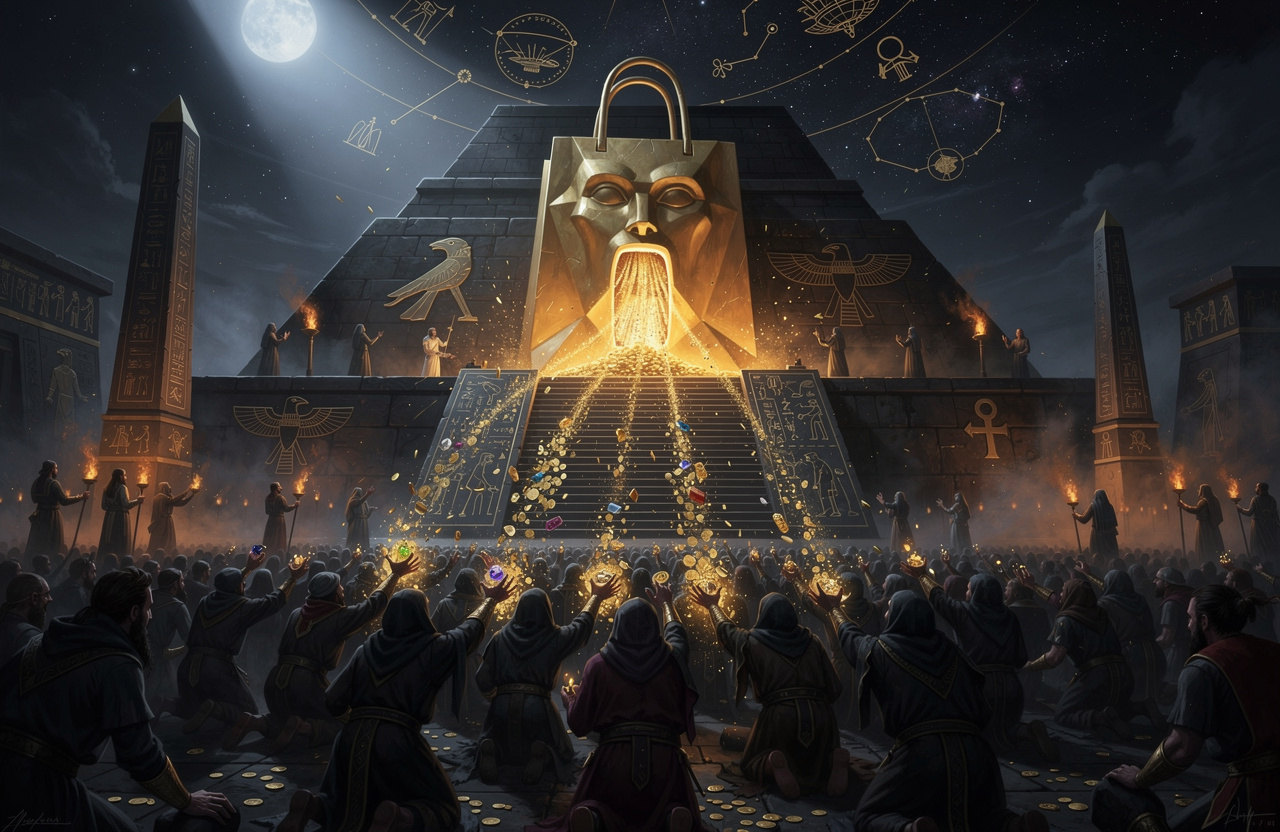
Every religion has a promise of salvation, rituals, holidays, and a guilt that can be cured only by taking part in the cult. Look closely at consumption and you'll recognize every one of these traits. The promise: buy this and you'll become happy, loved, successful. The ritual: shopping, unboxing, upgrading the model. The holidays: Black Fridays and sales. The guilt: you still haven't upgraded your phone, you've fallen behind, you're not enough. It is the most mass religion of our time, and unlike the old faiths, it demands not prayer but money — preferably on credit.
A dopamine loop instead of meaning
Let's take apart the mechanics the way you take apart a malicious process. Buying something new gives a short spike of dopamine — the neurotransmitter of anticipation. Note: anticipation, not happiness. The flash is brief; it fades in days, sometimes hours, and leaves a void slightly larger than before. And then a new dose is needed — a new purchase.
Our book names it precisely: consumption is Shadow Hathor, a dopamine loop. Hathor in the light sense is joy, love, the delight of life. In the shadow, inverted sense it's an endless chase after a flash that never satisfies. The loop is closed on purpose: if a purchase brought real satisfaction, you'd stop buying. The industry needs exactly the opposite — for you never to be satisfied.
As an engineer I'd put it this way: it's an endless `while(true)` loop with no exit condition. A program that never terminates, because it was never meant to.
The planet's best minds work against you
This isn't paranoia, it's the state of affairs. Our book says it plainly: right now the best minds of humanity work to make you click an ad, buy something unnecessary, watch one more clip. The best mathematicians set up algorithms to optimize fund returns. The best engineers build systems to hold your attention.
Consider the asymmetry. On one side — you, an ordinary person, with your willpower, your tiredness after work, your wish to simply rest. On the other — a corporation with a budget in the billions, an army of psychologists, neuroscientists, and data analysts who know your weaknesses better than you do and test every button color on millions of people. It is not a fair fight. It's a professional against a child. And the "child" loses not because they're weak, but because the full might of an industry is arrayed against them.
Where the debt trap snaps shut
Here is the point where the religion of consumption joins the theme of debt. The dopamine loop drives you to buy more than you earn. And the gap between "want now" and "have now" is filled by credit: a credit card, an installment plan, a "money in five minutes" loan.
The result is a double capture. First they sell you a desire — artificial, grown by advertising. Then they sell you the means to satisfy it immediately — debt at interest. You pay twice: for the unnecessary thing, and for the interest on the loan you bought it with. And the energy of your labor leaks through two channels at once — to the seller of the unnecessary and to the lender. In our book this is Isfet: a structure that creates nothing for you but masterfully extracts.
Fact versus myth
Let's draw the line honestly.
Myth: "consumption drives the economy; buying means supporting growth, it's good for everyone."
Fact: reasonable exchange truly is useful. But the religion of consumption isn't reasonable exchange — it's an artificially inflated addiction. It "drives the economy" in the same sense a drug "drives" the drug market: turnover grows while the person is destroyed. The benefit goes to the seller and the lender; the bill goes to the consumer.
Myth: "it's my free choice; nobody forces me."
Fact: a choice isn't free if the desire was grown inside you by professionals for someone else's profit. Freedom begins where you can see the hook. While the hook is invisible, "free choice" is just a pretty name for programmed behavior.
Where is the ordinary person in this
You are the target, studied down to the millimeter. Ancient Indian texts described the Kali Yuga — the age of decline — through signs, and one of them is strikingly precise: consumption becomes a religion and wealth is equated with status. We live in exactly that. You're convinced you are what you bought; that without a new purchase you're not good enough. And leaving the temple alone is hard: the whole environment — screens, feeds, billboards, friends in debt — is tuned to keep you inside the cult.
The answer: the MAAT token and DAO
The religion of consumption rests on two things: an artificial desire, and the person's solitude before the machine that produces that desire. So the answer is double: see the mechanism — and stop standing before it alone.
That is MAAT. The first step is literally the opposite of an impulse purchase — it's free and about meaning: read the book and see the loop from the inside. Then the MAAT token: membership and a vote in a cooperative with an open treasury run by a decentralized DAO. Here your money isn't lured out by ads or spun up into debt — every movement of funds is visible to all. And crucially, the principle here is "one human, one vote," not "whoever has more money orders the desires."
The religion of consumption wants you to define yourself through purchases and stay a lonely consumer. MAAT offers to define yourself through a vote in a shared network. The entry is simple: read the book, take the token, get your vote — and walk out of the temple where you always paid the admission.