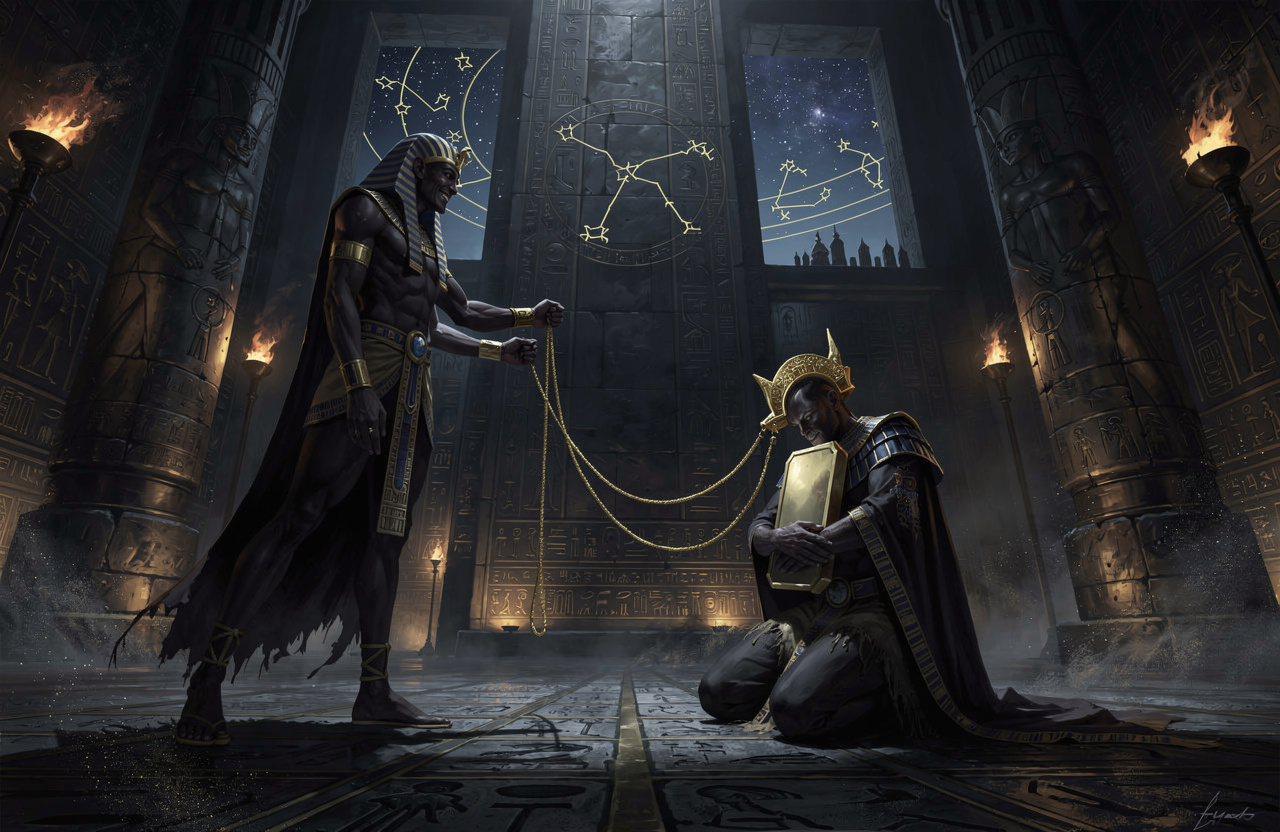
The most ingenious yoke is the one you put on voluntarily — and then thank them for the gift. Nobody forces a credit card on you. It's advertised as convenience, freedom, care: "a whole fifty days interest-free," "cashback on every purchase," "money at hand when you need it." You agree, because it sounds like a benefit. And a year later you discover you're wearing a thin, invisible, but very strong noose around your neck. Let's read this product like code — line by line, without the advertising music.
A grace period designed to make you slip
On the storefront: "fifty days interest-free." Sounds generous. Read the fine print and the generosity vanishes: if you go past the grace period by even one day, interest is charged not on the overdue amount but on the entire term you used the money. Retroactively, on the full sum.
The effective rate on such a card runs around thirty to forty percent a year, sometimes higher. That's not emergency insurance, that's a moneylender's rate. And the whole mechanics of the grace period are engineered not so you pay less, but so that sooner or later you slip by one day — and enter the mode where the bank truly earns.
In IT we call this a dark pattern: an interface deliberately designed to nudge the user toward the action that profits the developer, disguised as convenience. A credit card is a textbook dark pattern, except here the cost isn't an extra click but a chunk of your paycheck.
Cashback: a hook, not a gift
Here's the most beautiful trick, and as an engineer I tip my hat to its authors. Cashback is presented as "the bank sharing its profit with you." In reality it's a behavioral hook to make you pay by card instead of cash.
Why does that matter to the bank? Because it's been confirmed many times over by research: paying by card, a person spends on average twelve to eighteen percent more than with cash. Cash hurts to hand over physically — the hand feels it. A card numbs the spending; the brain doesn't register the loss.
Let's count honestly. They give you one and a half percent cashback. You spend twelve percent more. The payment system's net gain is about ten percent on top of your spending. On every purchase. Every month. You celebrate the "gift" of one and a half percent and never notice you paid ten for the privilege of receiving it.
Where your interest actually goes
This model is no local invention. It's American, refined since the 1980s, and it spread worldwide through licensing the Visa and Mastercard payment systems, through consultants from McKinsey, BCG, Deloitte, through software from FIS, Fiserv, Oracle. Every cent of fee on your purchase went to Visa's and Mastercard's cut.
And who are the largest shareholders of Visa and Mastercard? The same names we meet in every chapter: BlackRock, Vanguard, State Street — the "Big Three" funds. Which means your card overpayment isn't "the profit of the convenient bank around the corner." It's a thread of energy that, through the supply chain, leaks upward to those who own nearly everything at once. The local bank earns its slice, but the idea and the technology belong to the financial parasite, and part of the profit flows there.
Fact versus myth
Let's draw the line honestly.
Myth: "if you pay on time and use the grace period, the card is free and even profitable — you live on the bank's money."
Fact: even the perfect payer feeds the system. You spend more because of the card's numbing effect, and the merchant fee (baked into prices for everyone) flows to the payment system on every purchase. There's no "free" here — there are those who pay openly through interest and those who pay invisibly through spending and fees. Free is only an illusion.
That is Isfet in miniature: a structure that presents itself as a service and a kindness while being built to extract more from you than it gives. Polite, convenient, with a pleasant app — and all the more dangerous for it. A parasite that mimics a friend well.
Where is the ordinary person in this
You are the final node, drained a little at a time but constantly. The credit-card debt loop runs on psychology: the limit feels like "your money," the minimum payment feels like "everything's under control," when in fact minimum payments feed the interest for years while barely touching the principal. Getting out alone is hard: the whole system — from app design to marketing — is engineered to keep you.
The answer: the MAAT token and DAO
A credit card works because you face an enormous machine that knows more about your psychology than you do, one on one. So the answer isn't to "find a card with better cashback," but to stop being a lonely node and gather into a system where finances are transparent and the rules are written by members, not by the parasite's marketers.
That is MAAT. The MAAT token is membership and a vote in a cooperative with a shared, open treasury run by a decentralized DAO: no fine print, every movement of funds visible to all, nobody profiting from your slip on the sly. And crucially, the principle here is "one human, one vote," not "whoever has more money writes the terms."
A credit card is a yoke put on with a smile and a request to rate the app five stars. We offer to take it off — not for a new yoke, but for a tool that works for you. The entry is simple: read the book, take the token, get your vote — and stop thanking anyone for the noose.