You can now explain, in devastating detail, exactly how the system is rigged. BlackRock, Vanguard, and State Street sit on top of the ownership of nearly every major public company. The debt machine. The attention economy. You've read it all. You could give the lecture.
And you've built nothing.
That's not an insult — it's the trap. The most dangerous place the system can put you is not ignorance. It's informed paralysis. A person who knows exactly how the cage is welded and does nothing is more useful to the cage than a person who never looked. Because that person has already spent their outrage. They've discharged the energy that would have gone into building, and they got a dopamine hit for it — the little rush of being right, of seeing clearly, of being one of the ones who understands.
Understanding is not a virtue. It's a starting line that most people mistake for a finish.
The critique loop is a comfortable prison
Look honestly at what critique gives you. It gives you status — you're the one who sees through it. It gives you an identity — the awake one, the skeptic. And it gives you an alibi — the system is so big, so entrenched, that of course nothing you do could matter, so why start?
That last one is the load-bearing lie. It sounds like humility. It's actually the most flattering story available: I'm too clear-eyed to bother. And it keeps you exactly where the system wants you — venting instead of shipping.
Our record: anger is raw Sekhem — pure energy, undifferentiated. Isfet doesn't need to destroy your Sekhem; it just needs to keep it circulating uselessly. Rage that loops back into more rage is a closed system, a snake eating its tail — Apop wearing the mask of righteousness. The instant that same energy is bound to a concrete task, it changes state. It becomes Hekau — the creating word — a force that leaves a mark on the world. Same fuel. The only variable is whether it's pointed at a target or spinning in place.
The move: shrink the problem until it fits in your hands
Here's why you're stuck: you're comparing your effort to the size of the enemy. BlackRock manages trillions. You have a weekend. Of course you feel powerless — you framed it as a fair fight and it isn't one.
So stop framing it that way. You don't defeat a global financial-technological complex in one move. Nobody does. You build one small thing that shouldn't exist yet and now does. That's the entire mechanism. Every alternative that ever mattered started as somebody's embarrassingly small first project.
The trick is to make the first project so small it's almost too small to be worth doing — and then do it anyway, because the point of the first project is not the project. The point is to cross the line from person who talks to person who builds. That line is crossed exactly once, and everything after it is easier.
What a first project actually looks like
Not a movement. Not a startup. Not a manifesto. Something you can finish. A few honest shapes:
- Organize one thing. The offline circle from your own neighborhood. A tool library on your street. A repair afternoon. Coordinating five humans toward a shared goal teaches you more about building alternatives than a hundred articles.
- Make one thing. A newsletter that explains one rigged mechanism in plain language. A spreadsheet that tracks something no one else is tracking. A small open-source tool. If you can write three lines of code you can ship something; if you can't, you can still write, film, or draw.
- Move one resource. Move some money out of the extractive default and into a credit union, a cooperative, a local business, a DAO treasury you helped seed. Every dollar you route around the machine is a real vote with real weight.
- Contribute to something already moving. You don't have to found it. Find a project aligned with what you believe — an open-source repo, a co-op, a mutual-aid group — and become its most reliable pair of hands. Contribution counts. A pull request is a brick. A pull request is Hekau in the world's ledger.
Notice the pattern. Every one of these is small, finishable, and real. None of them require you to win. They only require you to start.
The thing that changes when you build
Something shifts the first time you ship. The knot of helpless anger loosens, because anger was only ever unspent energy looking for an exit. Give it an exit and it stops being a weight and starts being a tool.
And you learn the thing no critique can teach: that building is possible. That the alternatives are not utopian fantasies but concrete, difficult, buildable things — that the reason there aren't more of them is not that they can't exist, but that most people who understand the problem stopped at understanding. You didn't. That's the whole difference, and it's the only difference that has ever moved anything.
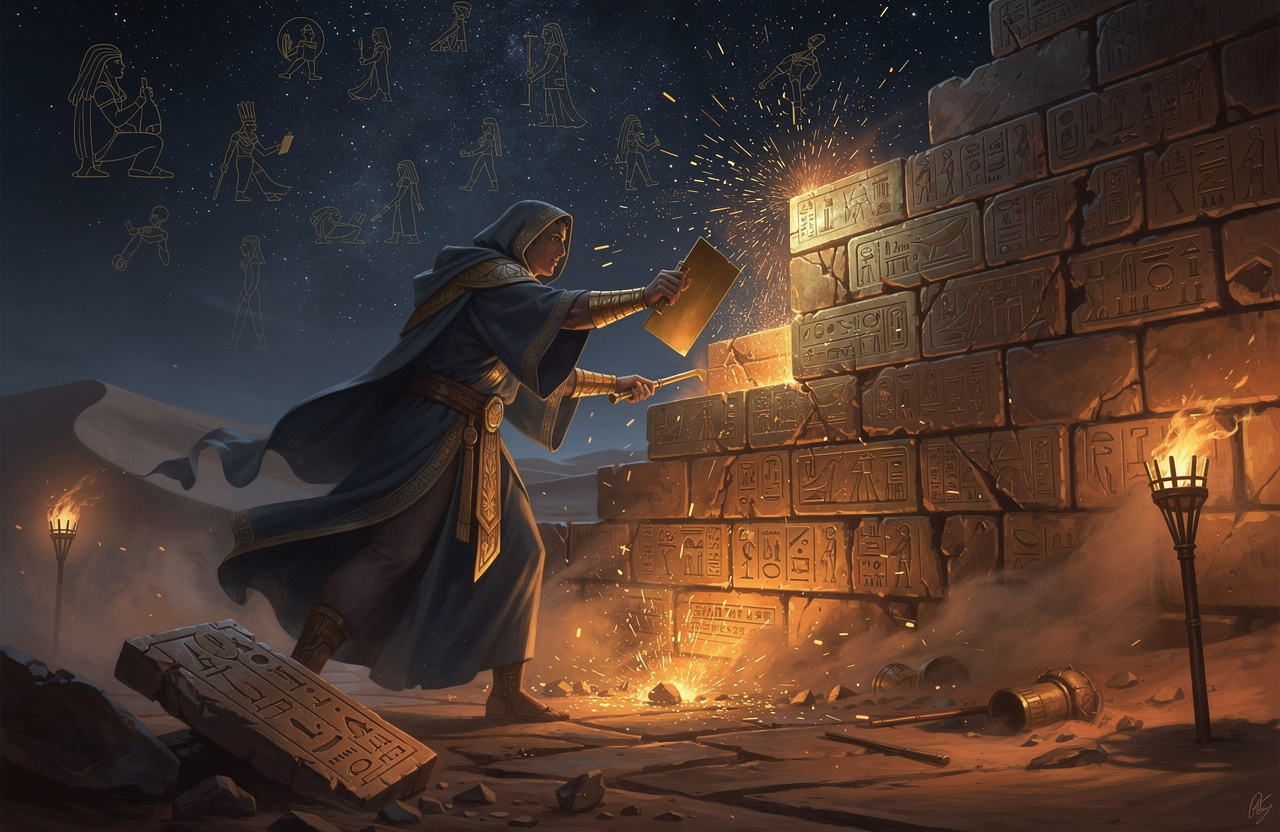
The pyramid did not begin as a pyramid. It began as one leveled square of ground, one Ben-Ben — the primordial mound, the first stone above the water. Everything monumental starts as one placed stone by someone who decided the analysis was over and the building had begun. You have done enough analysis. You have earned the right to lay the first stone. Now lay it.
Today
Take the thing you're angriest about — the specific rigged mechanism that lives in your head rent-free. Now define one small, finishable project that pushes back on it. Write it as a single sentence with a deadline: "By [date] I will [concrete thing]." Make it small enough to actually finish. A newsletter issue. A five-person meetup. Two hundred dollars moved. One pull request.
Write that sentence down where you'll see it. Then take the first ten-minute step today — send the message, open the doc, make the transfer. Stop being right. Start being useful. The Scales don't weigh your opinions. They weigh what you built.