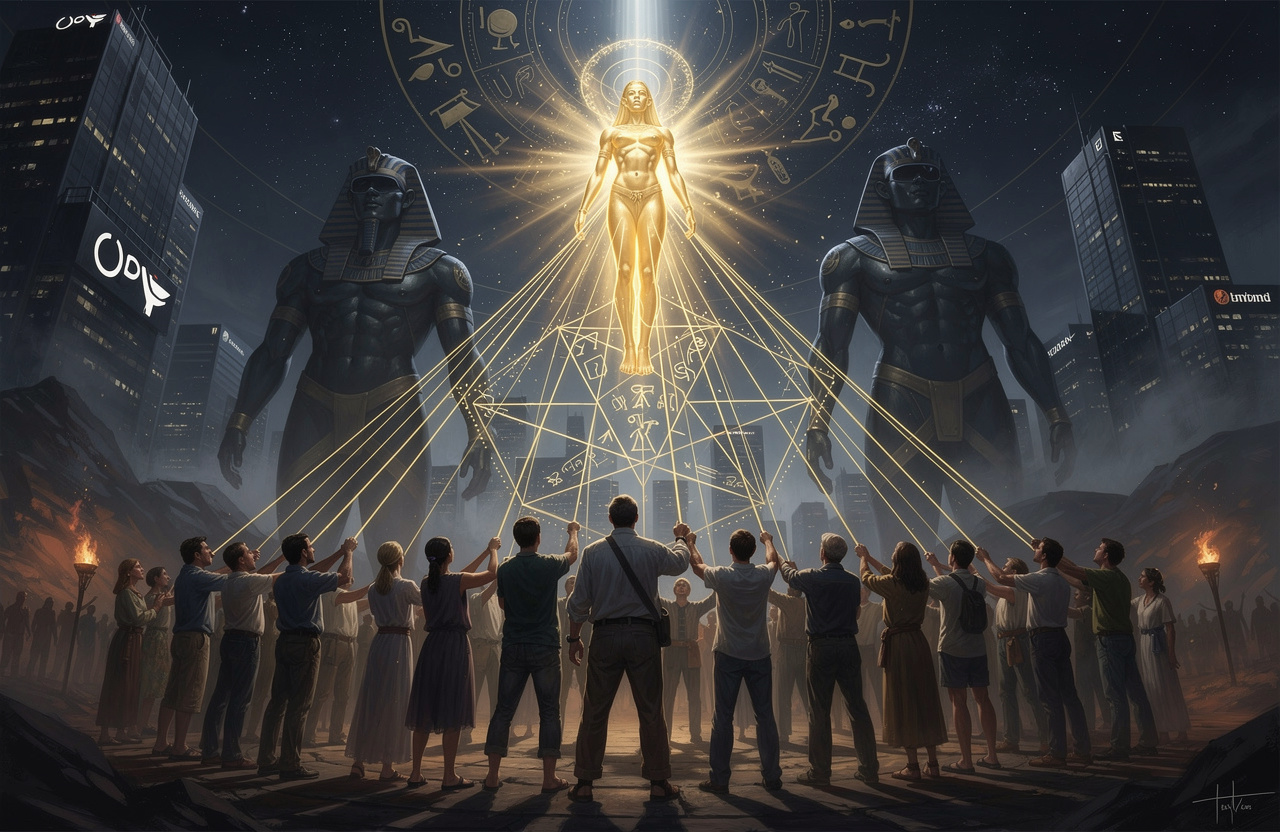
Ask the sharp question the AI boom is built to keep you from asking: who owns the model? Not who uses it. Who owns it. Right now the answer is a shareholder register in a handful of companies. OpenAI's economics run through Microsoft. The compute runs on NVIDIA. The models that will increasingly mediate how billions of people think, work, and decide are private property, governed by boards accountable to capital and to no one else. The most consequential technology of the century is being enclosed the way common land was enclosed three hundred years ago.
There is another way to own a thing that many depend on. Not the corporation, where a few hold the shares and the rest are customers. The cooperative — where the people who use and build the thing also govern and own it. Coops are old. What is new is that we finally have the machinery to run one at global, digital scale without a head office: the DAO.
What a DAO actually is
Cut the hype. A DAO — decentralized autonomous organization — is a cooperative whose rules live in code and whose treasury lives on a blockchain. Members hold governance tokens. Proposals are made openly. Members vote. The outcome executes through smart contracts that no single person can override. No boardroom. No CEO with a golden vote. No silent amendment to the terms at midnight. The bylaws are public, the treasury is auditable by anyone, and the rules run themselves.
Apply that to an AI model and the shape becomes clear. A DAO could own the weights of an open model. It could hold the treasury that pays for training compute. It could vote on what the model is allowed to do, what data it trains on, how it is aligned, and where any revenue flows. The community that depends on the model becomes the community that governs it. Owner and user collapse into the same word.
Why this beats the corporation
The corporation is not evil by nature. It is aligned by nature — to its shareholders, above all other claims. That is its whole design. When a corporate AI must choose between the interest of the billion people who use it and the interest of the shareholders who own it, the tie goes to the shareholders every time. Not from malice. From incorporation.
A model owned by its community has a different gravity. Its owners are the affected. The people voting on how the model behaves are the people who live with how it behaves. The incentive to surveil, to manipulate, to dark-pattern, to extract — that incentive weakens when the extracted and the extractor are the same body. You do not build a honeypot to trap yourself. This is not utopia. It is a change of alignment target, and alignment target is everything.
Our record
Weigh the corporation and the cooperative on the Scales. The corporation concentrates ownership in the few and directs the model's Sekhem — its power to act in the world — toward those few. Every gain the model produces flows up the register. That is the geometry of Isfet: value routed to a center, the many contributing and the few collecting. The cooperative distributes ownership across the many who use the model, and lets the model's power circulate back through the whole body that sustains it. On the Scales of Maat, the coop sits level because it gives back what it takes. The corporation sits heavy because it was built to take and keep. Distribution against concentration — the oldest fight, in the newest arena.
What a community-owned AI could look like
This is not pure theory. The scaffolding exists and pieces are running.
- The treasury. Members contribute funds. The DAO pools them to rent or buy training compute — the very GPU hours that are the real moat. Individually none of us can afford a training run. Ten thousand of us pooling a modest stake can.
- The weights as commons. The trained model's weights are held by the DAO and released openly to members — or to the whole world. No API landlord. The mind is a shared possession, not a rented service.
- Governance on-chain. Members vote on the roadmap: which model to train next, what it refuses, how it is aligned, whether to sell inference and how to spend the proceeds. The bylaws are code. The votes are public.
- Revenue that returns. If the model earns — from inference, from services — the revenue flows back to the members through the treasury, not up to a distant shareholder. The value the many create, the many keep.
The honest hard parts
I will not hand you a frictionless dream. DAOs have failed loudly, and the failures teach the design.
- Governance is hard. Voter apathy is real; most token holders never vote, and power quietly concentrates in the few who do. A DAO can re-grow a boardroom if you are not careful. Design for participation or watch plutocracy return through the back door.
- Whales. One-token-one-vote means whoever buys the most tokens rules. Without quadratic voting or reputation weighting or a cap, a DAO is just a corporation with extra steps. This is a solved-ish problem, but only if you actually solve it.
- Compute is still expensive. Pooling helps, but a frontier training run costs more than most communities can raise. The realistic near-term play is fine-tuning open models and governing those — not racing the frontier labs from a standing start.
- Legal ambiguity. DAOs live in a gray zone in most jurisdictions. This is improving — Wyoming recognized DAO LLCs — but it is not settled. Build with eyes open.
None of these are reasons to stay renters. They are the engineering spec for building it right.
The move
You do not have to found a DAO tomorrow. But you can start orienting toward ownership instead of tenancy.
- Own a piece of open infrastructure, not just an API subscription. Look for cooperatively-governed AI projects and join early, while a vote still means something.
- Learn how governance tokens work before the next wave, so you are a participant and not an exit-liquidity mark.
- Pool where you cannot afford alone. The whole point of the coop is that the many can buy what none of us can. Compute, weights, governance — pooled.
- Demand it of the projects you already use. Ask who owns the model. Keep asking until the answer changes.
The corporation asks you to be a customer of the mind. The cooperative invites you to be an owner of it. One of those relationships ends with you holding a receipt. The other ends with you holding a vote. Hold the vote.