There is a company you have never heard of that knows your income, your ailments, your address history, your religion, whether you're pregnant, whether you're grieving, and whether you're likely to buy a gun. You never signed up. You never got a bill. You are not the customer. You are the inventory.
This is the data broker industry, and it is one of the largest markets you don't know exists. Estimates put it at hundreds of firms — the California registry alone lists well over 500, and industry-wide the count runs past 700 — trading in dossiers built on nearly every adult in the developed world. The market is measured in the hundreds of billions of dollars. Its product is you, rendered as a file, sold by the row.
You are not on this market by accident. You are its entire reason to exist.
What They Actually Hold
Strip the euphemisms — "audience insights," "identity resolution," "marketing intelligence" — and the business is plain: buy, scrape, and merge every trace you leave, then resell the merged profile.
The raw material comes from everywhere. The apps that sold your location. The loyalty card that logged your groceries. The public records — property, voter rolls, court filings, licenses. The warranty card you filled out. The quiz you took. The website that fired off your browsing to an ad exchange in the 300 milliseconds before the page loaded. Each stream is trivial alone. The broker's craft is fusion: matching a thousand thin traces to a single identity, resolving "this cookie is this phone is this email is this human," until a person emerges from the noise.
The big names have been at this for decades. Acxiom — now part of a larger group — long boasted thousands of data points on hundreds of millions of people, describing them across thousands of behavioral and demographic categories. LiveRamp built its business on stitching identities across the web. Oracle ran a massive data marketplace before winding parts of it down under regulatory pressure. And beneath the giants sit hundreds of smaller shops, each with a niche: health inferences, financial distress, "life-event" triggers — the moment you move, marry, divorce, or bury someone, sold as a signal because that's when you're most malleable.
The 2010s U.S. Senate and FTC inquiries into the industry surfaced the detail that still lands hardest: brokers were caught selling lists sorted into segments with names like the financially desperate and the ailing elderly. Not marketing. A menu of human vulnerability, priced per thousand.
The Ka Sold By the Row
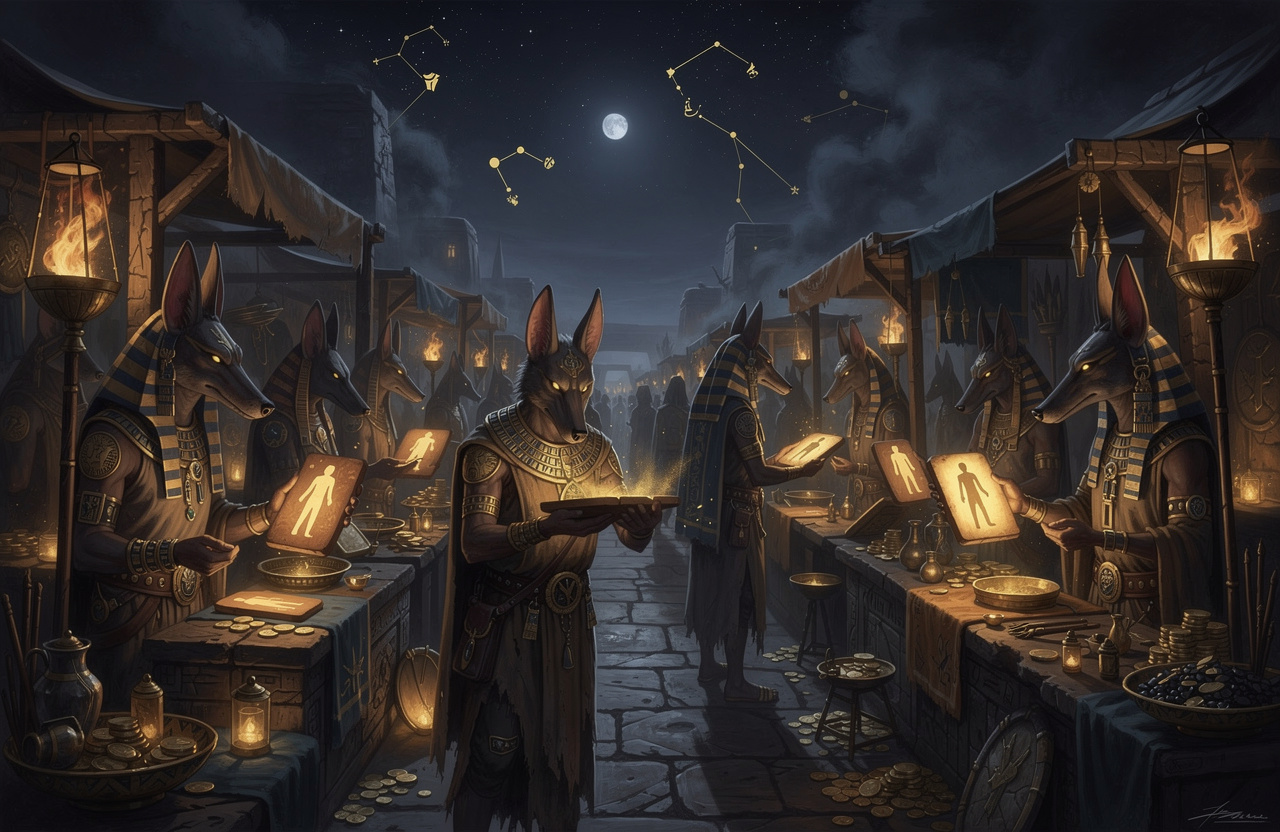
The Egyptians held that a name and a likeness carried real power — that to hold an accurate image of a person was to hold a thread to the person themselves. The broker's dossier is exactly that: a captured likeness, a Ka rendered in columns. Not your soul, but a working model of it — accurate enough to predict you, complete enough to move you, and sold without your knowledge to anyone with a purchase order.
And here is the poison. This dossier is now the feedstock. The models that score your credit, price your insurance, flag you at a border, target you with a scam, or decide whether you see a job ad — they are trained and fed on exactly this brokered data. The 700 firms are not a sideshow. They are the supply chain for the machinery of algorithmic control. Every model that "knows" you learned you from a file you never saw, assembled by a company you can't name, built from traces you didn't know you were leaving.
Our Record
Our record: in the old craft, to hold a true likeness of a being was to hold a lever on its Sekhem — its vital force — and that power was hedged with taboo precisely because it was real. The broker industry industrialized the taboo. It captures the likeness of hundreds of millions at once, renders each into a file, and puts the Sekhem of a whole civilization on an open market — traded, leased, and fed to models with no rite, no consent, no weighing. In the ledger of Ma'at, what is taken must be balanced and what is done must be seen. The brokered dossier is the perfect inversion: taken without balance, done without sight, a whole life extracted and sold while the living owner never learns the transaction happened. That silent extraction — value stripped from a soul that never consented and never sees the receipt — is Isfet running as a business model.
Why "It's Anonymized" Is a Lie
The industry's shield is a single word: anonymized. No names, they say. Just segments, cohorts, aggregates. Nothing personal.
It is not true, and researchers have proven it isn't for years. So-called anonymous location data is trivially re-identified — a handful of points of where a device sleeps at night and works by day fingerprints a single household. Studies have shown that a few coordinates, or a few purchases, or a birthdate plus a ZIP plus a gender, are enough to pick one person out of millions. "Anonymized" data is not anonymous. It is de-identified for exactly as long as no one bothers to re-identify it — and re-identification is a cheap join away. The word is a legal fig leaf over a naked profile.
And even where the name is genuinely stripped, it doesn't save you. The model doesn't need your name to act on you. It needs your pattern — and the pattern is you, name or not.
The Lever
Don't despair at the file. Understand its weakness — a market built on your data is a market you can tax, starve, and opt out of, one leak at a time.
Your levers are concrete. Where the law gives you a right to delete — California's CCPA, Europe's GDPR, and the new state registries that let you demand brokers erase you — use it, and use the bulk opt-out services that fire the request at hundreds of firms at once. Cut the intake upstream: the location apps, the loyalty cards, the free quizzes and the warranty cards are the brokers' feed pipes — decline them and the file goes stale. Poison the well with browser tracker-blocking so the real-time bidding stream carries less of you. And push, loudly, for the thing that actually breaks the model: laws that require consent before collection, not deletion after the fact — because a right to erase a dossier already sold is a bucket against a flood.
The deepest lever is the one the whole industry fears: data you hold and grant, not data they take and trade. Decentralized identity, user-owned profiles, systems where you keep the keys and the broker needs your permission to see anything at all. That's not a tweak to the market. That's the end of it.
You are not inventory. Delete the file. Starve the feed. Own your name.