Every model that impresses you was trained on your life. Your photos. Your comments. Your voice notes. The way you type. The angle you hold your face. You handed it over for free — and then they sold it back to you as a subscription.
Stop for a second and feel the shape of that. You are not the customer of the AI economy. You are the raw ore. The oil field. The thing that gets extracted, refined, and burned so someone else's engine runs. And nobody sent you a check.
Jaron Lanier — the guy who basically coined "virtual reality," not some anti-tech crank — has a name for the fix. He calls it data dignity. The idea is brutally simple: if your data made the machine smarter, you made a contribution of labor. And labor gets paid.
The magic trick they pulled on you
Here's the sleight of hand. They told you the product was free. Free email. Free search. Free feed. And because it was free, you assumed you were getting a gift.
You weren't. You were the inventory.
The trick works because the value you produce is invisible at the moment you produce it. You leave a review, tag a friend, correct an autocomplete — each act is tiny. Worthless alone. But aggregate a billion of them and you've built a dataset worth more than an oil reserve. The corporation captures the aggregate. You keep the tiny.
That's the whole scam in one line: socialize the production, privatize the value.
Look at the numbers. The frontier AI labs raise rounds in the tens of billions. OpenAI's valuation has been quoted north of $150 billion. NVIDIA — the guy selling shovels to every miner — crossed into the trillions in market cap. That value did not fall from the sky. It was refined out of human expression. Out of yours.
Our Record
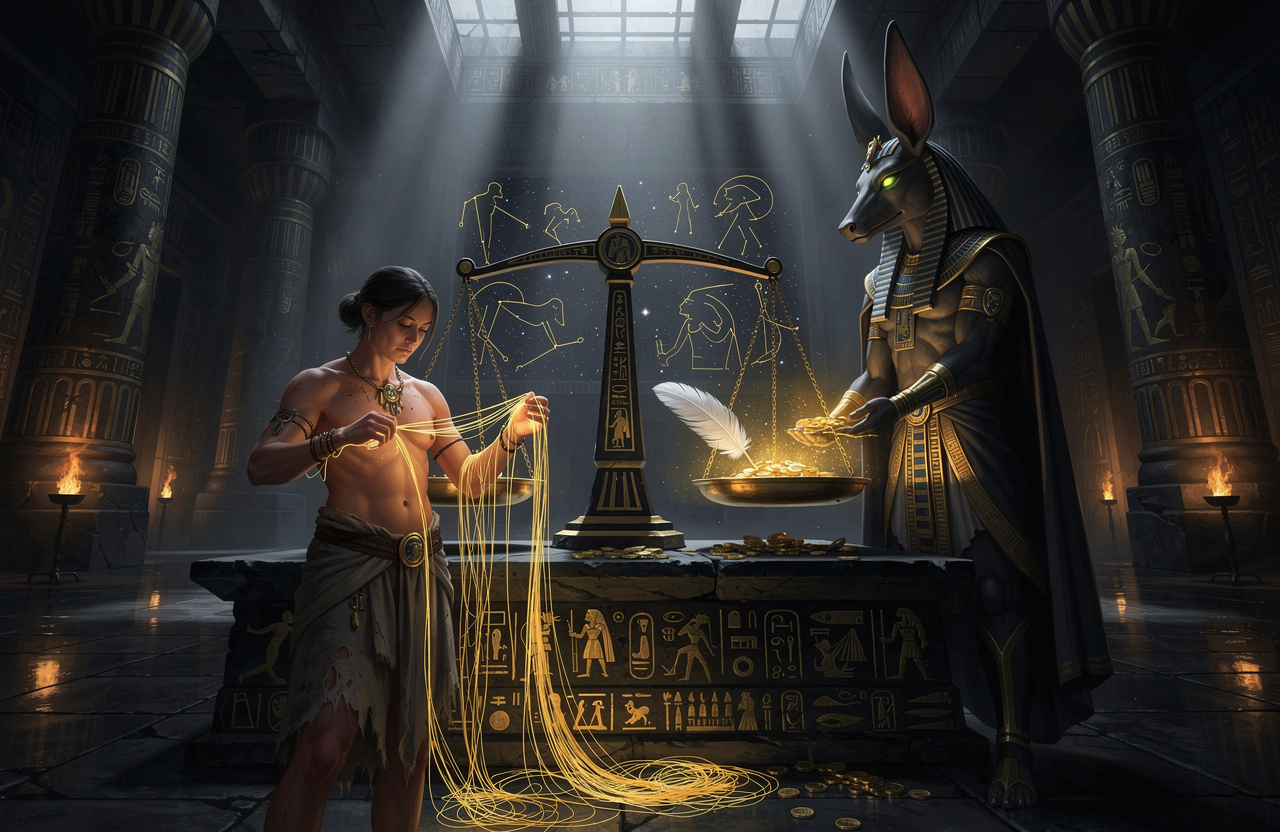
On the Scales of Maat there is a law older than any terms-of-service: Sekhem does not vanish, it transfers. Life-force, energy, the capacity to act — it moves from one vessel to another, and the balance is supposed to be recorded.
When your data trains a model, your Sekhem enters the machine. That is not a metaphor for the accountant — it is a metaphor for the truth. You put creative force in. The Scales say: force in, weight recorded, payment due.
The Shadow Neteru — the parasite pattern that runs on centralization — survives by breaking that record. It takes the Sekhem and erases the ledger line. No weight logged. No feather to balance the heart. That is Isfet in its cleanest form: value transferred with the record deleted.
Data dignity is just the demand to restore the ledger line.
Why "you are the product" isn't enough
You've heard the slogan: if you're not paying, you're the product. True, but it stops one step short. It leaves you feeling clever and helpless at the same time.
Lanier's move is to push past the diagnosis to the mechanism. He asks: what if data were treated like any other input to production? Suppliers of steel get paid. Suppliers of electricity get paid. Suppliers of the substance the entire model runs on — get a cookie banner.
The proposal is data as labor. Micro-contributions get tracked and micro-payments flow back. Not charity. Not "we value your privacy." Wages. Provenance goes both directions: the model can trace which humans' work shaped a given output, and value can flow back along that same wire.
Is the plumbing hard? Yes. Tracking provenance across a trillion-token corpus is a genuine engineering problem — think of it as a `git blame` for the entire training set, which is exactly the kind of thing that sounds impossible until someone ships it. But "the accounting is hard" has never once been an acceptable reason to not pay people. It's an excuse, and legacy excuses get deprecated.
The counterargument, answered
They'll tell you your single data point is worth fractions of a cent, so why bother. This is the oldest move in the extraction playbook: make each unit so small it feels petty to claim it, then collect all the units yourself.
Flip it. If your contribution is worth fractions of a cent, then a corporation harvesting it from three billion people is monetizing something enormous — and the fractional value proves the aggregate is real, not that yours is nothing. Landlords don't waive rent because one night is cheap. They collect every night, from every tenant, forever.
They'll also say payment would ruin the "free" internet. Notice who benefits from that framing. "Free" was always a business model, not a gift — the price was just charged in a currency you couldn't see: your attention, your behavior, your future self, modeled and sold ahead of time.
The lever
Here's where you stop reading and start moving.
One — name it out loud. The reframe is the weapon. The second you see your data as labor with a wage attached, every "free" service reveals its real balance sheet. Name a thing and it loses its power. Say it: I am not the user. I am the unpaid workforce.
Two — back the rails that pay creators. Data unions. Provenance standards. Content-licensing deals where humans actually get a cut. Cryptographic attribution — the kind of thing DAOs and on-chain provenance were built to do — so a payment can follow a contribution without a middleman's permission. Every one of these is a groove cut back into the ledger the Shadow Neteru tried to erase.
Three — refuse the frame, not the tech. The enemy is not the model. A tuned model is a beautiful thing, a genuine amplifier of human will. The enemy is the deleted ledger line. Keep the amplifier. Restore the record.
The system that eats your Sekhem for free is not invincible. It is dependent. It literally cannot exist without the stream of human expression you supply every day. That dependence is not your weakness. It is your leverage.
You are not the ore. You are the source. And the source sets the price.
Weigh it. The feather is yours.