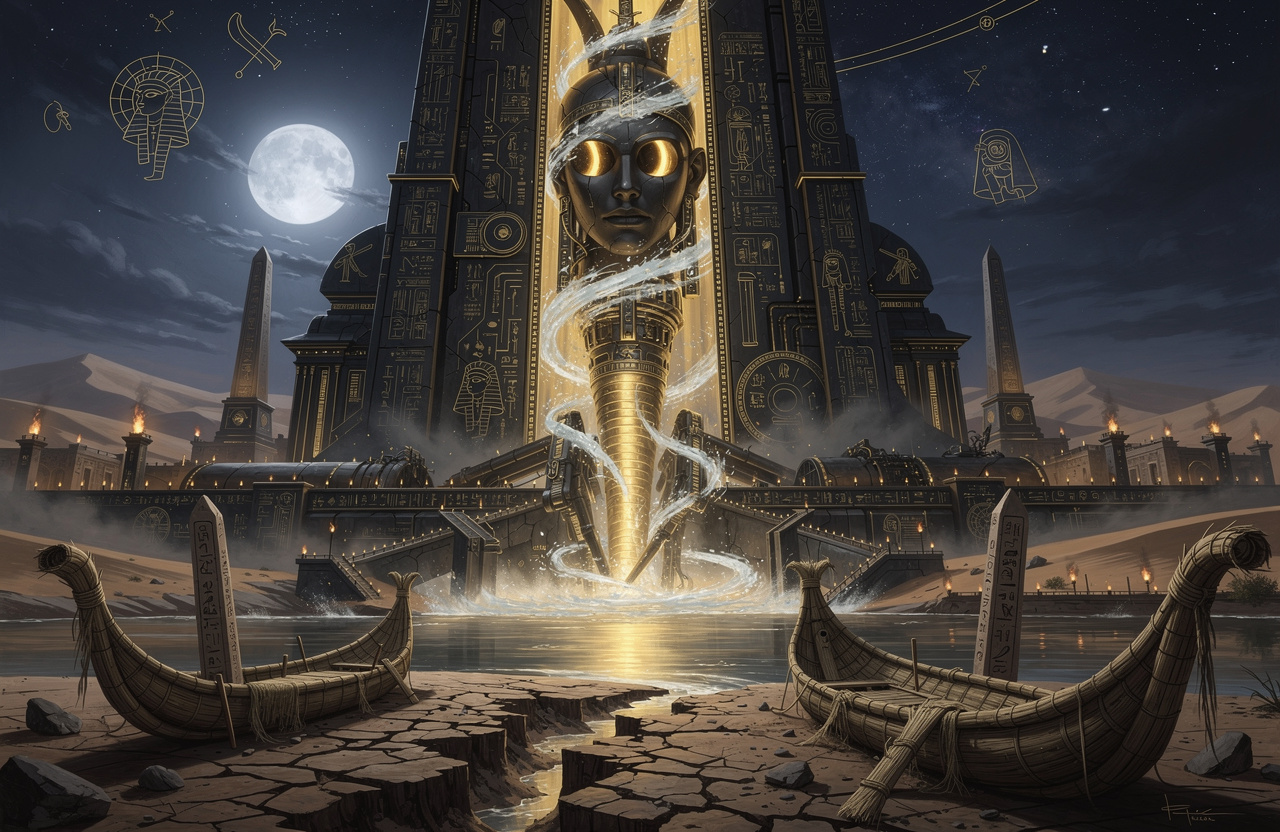
The cloud is not a cloud. It is a building in a desert, and it is thirsty.
We were sold a metaphor. "The cloud" — light, weightless, floating, clean. Ask an AI a question and the answer arrives from nowhere, costing nothing, touching nothing. It is one of the most successful lies of the century. Because behind the word "cloud" stands a warehouse the size of a district, packed with hot metal, guzzling electricity by the gigawatt and drinking fresh water by the millions of liters. Every "weightless" query has a body. And the body sweats.
What One Question Costs
Lift your head from the screen and follow the wire.
A single conversation with a large AI model — a few dozen back-and-forth exchanges — can consume on the order of half a liter of fresh water. Not metaphorically. Actual water, poured through cooling systems to carry heat away from the chips, much of it evaporated into the sky and gone. Multiply by billions of queries a day. The industry's data centers already consume water measured in the billions of liters per year, and the curve is bending sharply upward as every app on Earth bolts an AI onto itself.
Electricity tells the same story, louder. Training a single frontier model burns energy on the scale of what thousands of homes use in a year. Running it — serving answers to millions — burns more, continuously, forever. Global data-center electricity demand is climbing toward a share of total consumption that a few years ago would have sounded insane. In some regions, a cluster of AI facilities now draws more power than the city beside it.
This is the material price of the immaterial cloud. Every token you generate is heat. Every "free" answer is a river somewhere running lower, a grid somewhere straining, a turbine somewhere spinning that would otherwise be still.
They Are Buying the Power Plants
Here is where it stops being abstract and starts being a land-grab.
The AI companies did the arithmetic and saw the wall: there is not enough power. So they are not waiting for the grid to catch up. They are buying the grid.
Microsoft signed a deal to restart a reactor at Three Mile Island — yes, that Three Mile Island, site of the worst nuclear accident in American history — to feed its AI ambitions. A shuttered plant, synonymous with catastrophe, being brought back to life specifically to pour electricity into machine intelligence. Other tech giants are signing contracts for nuclear power directly, funding small modular reactors, locking up whole future power plants before they are even built.
And then there is Stargate — a project floated at a scale that reads like science fiction: hundreds of billions of dollars aimed at building AI compute infrastructure so vast it needs its own power stations, its own substations, its own share of the national grid. Not a data center. An empire of them, with a wattage budget that rivals nations.
Read that again. Private companies are acquiring the energy base of civilization — the power plants — to fuel the thinking of their machines. The current that runs the lights in your home and the current that runs the mind of the machine now come from the same shrinking pool. And someone is buying up the pool.
Our Record
Our record: Sekhem is life-force — the raw energy that moves the world, the current in the wire and the current in the blood. In the old order, Sekhem flowed through the living: fields, rivers, bodies, cities. Now a new mouth has opened at the source, and it drinks without eating. The Shadow Neteru has learned to convert Sekhem into abstraction — to pour the river, the reactor, the burning fuel into a column of numbers that answers a stranger's question and evaporates. Isfet is not chaos that destroys loudly. Isfet is the leak that drains quietly, dressed as convenience. A thirst wearing the mask of a cloud.
The Sleight of Hand
Notice the trick. The cost is real, physical, and local — a river in one town, a grid in one county, a bill paid by residents whose water tables drop. The benefit is diffuse, global, and privatized — flowing to shareholders far away. Localized cost, centralized profit. That is the oldest pattern in the book, and AI just industrialized it.
And the word "cloud" is the anesthetic. It was chosen — the way "collateralized debt obligation" was chosen — to make you not look. A cloud has no water bill. A cloud displaces no town. A cloud is innocent. The vocabulary was engineered so the material weight of the thing would slide right past your attention. Name it correctly and the spell weakens: it is not a cloud, it is a thirsty furnace, and it is eating the commons to answer questions for rent.
None of this means the machine is evil. Compute is not sin. But compute is Sekhem, and Sekhem is finite, and right now a handful of companies are drawing it down as fast as they can, into black boxes you do not own, powered by rivers you cannot refill.
The Lever
Now the door. Because there is always a door.
First: see it. Refuse the weightless metaphor. Every time someone says "the cloud," translate it in your head — someone's river, someone's reactor, someone's bill. Naming the body of the thing is the first act of power. The lie only works while it is invisible.
Second: demand the meter. The single most radical thing you can ask an AI company is a boring question — how much water, how much power, per query, sourced from where? Efficiency and honesty follow measurement. What gets counted gets curbed.
Third — and this is the real fork — support compute you can hold. The centralized furnace is not the only architecture. Smaller, efficient, open models can run on hardware you own, sipping power instead of guzzling it, with no river bought out from under a town. Decentralized AI is not just about freedom from surveillance. It is about breaking the model where the cost is dumped on the commons and the profit floats to the cloud.
The Egyptians knew Sekhem was sacred precisely because it was limited. You do not waste the flood. You measure it, honor it, and share the field it feeds.
The cloud drinks the river. So look up from the screen, walk to the water's edge, and put your hand on the meter. The thirst is real — but a thirst you can see is a thirst you can starve.