There is no cloud. There is only someone else's building, on someone else's land, drawing someone else's power, and you renting a slice of it by the millisecond.
"The cloud" was the most successful piece of marketing in the history of computing. It made you picture something weightless, everywhere and nowhere, floating. And that image did exactly one job: it stopped you from asking where the buildings are, who owns them, and who owns the dirt they sit on. Because the answer is concrete — literally. Windowless boxes the size of stadiums, humming on cheap power near fiber trunks, and increasingly owned not by tech companies but by landlords. The cloud has a landlord. Meet him.
The cloud has an address — and a deed
Every app you touch, every model you query, every file you "put in the cloud" lands physically in a data center. And a huge share of the world's data centers are owned or operated by a small set of specialist companies whose actual business is real estate.
Equinix. Digital Realty. These are not household names, and that's the point. Equinix runs a global network of interconnection facilities — the buildings where networks physically plug into each other, the crossroads of the internet. Digital Realty owns and leases data-center real estate at massive scale across continents. Both are structured, notably, as REITs — real estate investment trusts. Read that again. The core infrastructure of the digital age is legally organized as landlording. Not a tech play. A rent play. The internet runs on a business model older than agriculture: own the ground, charge for standing on it.
From pumping oil to renting compute
The 20th century ran on oil, and whoever owned the wells and the pipelines owned the century. Everyone knew their names. The 21st century runs on compute — and the equivalent of the oil field is the data center, and the equivalent of the pipeline is the fiber and the interconnection point. But this time, almost nobody knows the names.
And here's the move that closes the ring: the same concentrated capital pools we track everywhere else are pouring into this. Big asset managers and infrastructure funds hold major stakes in the listed data-center REITs. Private-equity and dedicated infrastructure vehicles — the kind of "digital infrastructure" funds raised by the giant alternatives managers — are buying data centers, fiber, and cell towers by the tens of billions. The AI boom has turned "compute real estate" into one of the hottest asset classes on Earth. The picks-and-shovels of the AI gold rush aren't the models. They're the land and the buildings and the power hookups — and the same hands are quietly buying all three.
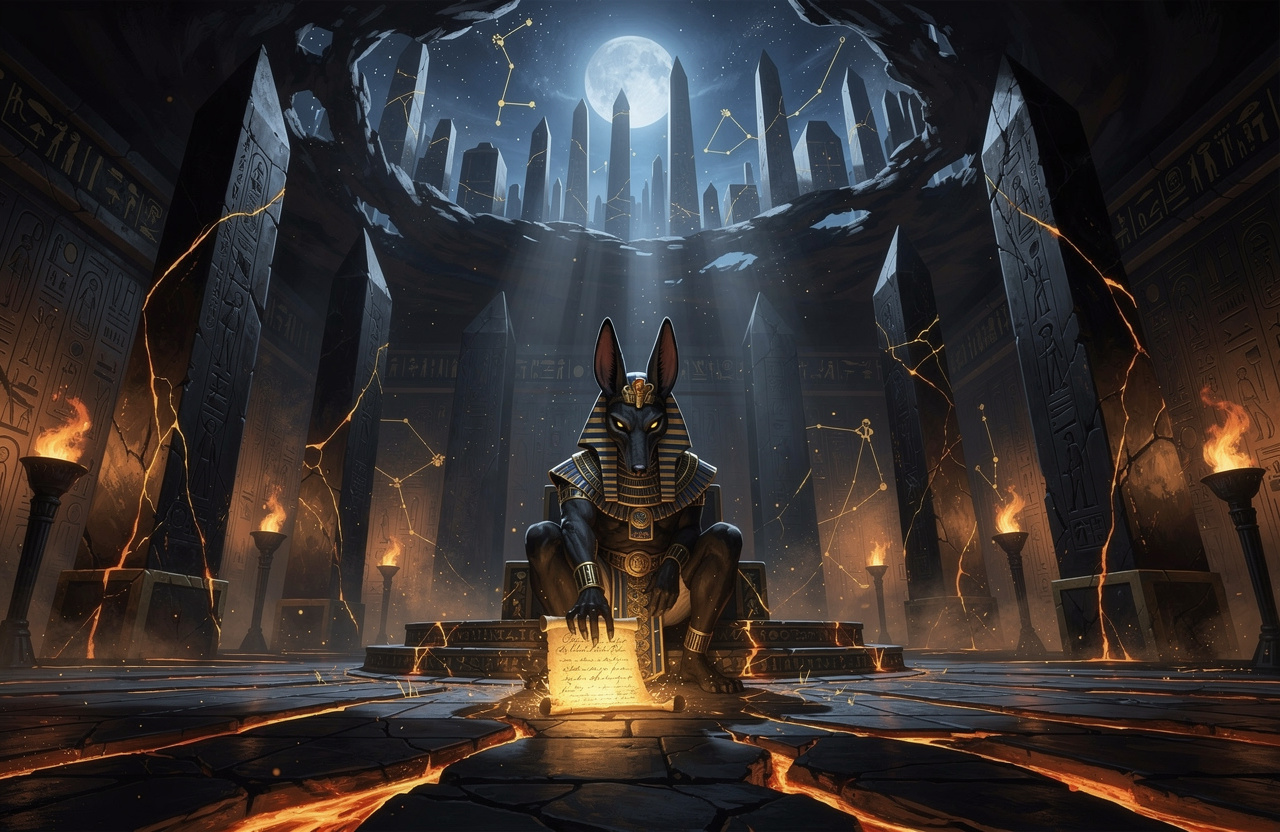
Our record. Watch the shape repeat, because it always repeats. Sekhem — life-force, capacity, the power to act — now flows as electricity and computation. And Isfet's eternal instinct is to find where the Sekhem flows and build a gate across it. Not to generate the power. To own the channel it must pass through. The data center is the new riverbank, and whoever owns the bank taxes the river. The Shadow Neteru doesn't need to make the water or the current; it only needs to own the narrow place everything is forced through. Every era, new Sekhem. Every era, the same gatekeeper, reaching for the chokepoint.
The stack you can't see
Layer it out, because the layering is how the capture hides.
At the top: the apps and AI you actually use — visible, glossy, competing loudly for your attention. Below that: the cloud providers, the big three hyperscalers, powerful but at least named. And below them, load-bearing and nearly invisible: the physical layer — the REITs, the infrastructure funds, the owners of the buildings and the land and the grid connections that everything above literally cannot exist without.
That bottom layer is the quiet one, and it's the one that matters most, for a brutal reason: you can switch clouds, but you cannot switch physics. A hyperscaler can lose your business tomorrow. The company that owns the building it rents, the interconnection point every network must reach, the substation feeding the racks — that owner has no competition you can flee to, because there's only one crossroads, only one plot near the fiber, only one grid tie. It's a single point of failure wearing the costume of "boring real estate." The most defensible monopoly is always the one at the bottom of the stack, where the moat is made of concrete and copper.
The lever
Never doom without a door. And this door is being welded open right now, by hand, by builders.
The whole game is centralized physical chokepoints. A few giant buildings, a few interconnection hubs, a few owners — that concentration is the vulnerability and the target. The counter-move is to spread the physical layer back out until no single landlord can gate it.
That's not a fantasy — it's a live movement. Decentralized physical infrastructure networks (DePIN) are being built to do exactly this: distributed compute, distributed storage, distributed connectivity, contributed by many independent operators and coordinated by open protocols instead of a REIT's rent roll. Community-run nodes. Cooperatively owned racks. Open compute markets where you don't rent from the landlord because there's no the — there are thousands, and the coordination layer is public code, not a lease. Ownership of the substrate spread wide instead of stacked into a handful of windowless boxes.
So do the concrete thing. Stop saying "the cloud" and start asking whose building, whose land, whose power. When you read that a fund raised tens of billions for "digital infrastructure," understand you just watched the oil barons of this century buy their wells. Support decentralized infrastructure — run a node, back a DePIN project, choose providers that distribute rather than concentrate. Put a piece of your own footprint on rails you help hold up.
The cloud was a spell that made you stop looking down. So look down. There's a building. There's land. There's a landlord.
Now you know where to point the lever.