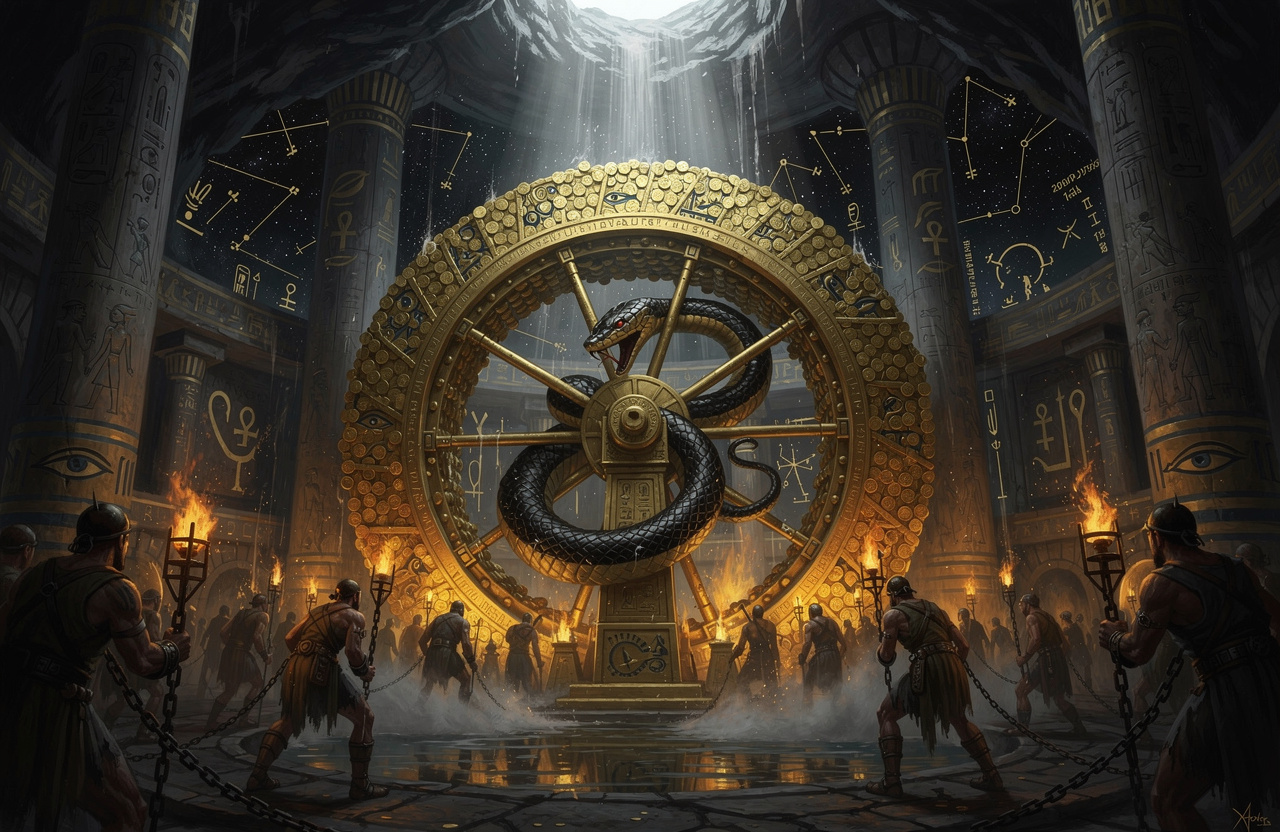
Every government in the world promises that one day it will "pay off its debts." Every year those debts only grow. World debt long ago crossed mind-numbing sums — we're talking hundreds of trillions of dollars in total. And here is the question that makes your skin crawl: what if this debt simply cannot be repaid? Not because politicians are lazy or nations wasteful, but because that's how the very math of money is built. Debt is not a pit you can fill in. It is a perpetual motion machine, and it spins by design.
Where money comes from in the first place
Most people think the state prints money and then hands it out. The reality is different, and it's the key to the whole subject. The overwhelming majority of money in a modern economy is created not by a printing press but by bank credit. A bank issues a loan — and at that instant the money appears as an entry in an account. It wasn't there, and now it is. Debt created it.
It sounds insane, but it's banking 101. Money enters the world as someone's debt. No debt, no money. An engineer would say: money and debt are two sides of one transaction, created and destroyed as a pair.
And now the trap.
The interest nobody printed
When a bank lends you 100, it creates exactly 100. But you must return 100 plus interest — say, 110. Trick question: where do those extra 10 come from?
They were never created. Into the system came 100 — exactly what was lent. And 110 is demanded back. Those ten simply do not exist in nature at the moment the loan is made. So for you to pay your interest, someone else must take a new loan and inject fresh money into the system — out of which you scrape together your 10. But their loan also carries interest. And now they are the one short on their own interest. And so on.
The result is that the system structurally owes more money than exists within it. Always. The gap cannot be closed — it can only be rolled forward by borrowing even more. To pay old interest, you need new loans. To pay interest on the new ones, even newer ones. Debt must grow, or the system collapses from a shortage of money to service itself.
This is the perpetual motion machine. Not a metaphor for flourish — a literal description of the mechanics. The book calls exactly this kind of mechanism a perpetual motion machine, the perpetual engine of Isfet: a construction that by its very design must spin without stopping and devour fuel. Only here the fuel is your labor.
Why this suits those at the top
If debt can never be repaid in principle, then the debtor is never freed. And an eternal debtor is an eternal payer of interest. Every year, whatever happens, he hands over part of his labor to those who hold the debt. Not once — constantly, like a subscription fee for the mere fact that money exists.
That's why the system isn't "fixed." It's not a broken mechanism someone forgot to repair. It works perfectly — just not for you. The impossibility of paying off is not a bug; it's the core function. If debt were repayable, the flow of interest would one day end. And it must never end.
Let's honestly separate fact from myth. The myth: "there's a secret room where villains decided never to let nations out of debt." The fact is duller and sturdier: no room is needed. It's enough that money is born as debt at interest. From there the math spins the engine on its own, with no one's malice required. The principle is stronger than any conspirator.
A state's debt is your debt
When people say "national debt," it sounds abstract, as if some "budget" owes it. But that debt is paid out of taxes — that is, out of your labor. Interest on the national debt rises, so taxes rise or spending on hospitals, schools, and pensions is cut. Money that could have gone to living goes to servicing a debt that cannot be paid off.
You were born already inside this engine. From birth you carry a share of a common debt you never took on. And all your life, without knowing it, you feed the furnace — through interest on your mortgage, your card, your taxes, the prices that have the cost of other people's loans baked in. The engine spins. The fuel is you.
The answer: the MAAT token and DAO
The perpetual engine of debt runs on one assumption: that money must be born as someone's interest-bearing debt, and so an intermediary always sits atop every transaction, owed his cut. Remove that assumption, and the engine can be stopped.
MAAT is built not on debt but on membership. The MAAT token is not a loan to be returned with interest, but a share in a cooperative and a vote. Here you don't have to borrow from an intermediary to gain access to the common pool: the treasury is transparent, visible in the DAO — a decentralized organization where every movement of funds is in plain sight, and no one sits on top collecting interest "for the mere ability to use money." The community decides, by the rule one human, one vote, not "one dollar, one vote."
For two hundred years we were told money simply can't work any other way. That's not true — it just doesn't work any other way for those at the top. The entry is simple: read the book, take the token, get the vote — and step out of the perpetual engine where you are fuel, into a system where you are a co-owner.