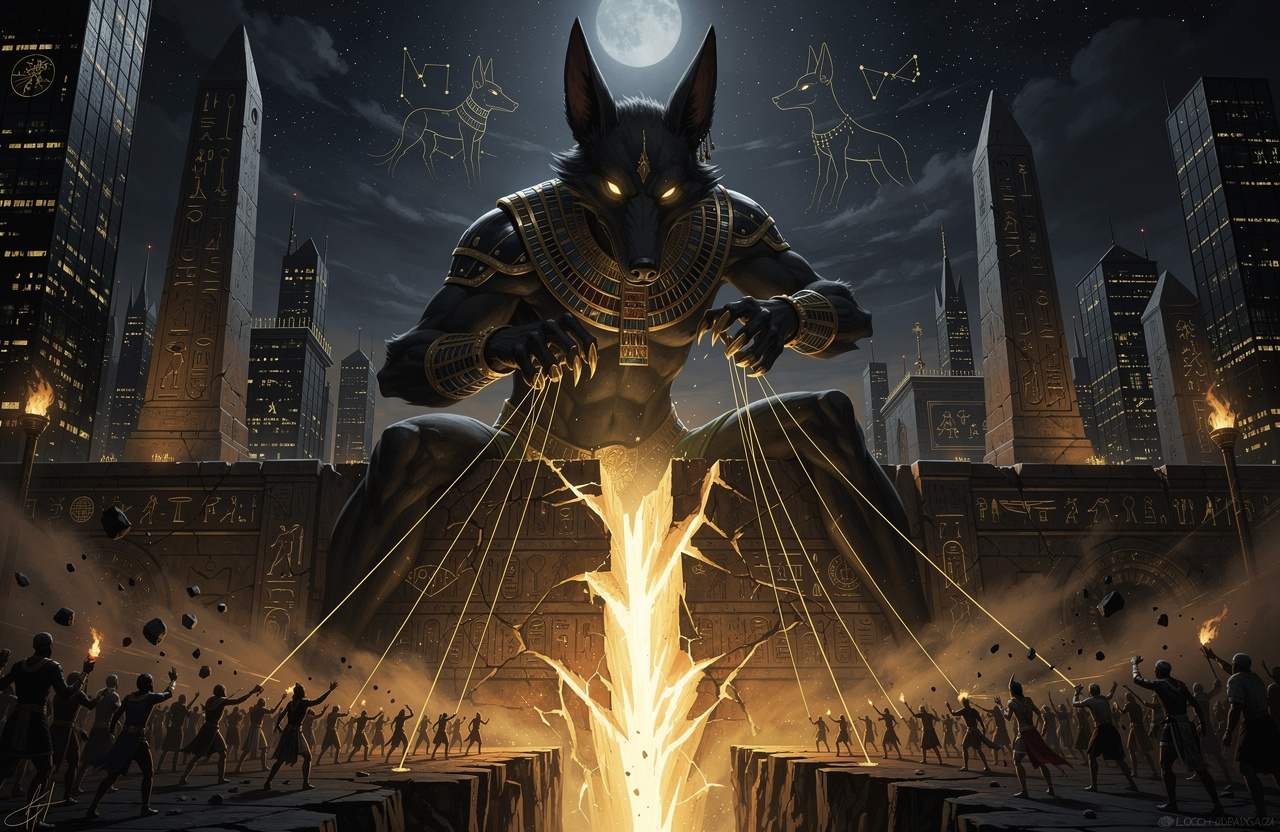
Some tricks never go out of date because they strike at the very construction of a human being. "Divide and rule" is one of them. It's thousands of years old, attributed to the Romans and to those before and after them — and it still works, because it rests on the simple arithmetic of force: one against a thousand always loses, but a thousand turned against each other is a thousand loners, and each can be taken one at a time.
Notice the key point: to manage a crowd, you don't need to be stronger than the crowd. The crowd is always stronger than any ruler — by sheer numbers. You only need to stop it from gathering into a fist. While it fights itself, its combined strength zeroes out, and the handful at the top calmly rule a majority that could physically sweep them away in a day.
Why it beats direct violence
Direct violence is expensive and dangerous. To hold a million discontented people by force, you need an army of overseers, and one day that army starts thinking for itself. "Divide and rule" solves the problem more elegantly: let the million guard themselves.
For that, people are split into groups and the hostility between them is carefully maintained. Young against old. City against countryside. Locals against newcomers. Left against right. Believers against unbelievers. Pro against anti. The specific lines change from era to era, but the mechanics are one: give each group an enemy in the neighboring group, and it will forget to look up.
In engineer's terms, this is an attack on network connectivity. A network's strength isn't in the nodes but in the links between them. Cut the links, and a powerful network falls apart into isolated points, each one helpless. You don't need to destroy the nodes; it's enough to sever what connects them. "Divide" is exactly the systematic severing of the links between people.
What it looks like today
No crude conspiracies needed — the trick has nearly automated itself. Remember the feed algorithm that feeds on outrage? By design it pits groups against each other: it shows everyone the worst version of the "enemies" from the neighboring camp and hides the normal people on that side. Not from malice — conflict simply holds attention better. The machine fractures society as a side effect of chasing its metric, and that turns out to be exactly what anyone who wants to rule the divided needs.
Add to this the inflation of any difference up to the level of "irreconcilable enemy." Real disagreements among people always exist; that's normal. The trick is to turn disagreement into enmity: not "we see things differently," but "they're a threat, you can't negotiate with them." Once a group believes the neighboring group is the enemy, it will sever the links itself, and the manipulator has nothing left to do.
Where fact ends and myth begins
Let's draw the line. Fact: "divide and rule" is a real, documented, repeatedly applied strategy, from colonial administration (set tribes against each other so they don't rise against the metropole) to modern information campaigns that openly strike at fault lines. Fact: a divided society is objectively weaker and more manageable than a united one.
Myth: that every quarrel between people is staged by someone. No. Most conflicts are genuine; people really are different. The trick isn't to invent enmity from scratch, but to find a ready crack and drive a wedge into it: amplify, inflate, don't let it cool. So the test is simple: whenever you're loudly invited to hate the neighboring group, ask — who benefits from us fighting them instead of looking up together?
The link to the book: a severed network versus a cohesive one
The book The Architecture of Chaos arrives at the same thought from another side. A parasitic structure's strength isn't in its own might, but in concentration: it gathered scattered resources into one fist while the rest stayed alone. A parasite is strong as long as its victims are disconnected. And Maat, in the book, is the just order, connectivity, wholeness — the thing that gathers the severed back together.
Hence the conclusion that makes the formula eternal: division is Isfet's working mode at the social scale. You don't need to break anyone by force if you can simply stop people from connecting. And precisely for that reason the only real counter-move is restoring the links. Not to defeat the strong, but to stop being a crowd of loners.
Where is the ordinary person in all this
He's a node of a severed network who thinks his main enemy is just another node in the neighboring camp. He spends his anger on his neighbor while the distant one calmly collects from both. The bitter part: the more sincere his enmity toward "those people," the more reliably he guards himself — for free, of his own will, proud of his principles.
The defense is unpleasant but simple: every time you feel a surge of hatred toward a group, ask who lit the fire and who's warming themselves by it. And remember that the person on the other side of the divide is most often the same battery as you, not the owner of the farm.
The answer: the MAAT token and DAO
"Divide and rule" works exactly as long as we're a crowd of loners with severed links. The clans' strength isn't in their numbers (there's a handful of them) but in our disconnection. So the only symmetric answer is to restore the links and gather into a network that can't be torn apart by a quarrel over trifles.
That is MAAT. The MAAT token is membership in a cooperative where scattered people reconnect and gather their votes into a single bundle across any differences. The principle is strict: one human, one vote — not "one dollar, one vote" — and by design it doesn't let the community be split into the "important" and the "minor." Decisions run through a DAO — a decentralized organization with a transparent treasury where every movement of funds is visible, and where members can't be quietly set against each other, because everything is in plain sight. The entry is simple: read the book, take the token, get your vote — and stop being a lone arrow kept apart from the others precisely so it can be snapped.