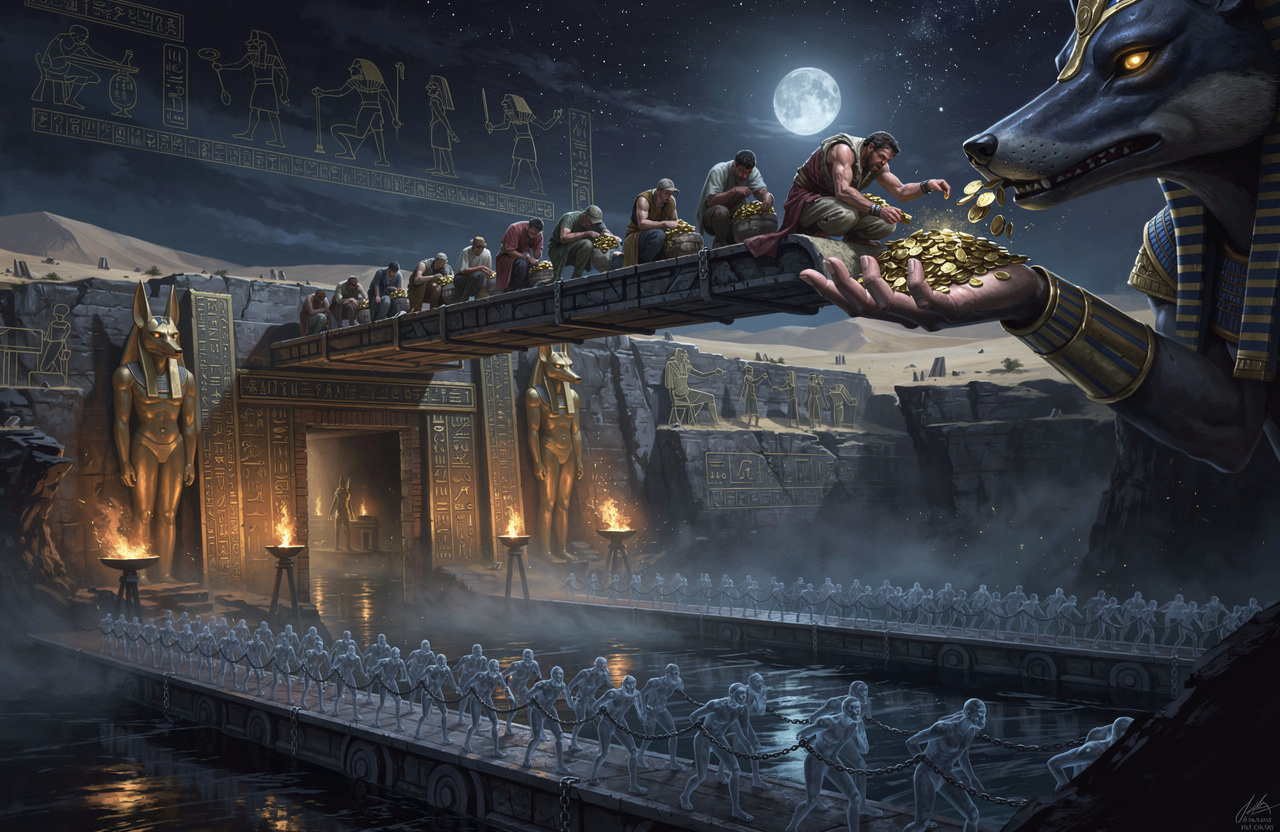
There's an image in the book that makes your spine go cold, because it's far too recognizable. The priest was shown the underside of the Duat — not the ceremonial Hall of the Scales, but the service corridors where the dead get stuck. And there, among other things, he saw a conveyor: a track along which souls are driven past judgment — for a fee. Not an individual journey with a guide, but a rail. Step on, and you're carried off. No choice, no awareness, no Scales. An automatic route. And then he was shown the most unpleasant part: the very same architecture works on Earth. The same pattern. The same conveyor. Only here the souls are called debtors.
What the conveyor in the Duat is
First, the original. In the proper picture, the dead person comes to the Scales of Maat: the heart (the Ib) is placed on one pan, the feather of truth on the other. It is a moment of honest assessment. A judgment that cannot be faked — but can be bypassed.
And here is the bypass. The book calls it a "guide track." Not a "journey with a guide," where the priest takes each person by the hand and leads them one by one. But a rail, laid in advance to run the dead past judgment in bulk. The book says it plainly: this is "the infrastructure of the Duat's black market. A ready-made path, laid in advance, to drive the dead past the court. A conveyor belt bypassing the Scales."
The key phrase is "for a fee." A businesslike dead man arrives with his living model of the world: everything is for sale, need a result — find a contractor, pay. And he's offered a "service": skip the Scales, don't go through honest assessment, just step on the rail. Convenient. Fast. And fatal, because without the Scales there is no transformation, only an eternal half-existence on the track.
And now the same thing on Earth
Strip off the mystical layer, and beneath it the familiar financial mechanics are laid bare. The earthly conveyor of debtors is built to the very same blueprint.
A person is born and immediately steps onto the rail. He didn't lay it — it was ready before him. A student loan for education. A mortgage for housing. A credit card for the "here and now." Installments for a phone. Each step is a route laid in advance, along which you ride with little real choice, because "everyone does it" and "there's no other way."
And, as in the Duat, the core of it is "for a fee." At every section of the conveyor sits an intermediary to whom you hand a percentage simply for riding his rail. You go through no honest assessment — whether you need this debt, whether it's on your terms, whether it benefits you. You're just placed on the track and carried. No choice. No awareness. No Scales.
The book spells out the link directly: "From the dead man in the Duat to the living BlackRock on Wall Street." The same pattern of parasitism that controls dark entities in the Duat controls the financial clans on Earth. The same attachments. The same conveyor.
Why a conveyor is more dangerous than robbery
A robber takes your wallet and leaves. It's frightening, but it's a one-time event, and you understand what happened. The conveyor is subtler. It doesn't take — it connects you. You step onto the rail yourself, sign yourself, and tell yourself "that's how everyone lives." And you ride it for years, handing over a little at every joint.
The most insidious part is the same as in the Duat: the conveyor relieves you of the Scales. Of the moment of honest assessment. You have no time to stop and ask: whom am I paying interest to? why do I need this thing on credit? on whose terms am I riding? The track makes no provision for stops. It provides for motion and payment. In the book's terms this is Isfet — the inversion of fair exchange: you give your labor (the energy of the Ka), and in return you get not transformation, but only the chance to keep riding the same rail.
Where the ordinary person is in this
He is the soul on the conveyor. From birth, a share of a common debt he never took. Then his own chain of rails: study on credit, housing on credit, life in installments. And every day he feeds someone else's furnace with interest, never once getting to pass the Scales — that is, to stop and honestly weigh what his life is going to, and to whom. The conveyor is designed for exactly this: that you ride, pay, and never look back.
The answer: the MAAT token and DAO
The conveyor works as long as a person has no Scales of his own — no moment and no instrument of honest assessment — and as long as he rides the rail alone, seeing neither the driver nor the till. The whole power of the track is that it's automatic and opaque.
MAAT brings back the Scales. The MAAT token is membership in a cooperative built as the opposite of a conveyor: here there is no rail you're carried along, but a shared table where decisions are made. The treasury is transparent and visible in the DAO — a decentralized organization where every movement of funds is in plain sight, there is no hidden intermediary at the joints, and no one runs you past honest assessment. The community decides, by the rule one human, one vote, not "whoever has more money laid the rail."
The book showed that the earthly debt conveyor is the same architecture that drives souls past the Scales in the Duat. So the answer is one: step off the rail and return to the Scales. The entry is simple: read the book, take the token, get the vote — and, for the first time in a long while, stop the conveyor to honestly weigh where your life is going.