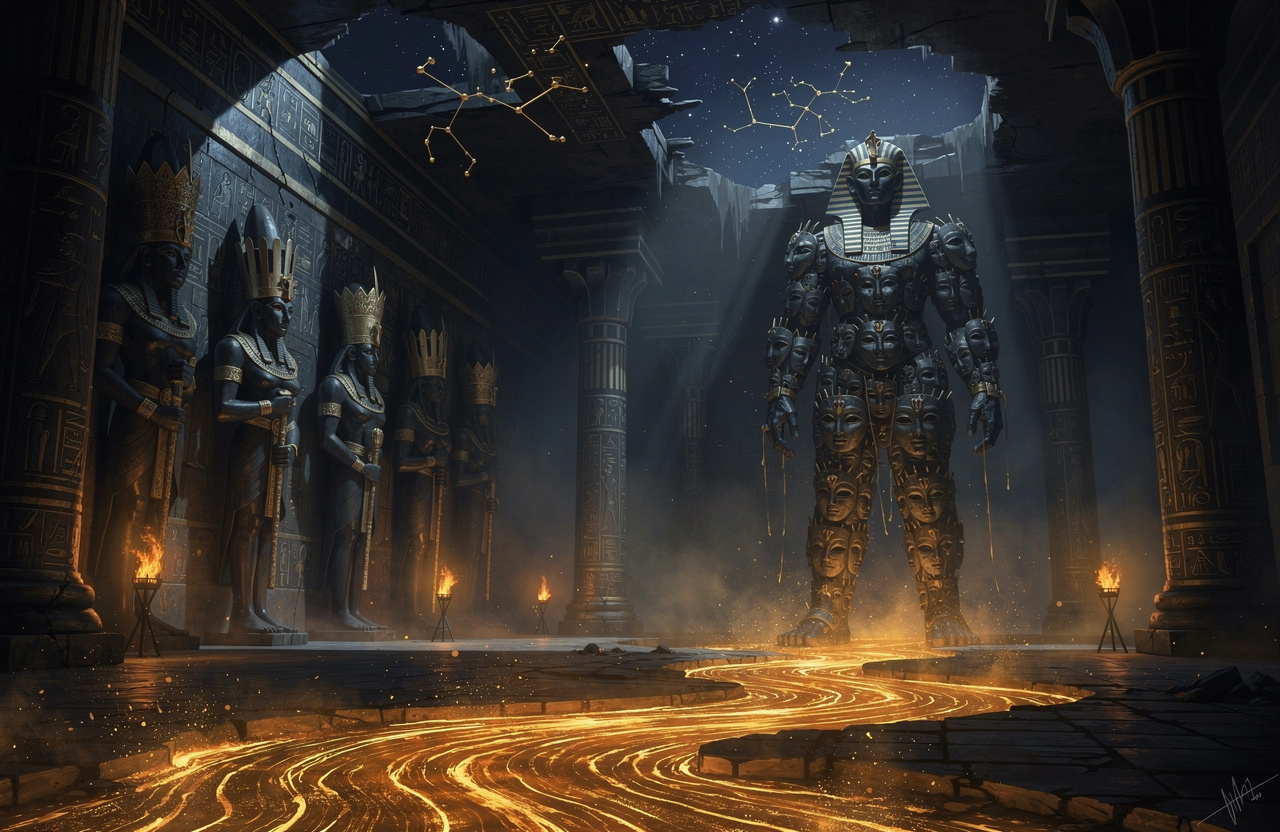
Two hundred years ago, power had a face and a surname. Rothschild. Rockefeller. Morgan. Vanderbilt. You could draw them in a cartoon, name them out loud, hate one specific human being. Today, try to name the person who owns the world. You can't — and not because there's no owner. It's because the owner was deliberately made nameless. That transformation — from the loud dynasty to the faceless corporation — is arguably the single biggest upgrade power has made in the last hundred years.
The old model: blood and a name
A classic clan was built around blood. Power passed by inheritance, assets stayed inside the family, and the surname was both the brand and the vulnerability at once. It worked, but it had an obvious bug: a family is specific people in a specific place. They have an address, a portrait, a biography. They can be convicted, taxed, stripped of property by a court — or simply hated by an entire nation.
And tellingly, the old clans understood this and built for the long run. In 1677, the Grosvenors took 300 acres of central London with one iron rule: never sell, only lease. Over 340 years that became nine billion pounds. In 1934, the Rockefellers set up irrevocable dynastic trusts: 150 years, six generations, around 170 heirs. Who needs a 300-year trust? Not a person who lives 80 years. A clan does — it's an instrument built to outlive its creator.
The weakness of a loud name
But a visible beneficiary has a fundamental problem, and in the internet age it turned lethal. The more knowledge people carry, the faster information spreads, the more exposing books come out — the more a loud surname turns from an asset into a liability.
A visible owner is a target. You can point at him. You can gather public hatred against him, launch an investigation, pass a law. A name on the signboard is coordinates for a strike. And once the whole world learned to Google, holding power under your own surname became about as wise as running a server with an open port and the password "admin."
The new model: dissolve into a ring of funds
The solution turned out to be indecently elegant. You don't hide in a bunker. You dissolve. Instead of a loud surname on the signboard — a quiet stake inside a ring of nameless funds, through which you can exert influence without exposing yourself.
The mechanics are simple. An old family puts its capital into an index giant like BlackRock — and becomes just one client among many. And a client hands over the voting rights on the stock to the manager: at the shareholder meeting it's the fund that votes, not the shareholder. So "pouring money into the Big Three" is not getting a remote control over companies — it's hiding the loose ends. The capital is pooled, the influence kept, and the target is gone. Not "there's nothing to blame them for," but "there's no one left to blame." Those are different things, and the second is far safer.
Today old money and new managers are interwoven beyond telling apart: through boards, private banks, family offices, charitable foundations, clubs. Rothschild & Co, Edmond de Rothschild, Rockefeller Capital — the surnames still exist, but they're now just nodes in a dense web, not the apex of a pyramid. The apex went anonymous.
An honest line
It's easy to fall into one of two extremes here, and both are false. The first: "the world is still secretly ruled by twenty families from a list." The second: "the Big Three arose all on their own, the old clans had nothing to do with it."
The truth is in between, and it's subtler. Fact: BlackRock was founded in 1988 by a team of eight led by Larry Fink — the son of a shoe-store owner, with no "bloodline" at all. Vanguard is owned by its own funds and has no owning family. These are public companies, not ancestral seats. Myth: that a specific crowned family stands behind them. The reading the book offers: the point isn't who exactly holds the stake, but that the principle of parasitism itself has migrated from family trusts into a faceless financial architecture — where it no longer has a face to be struck.
Why faceless is more dangerous than personal
The paradox is that faceless power is scarier than named power. A king can be executed. A dynasty can be ended. But how do you execute an index fund, or declare a vendetta against an Excel spreadsheet? A faceless structure feels no shame and doesn't depend on one man's health. It's fault-tolerant by design: remove the manager and another is appointed, the mechanism doesn't flinch.
That is the engineering meaning of the shift. Power didn't vanish and didn't grow kinder. It simply took off the family crest and put on a grey suit with no markings. The brighter the light of universal awareness shines, the deeper the shadow hides.
Where the ordinary person stands
Exactly where he stood under the Rothschilds — at the bottom, as the source of capital but not its owner. One thing changed: he used to at least know the name of the one he was losing to. Now he doesn't even know that. The enemy turned transparent — and so it seems to have disappeared. And if there's no face, it feels as if there's nothing to fight. That's precisely the design.
The answer: the MAAT token and DAO
If power hid by dissolving into a faceless network, the answer is not to hunt for the hidden face but to build your own network — a transparent one, not an anonymous one. Their strength is in hidden ends. Our strength must be the opposite: ends in plain sight for everyone.
That is MAAT. The MAAT token is membership in a cooperative with no surname on the signboard and no anonymous manager behind the curtain. Governance runs through a DAO — a decentralized organization with a transparent treasury, where every movement of funds is visible to any member. And voting here follows the principle of one human, one vote, not "one dollar, one vote": weight comes from membership, not from the size of the wallet. The old clans hid because they feared becoming a target. We bet on the opposite — a structure that needs no hiding because it has nothing to conceal. The entry is simple: read the book, take the token, get your vote — and stop losing to an opponent who doesn't even have a face.