There is a place in the United States where money never dies.
Not New York. Not Delaware. South Dakota — a state with fewer people than a mid-size city — now guards on the order of half a trillion dollars in trust assets. Money flows there from all over the world, and once it arrives, it can stay for a very long time. In many states a trust must eventually end. In South Dakota, thanks to a rule quietly repealed in 1983, a trust can last forever.
Forever is not a figure of speech here. It's a legal structure. And it is one of the cleanest machines ever built for making sure a family's wealth outlives the family, the tax collector, and the century.
Let me show you how it works — because the mechanism is more interesting than the outrage.
The problem wealth is trying to solve
Great fortunes have one natural enemy: time.
Left alone, wealth erodes across generations. Estate taxes take a bite each time it passes down. Heirs divide it, spend it, sue over it, marry badly and lose half of it. The old saying — "shirtsleeves to shirtsleeves in three generations" — is the historical default. The first generation builds, the second holds, the third scatters.
The dynasty trust exists to break that default. Its single purpose is to make wealth permanent — to lift it out of the ordinary cycle of taxation and division and freeze it into an entity that has no death, no divorce, and no spendthrift heir.
Think of it as legacy code that refuses to be deprecated. Written once, it runs for centuries, and no one alive can patch it.
How the machine is built
The move is simple in shape. A wealthy person places a large sum — say, up to the lifetime gift-and-estate exemption, which in the U.S. runs into the tens of millions of dollars per person — into an irrevocable trust before they die. The moment it goes in, and the tax is settled once at that boundary, something powerful happens: the assets are no longer "owned" by any person.
They belong to the trust.
And here is the trick. The estate tax is a tax on transfer — on wealth passing from a dead person to a living heir. But a trust never dies. So the wealth never "transfers." The children benefit from it. The grandchildren benefit. The great-great-grandchildren, two hundred years out, benefit. But because none of them ever owns it, no estate tax is ever triggered again. One tax event at the entrance, then a clean run for centuries.
Layer on the tools South Dakota perfected:
- Perpetuity. No rule forcing the trust to end. It can outlast dynasties.
- No state income tax. Growth compounds without a state taking its slice.
- Iron privacy. Court sealing keeps the trust's contents permanently secret. Outsiders — including creditors and ex-spouses — can't see in.
- Asset protection. Well-structured, the assets sit beyond the reach of most lawsuits and claims against the beneficiaries.
Put together, you get a fortress: perpetual, private, tax-shielded, lawsuit-resistant. Money that compounds in the dark for three hundred years.
What "300 years" actually buys
Run the math on time, because time is the real weapon.
A sum compounding at even a modest real rate doubles roughly every generation. Over three hundred years — ten generations — a fortune left undisturbed can multiply many, many times over, all while paying no estate tax on the way. A family that puts a large fortune into perpetuity today is not planning for its children. It is planning for descendants who will not be born until the 2200s.
That is a different time-scale of power than the one you and I live on. You plan for a mortgage, a retirement, maybe a college fund. They plan in centuries. And the law of one small state lets them.
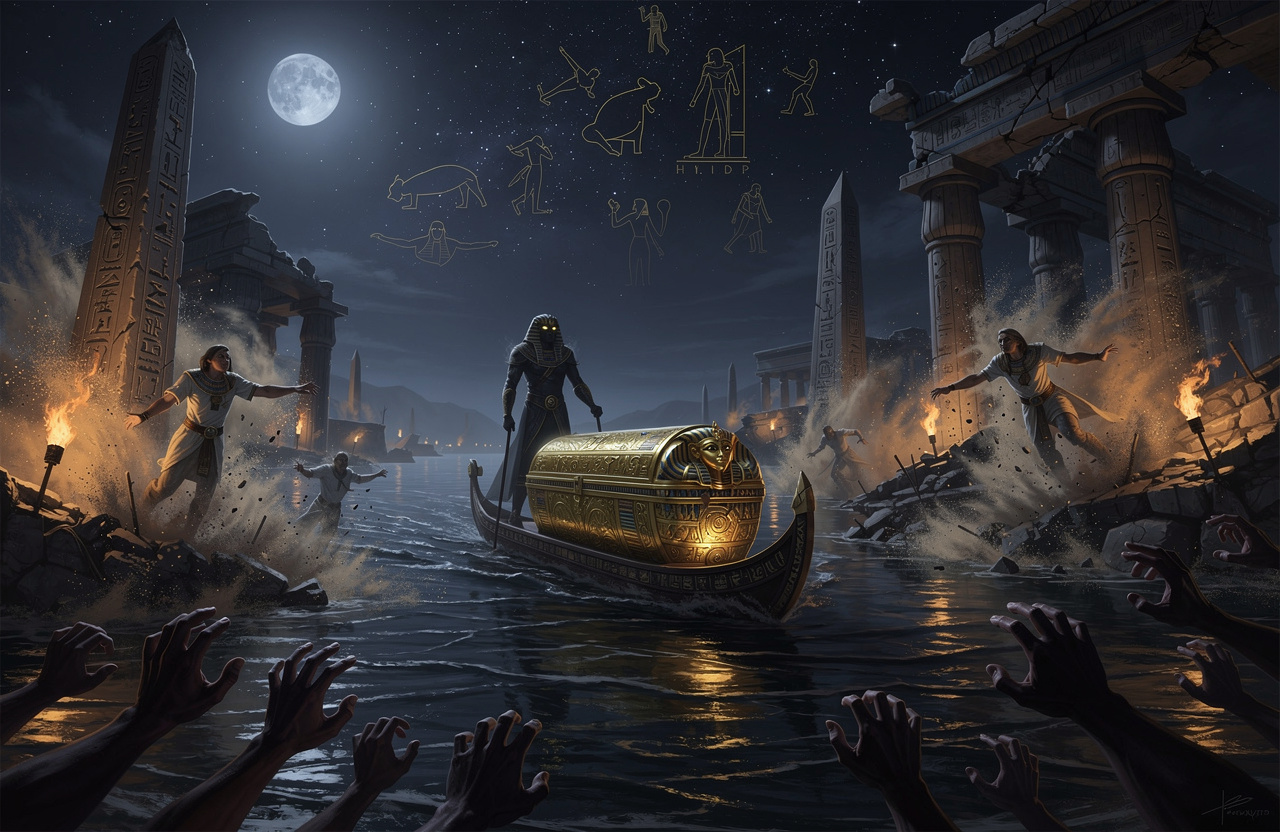
Our record. In the old temple, the name preserved was the path to eternal life — to keep the Ka fed and the memory unbroken was to defeat death itself. The dynasty trust is a dark mirror of that instinct. It seeks eternity not for the soul but for the ledger. It builds a monument, but the monument is a wall — a vault sealed against the tax collector, the creditor, the wider world, and time itself. Sekhem that should circulate through the living is instead embalmed. This is Isfet wearing the mask of legacy: not the honoring of a name, but the hoarding of a current that was meant to flow.
Why this is the deepest form of concentration
Asset inflation makes the rich richer within a lifetime. Dynasty trusts make them richer across lifetimes — and that's a harder thing to undo.
When wealth locks into perpetual, private, tax-immune structures, it stops being a pool that can rejoin the economy through inheritance and taxation. It becomes a permanent floor beneath one bloodline and a permanent ceiling over everyone else. The estate tax was one of society's few tools to loosen concentrated wealth every generation. The dynasty trust was engineered, deliberately, to route around it.
And it's legal. That's the part to sit with. No law was broken. A law was written — a repeal in one small state — and the money followed. This is not crime. This is the operating system working exactly as configured for those who wrote the config.
Where the door is
Never doom without a door. So here is the door.
See the time-scale. The most important thing you can take from this is a recalibration of scale. The powerful do not think in years. They think in centuries. When you plan, stretch your own horizon — build things meant to outlast you, not just to serve this quarter.
Refuse the myth of the level field. Anyone who tells you the game resets each generation is describing a world that the dynasty trust was specifically built to abolish. Plan with the real board in mind.
Build permanence you can control. The lesson of the trust is not "be cynical." It's "structure matters more than income." A structure that compounds, protects, and persists beats a big paycheck that leaks. You can't buy a South Dakota trust — but you can own things that compound, hold them across time, and pass on more than money: a name, a craft, a network, a record.
Choose transparent permanence over sealed permanence. Their eternity is a vault — locked, hidden, extractive. There is another kind: an open ledger, a cooperative, a protocol that no single family owns and no court can seal. Wealth that persists in the open and stays in circulation is the counter-design. That's the whole point of building on rails no one can quietly repeal a law to bend.
Money that never dies is not a fairy tale. It's a filing in a small state's courthouse. Name the machine — and start building one that flows instead of one that hoards.