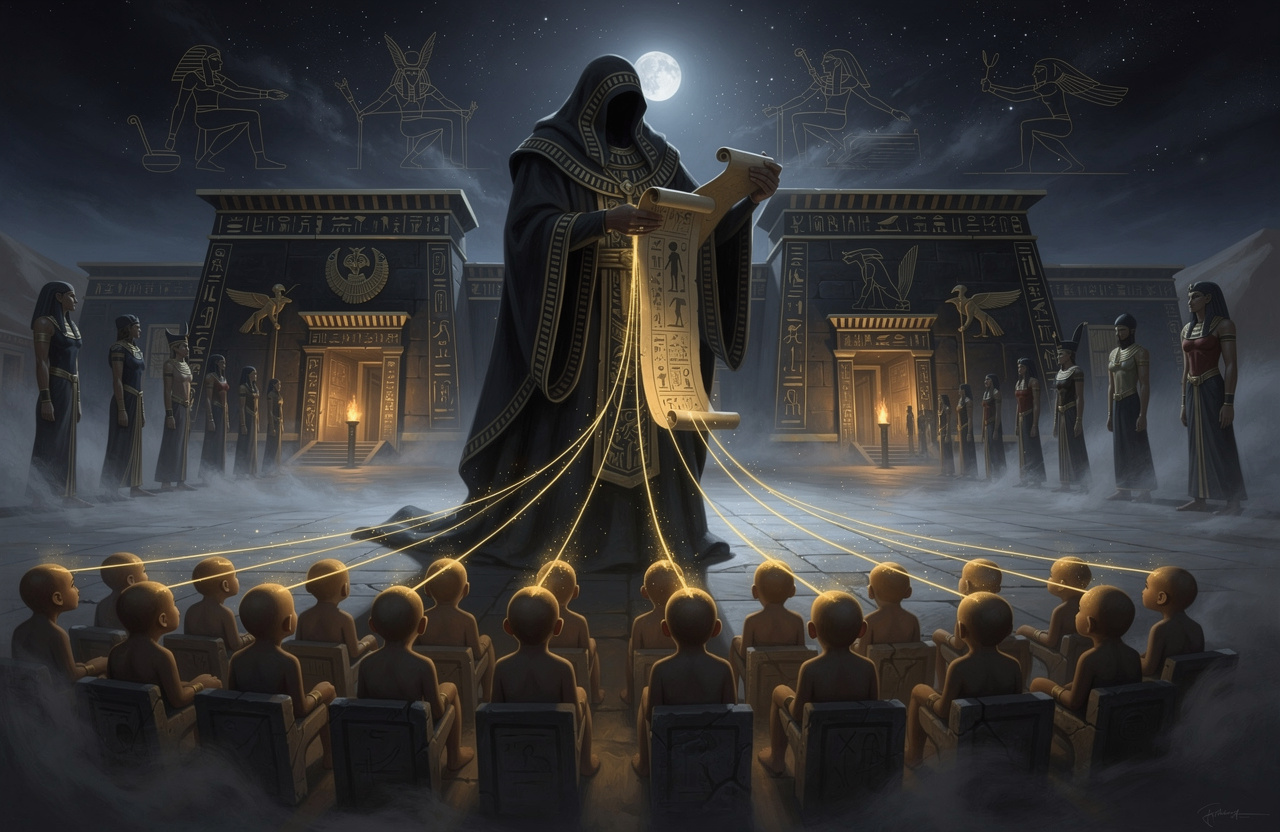
If you want a person to think within certain bounds for life, don't argue with him as an adult. That's expensive and unreliable. Get in earlier — when he's seven and doesn't yet know how to doubt, but simply writes down what the teacher says. Education isn't villainy. It's the earliest and deepest channel of influence humanity has ever invented. And that's exactly why it's always fought over.
School does two things at once. The obvious one — teaching reading, arithmetic, facts. And the non-obvious one — setting the frame: what counts as important, what's normal, which questions you're even allowed to ask. Everyone notices the first. The second works quietly, and is therefore stronger.
The firmware installed before you learned to doubt
In engineer's terms, a child's mind is a device on factory settings. Whatever gets loaded first becomes the background for life. Not the specific facts — those are forgotten — but the structure: how the "normal" world is built, who its heroes are, what success is, whom to trust.
A child doesn't fact-check the teacher's sources. He doesn't ask "who funded this textbook?" He absorbs. And when he grows up, that early firmware runs like an operating system: all his adult "free" opinions spin on top of it, within bounds he never chose and doesn't even remember receiving.
That's why education is a prize fought over by states, churches, corporations, and foundations. Whoever writes the history textbook defines what a whole generation will consider its past. Whoever sets the school economics curriculum decides whether a person will even be able to ask "where does money come from and to whom do I pay interest?"
What usually gets cut from the curriculum
The most interesting thing about education isn't what's in it, but what isn't. Silence is also a message.
Think: how many years were you taught math, and how many hours were you taught how credit works, inflation, bank interest, who owns the money? You were prepared to solve other people's equations, but not to understand the system you'll live your whole life inside. This isn't a random gap. A financially illiterate person is the perfect bank customer and the perfect battery for the system. He asks no awkward questions because he doesn't know they can be asked.
Same with the history of money, the architecture of power, who actually makes the decisions. These topics are either absent or presented so that no questions arise. The best censorship isn't banning a book; it's leaving it off the list. What you weren't taught simply doesn't exist for you as a topic.
Where fact ends and myth begins
Let's draw the line honestly. Fact: states and ideologies have always used school to form the "right" citizen — an open practice, from history textbooks to national programs. Fact: large foundations genuinely fund educational standards, programs, and academic chairs, and whoever pays for the program influences what's in it. Fact: financial literacy is systematically washed out of mass schooling.
Myth: that there's a single secret committee writing one textbook for all nations. Reality is more fragmented: different forces pull the curriculum their own way. But the rule holds — whoever has the resource gets their version entrenched. And almost everywhere one thing coincides: you're taught to be an executor and a consumer, not to understand how power and money work. Not by command from a center, but by the converging interests of all who benefit from a manageable person.
The link to the book: control of meaning
The book The Architecture of Chaos states the formula of power directly: the military hold the body and resources, the priests hold meaning — control of the Ib. Education is that priestly function in modern packaging. Not a temple but a classroom; not a priest but a textbook; but the task is the same — to set the meaning before a person learns to choose for himself.
And here's an important detail from the book: Isfet hides behind names. "Education" sounds impeccable — who's against knowledge? But under that name can hide both light (real ability to think) and obedience-firmware (the ability to execute without asking). One word, two different cargoes. Telling them apart is the work: strip the camouflage off "education" and look at what's actually being taught.
Where is the ordinary person in all this
He carries firmware that someone else's hands installed at age seven, and takes it for his own mind and his own choice. The worst part — he doesn't even remember the install. It feels like he always thought this way.
The defense isn't to curse school — there was real knowledge there too. The defense is re-educating yourself as an adult: notice the gaps, deliberately go where you weren't let in — toward how money, power, and influence are built. Naming the gap is already halfway to closing it.
The answer: the MAAT token and DAO
The system is held in place by being taught to be executors, one by one, and never given the map that shows how power is built. A scattered, financially illiterate person is the perfect battery. So the answer begins with access to knowledge and with uniting those who've gained it.
That is MAAT. Entry into MAAT is, literally, education: the first step is to read the book — that is, to get the very map that was cut from the school curriculum. The MAAT token is membership in a cooperative where people who have seen the system gather their votes into a single bundle. The principle is strict: one human, one vote — not "one dollar, one vote." Decisions run through a DAO — a decentralized organization with a transparent treasury where every movement of funds is visible. The entry is simple: read the book, take the token, get your vote — and stop being the carrier of someone else's firmware who doesn't even remember who installed it.