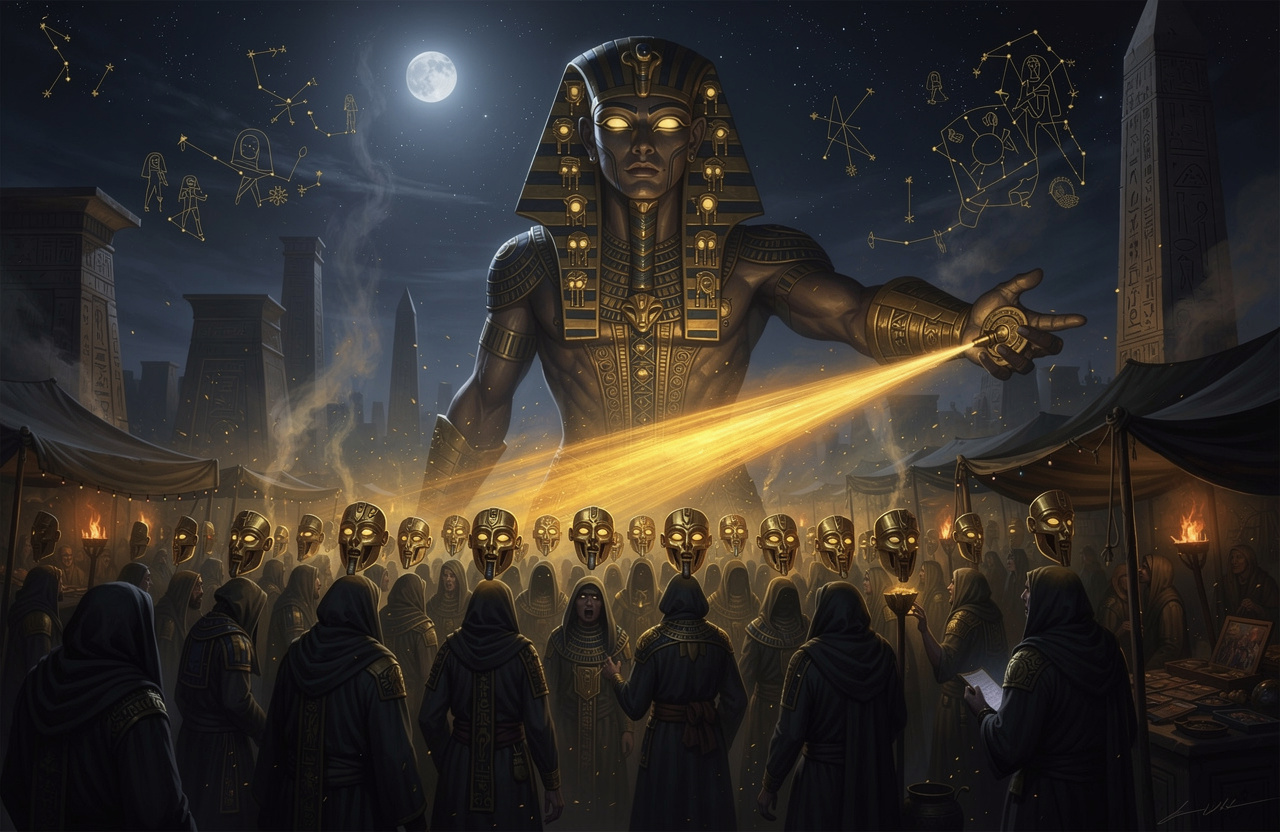
There was, for the whole of human history, one place you were always free: the crowd. A face in a street, unnamed, unlogged, just passing through. That freedom died quietly around 2020, and a company most people still can't name is holding the knife.
The company is Clearview AI. Its product is simple to state and staggering to grasp: a search engine for faces. Upload a photo of a stranger, and it returns their name, their other photos, and links to where those photos live online. The way it built that engine is the part that should stop you cold. Clearview scraped the open internet — social media, news sites, public profiles, anywhere a face sat in a public image — and hoovered up billions of photographs without asking a single person. Its own claims put the database in the tens of billions of images, with public statements aiming toward one hundred billion — enough, they've said, to identify almost anyone on Earth.
You are almost certainly in it. You never consented. You were never told. And your face is now a query someone else can run.
The Face Was the Last Password You Couldn't Change
Think about what a face is, technically. It is a biometric — a key drawn from your body itself. And unlike a password, you cannot rotate it. You cannot revoke it. When your password leaks, you change it in thirty seconds. When your face leaks — when it's scraped, vectorized into a mathematical faceprint, and filed in a private database — it is compromised forever. There is no reset button on your own skull.
That's what makes facial recognition categorically different from other surveillance. A license plate can be swapped. A phone can be left at home. A face walks with you into every room, and now every camera it passes is a potential login prompt against a database that already has your name. The store camera. The doorbell. The traffic cam. The stranger's phone. Each one is a scanner, and the match runs in the time it takes to blink.
Clearview isn't alone — it's just the most brazen. Governments run their own systems. Retailers deploy face-matching against "banned customer" lists. Airports, stadiums, and city street cameras increasingly carry the capability baked in. The infrastructure is being poured while the debate about whether it should exist is still, theoretically, ongoing.
The Wedjat Learns Your Name
For thousands of years the Eye of Horus watched — but it watched a crowd. It saw movement, presence, the mass of people, without knowing which soul was which. Anonymity in the multitude was so basic a fact of life that no one thought to name it as a freedom. It just was.
Facial recognition is the Wedjat learning to read names. The eye no longer sees "a person passed here." It sees you passed here, at 3:14, near this shop, next to this other named person, and it writes the line into a permanent record. The crowd — the last commons where you could be no one — is being converted, camera by camera, into a room where everyone is instantly, permanently identified. The right to be a face without a name, a freedom older than any state, is being deprecated without a vote.
Our Record
Our record: in the old teaching, to speak a being's true name was to hold power over it — the name was a handle on the Ba, and to know it was to command a thread of the soul. That is why true names were guarded, given carefully, protected by rite. Facial recognition industrializes name-power. It resolves the true name of anyone in view, instantly, at scale, and hands the handle to whoever paid for the license — no rite, no consent, no ward. In the weighing of Ma'at, a soul is named and judged once, openly, with the outcome visible to it. The faceprint database inverts every term: the naming is secret, constant, and done to you by a machine you cannot see, feeding a scale you cannot inspect. That theft of name-power — the true name taken from millions at once, without their knowledge, and stored for use against them — is Isfet reaching for the deepest lever the old craft knew.
Why "Only Catching Criminals" Is the Trap
The defense is always the same, and it wears a badge: it catches criminals. Finds the missing child. Identifies the fugitive. Who could object to that?
Here's the trap. A tool that can identify anyone, anywhere, from any photo does not stay pointed at criminals — it points at everyone by default and singles out targets after. To find one fugitive in a crowd, the system must first identify the entire crowd. Everyone is scanned; everyone is named; the innocent are processed exactly like the guilty, and only afterward filtered. That is not targeted surveillance. That is universal surveillance with a targeted excuse. The presumption of innocence assumed you were unknown until suspected. Face recognition inverts it: you are known first, and your innocence is something the database can revise.
And the errors don't fall evenly. Face-matching systems have documented higher false-match rates for some groups than others, which means the burden of a wrong identification — the stop, the arrest, the accusation — lands hardest on those least able to fight it. "Catching criminals" is the phrase that ships a universal dragnet under the cover of a narrow good.
The Lever
Don't despair at the eye that knows your name. It is powerful, but it is not invincible — and the pushback is already landing blows.
The levers are real and they work. Clearview has been fined and banned in multiple jurisdictions — Italy, France, the UK, Australia, and others have ruled its scraping illegal and ordered deletions. Under Illinois's biometric privacy law, Clearview was forced into a nationwide settlement restricting who it can sell to. Cities have banned government face recognition outright. These are not symbolic wins; they are proof the eye can be blinded by law. Demand biometric-privacy statutes where you live — the model exists and it bites.
Protect your face at the source: lock down photo privacy, limit what's public, support platforms that resist scraping. Support the researchers building adversarial tools that poison faceprints and cloak images from recognition. And hold the line on the principle, loudly: a face is a body, a body is not public property, and consent is not optional because a camera was cheap.
The crowd was a commons. Commons can be defended — they always had to be. Guard your name.