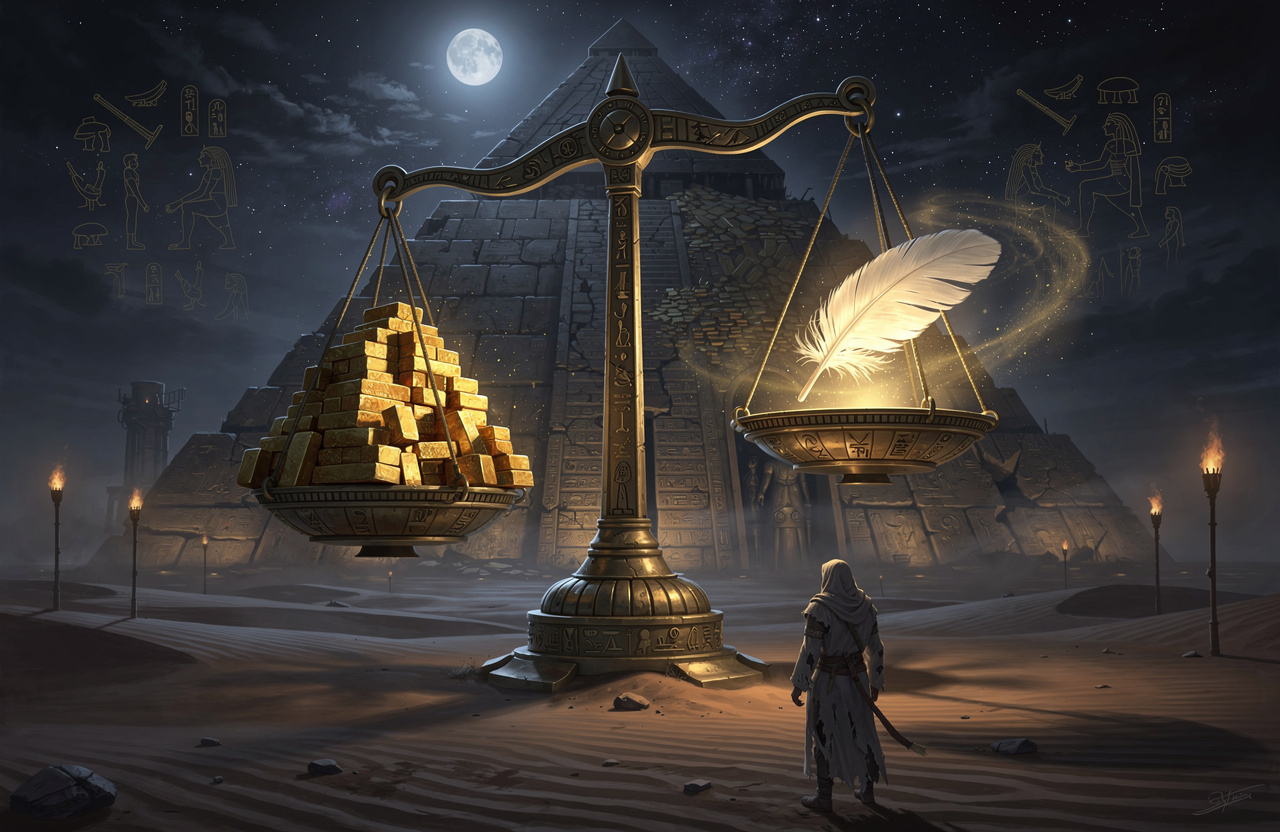
Two shapes are fighting for the future, and you already carry both of them in your head.
One is the pyramid. A vast base, a narrow middle, a single point at the top. Almost everything the base builds ends up at the tip. It's the shape of the pharaonic tomb — and, unnervingly, the exact shape of the modern wealth distribution. The global top 1% holds roughly half the world's wealth; the bottom half holds a couple of percent. Draw that as a solid and you get a pyramid so top-heavy it shouldn't stand. It stands because the base holds it up.
The other shape is the scale. A beam, a fulcrum, two pans — and on one pan, a single feather. The Egyptians put the Feather of Maat there deliberately: truth is light. A just heart doesn't need to be heavy to balance the world; it needs to be true. The scale is the anti-pyramid. It doesn't ask everything to pile at one end. It asks the two ends to answer to each other.
This isn't poetry against economics. It's two distribution models, and one of them is a machine for making pyramids.
The pyramid is a pump, not a shape
Here's the thing people miss. A pyramid of stone is stable — the weight presses down and settles. But a pyramid of wealth isn't stable, because wealth flows. To keep everything piled at the tip, something has to keep pumping it upward against the natural spread. That something is the extraction machinery: rent you don't set, interest you didn't choose, fees on your fees, wages that lag the value you make.
Call it what it is: a parasitic pump. It runs continuously, and it has to, because the moment the pump stops, the wealth would spread back out — down the sides, into the base, toward the level. The pyramid isn't a natural resting state. It's an actively-maintained disequilibrium. Somebody is running the pump around the clock, and you are paying the electricity bill.
That reframes the whole question. The problem was never that some people have more. The problem is the pump — the machinery whose entire job is to prevent the level from ever being found.
Our record
The Egyptian read here is not decoration. It's the original theory of the case.
Maat is not equality. Read the texts and you find something subtler and stronger: Maat is right balance — each part in its true proportion, the whole answering to a level. The Feather is the reference weight. Put your heart against it, put your kingdom against it, put your economy against it. If the pan holding "what people receive" and the pan holding "what people give" swing free and settle even, that's Maat. If one pan is chained to the floor and can never rise no matter what the base pours in, that's Isfet wearing the mask of order.
The pyramid, in this read, is Isfet's masterpiece: a structure that looks like the peak of order — grand, geometric, eternal — while functioning as a pump that violates the level. The most stable-looking shape in the world, built on the most unstable arrangement of wealth. That's the tell. When something is too solid at the top, ask who's running the pump underneath.
What the level actually looks like
So drop the pyramid and picture the scale settling free. Not everyone identical — Maat was never flat equality, and neither is any economy that has to reward effort and risk. The Feather is light, not zero.
A just distribution looks like a scale that can move. Where the value you create and the value you receive are roughly tethered — not by force, but because no pump sits between them skimming the difference. Where being at the base doesn't mean your pan is bolted down. Where a good year for the people who build things is a good year for the people who build things, not just for the people who own the claim on what's built. Concretely: worker pay that tracks worker productivity instead of diverging from it. Ownership spread wide instead of collected at a point. Rent-seeking machinery dismantled, not oiled.
You don't have to imagine this from scratch. Cooperatives already run it — the people who do the work hold the claim on the surplus, so the two pans are chained together by design. That's not utopia. That's just the pump removed.
Two shapes, two futures
Everything comes down to which shape you're building toward, because you're always building toward one of them.
Every rent you pay to an owner who does nothing but own — a brick in the pyramid. Every fee skimmed off a transaction that needed no middleman — the pump running. Every wage that lags the value it produced — one more parcel routed to the tip.
And every counter-move builds the scale. Every asset owned by the person who uses it. Every cooperative that keeps the surplus with the people who made it. Every open protocol that removes a toll-taker from the middle. Every stake you hold instead of rent you pay. You are, transaction by transaction, either feeding the pump or dismantling it.
The lever
The pyramid needs the pump. Kill the pump and the pyramid can't hold its shape — the wealth spreads back toward the level, not because anyone forced it, but because that's what wealth does when nothing is straining to hold it at the tip.
So find your nearest pump and unplug it. The landlord who owns and does nothing — become an owner. The middleman who skims and adds nothing — route around him; the whole promise of an open protocol is a transaction with no toll-taker in the middle, the pump written out of the code. The fee, the rent, the interest that flows up and never comes back — replace it, one at a time, with a stake that stays yours.
The pyramid is a machine for defying the level. The scale is what the level looks like when you stop defying it. You don't have to build the scale from nothing — it's the default the moment the pump stops.
So stop feeding the pump. Put the Feather on the pan and let the scale find level. It always wanted to.