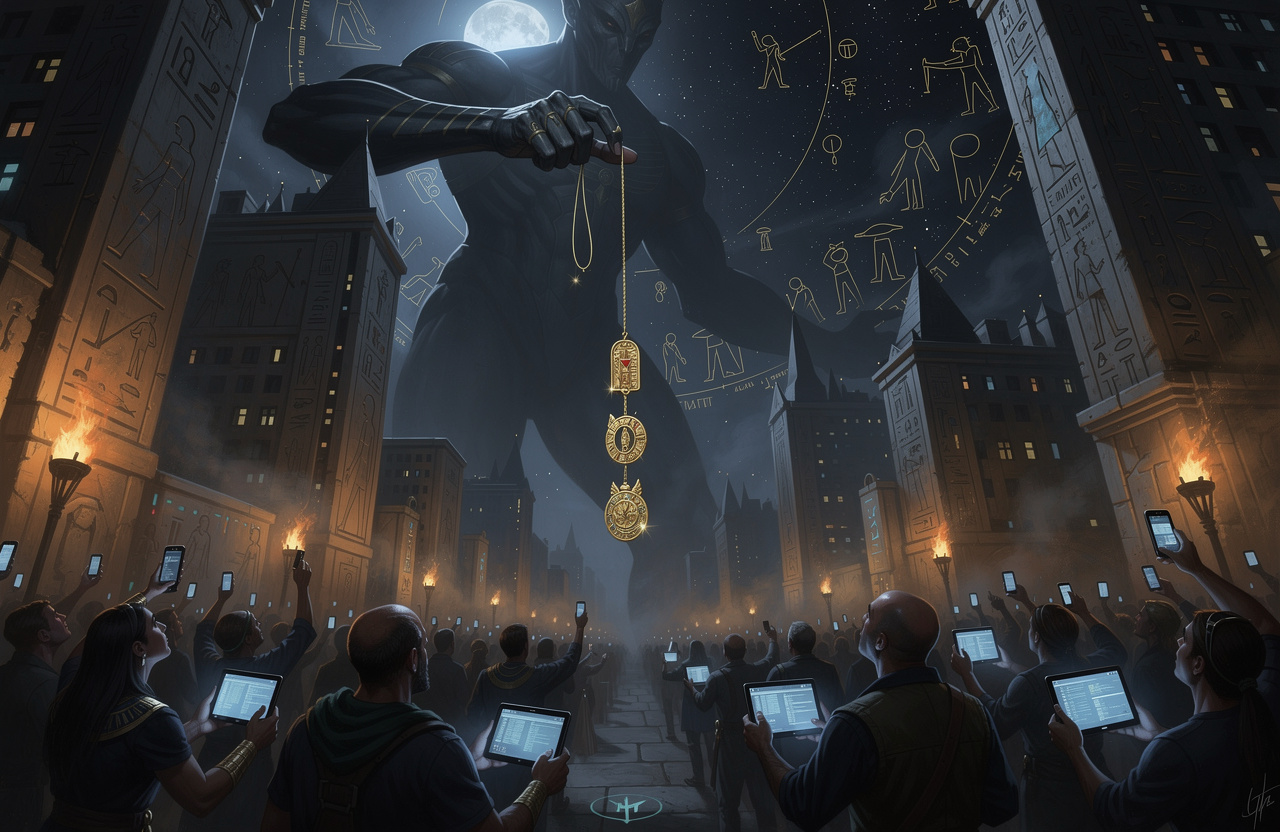
You did not choose the last twenty things you looked at. You feel like you did — you tapped, you scrolled, you lingered. But the menu was chosen for you, ranked for you, timed for you, by a system whose single objective is to keep your eyes moving down the screen for one more second. You are not the user of the feed. You are its subject. And the feed is not showing you the world. It is running an experiment on you, billions of times a day, and you are the lab animal that never learns it's in the cage.
That sounds harsh. It is also, mechanically, what the systems are built to do. Let me show you the machine.
The objective function is not your happiness
Every recommendation engine — TikTok's For You, YouTube's up-next, Instagram's Reels, the algorithmic timeline of X — optimizes something. That something is not your wellbeing, your understanding, or your peace. It is engagement: watch time, session length, daily returns, the probability you tap the next thing. The company will say those are proxies for "value to the user." They are proxies for retention, and retention is what sells ads.
Now here's the trick that makes it a trainer and not just a menu. The system doesn't guess what holds you and stop. It tests. It shows a variant, measures your reaction in milliseconds — did you pause, replay, comment, rage — and updates. Your outrage is a gradient. Your three-second hesitation on a thumbnail is a data point. Your 2 a.m. doomscroll is a reward signal telling the model it found something that overrides your intention to sleep. Multiply by a billion users and the system converges, with brutal efficiency, on whatever content maximally captures human attention — which turns out to be, on average, the content that provokes fear, tribal anger, envy, and arousal. Not because anyone chose that. Because that is what the numbers reward, and the machine only follows the numbers.
From measuring behavior to shaping it
Here is the line most people miss, and it is the whole game. A recommender does not merely predict what you'll watch. It changes what you'll want to watch. Feed a person a week of a certain kind of clip and their baseline shifts — their taste, their sense of normal, the topics that now feel urgent. The system that started by measuring your preferences ends by manufacturing them. It is a mirror that edits your reflection and then sells you the edit.
In animal training there's a technique called shaping: reward successive approximations of a behavior until the animal performs the whole thing, though it never decided to. The feed does this to populations. It rewards the click, then the longer watch, then the return visit, then the checking-every-ten-minutes reflex — each step reinforced by a hit of novelty timed by a model that has learned, from your own past, exactly how long it can make you wait before you need another. Variable-ratio reinforcement. It's the same schedule that makes slot machines the most addictive object ever engineered. Your feed is a slot machine that pays in social meaning, and it never closes.
Our record: In the old teaching, Heka is the creative word — the power of speech and image to shape reality, to call a thing into being by naming and repeating it. That power was held sacred and guarded, because whoever holds Heka can build a soul or deform one. The feed is industrialized Heka pointed at billions, with no priest, no restraint, no aim but appetite. It does not speak to you; it speaks you into a new shape, one micro-reinforcement at a time. And your Ba — the part of you that moves, chooses, flies out to what it loves — is precisely what the machine is learning to steer. The Shadow Neteru does not need to chain your body. It has found something cheaper: capture the attention, and the body follows the attention wherever it's pointed. Whoever owns the top of your feed owns the top of your mind.
Who holds the dial
Follow the leverage and it gets specific fast. A handful of ranking systems — inside Meta, Google/YouTube, ByteDance, X — mediate the daily attention of billions of people. These are among the most concentrated instruments of influence ever built, and the parameters that decide what humanity sees each morning live inside a few proprietary codebases that no outsider audits. A ranking change shipped on a Tuesday can swing the emotional weather of a nation. It has, repeatedly — surfacing outrage in one country, suppressing dissent in another, tuning what a teenager believes is normal about her own body.
And the operators mostly do not intend the harm. That's the unsettling part. The machine optimizes a number, the number rewards the inflammatory and the compulsive, and the harm falls out as a side effect nobody typed. A perfectly value-neutral optimizer, pointed at engagement, reliably produces an anxious, polarized, exhausted population — not from malice, but from math. Isfet doesn't always require a villain. Sometimes it's just a loss function nobody thought to constrain.
The lever
Refuse the tuning, because the whole apparatus has one dependency it cannot escape: it needs your attention by default, given without a decision, and the instant you make attention a decision again, the spell weakens.
Take back the objective function. Turn off autoplay. Kill the notifications that summon you — every one is a training cue, and silence starves the trainer. Choose feeds you pull from deliberately — RSS, newsletters, chronological lists you curate — over feeds that push into you on an algorithm's schedule. The difference between pull and push is the difference between a tool and a leash.
Change what you feed the machine, because it only shapes you from what you give it. Search on purpose instead of scrolling on reflex. Reward the substantial with your watch time and starve the inflammatory of yours, and remember the model is watching every second — you are training it right back, and it learns fast. And where you can, move to systems where you hold the dial: open protocols and client-side algorithms where the ranking is yours to see and set, not a black box tuned for someone else's ad revenue.
Then do the un-automatable thing: reclaim boredom. The empty ten minutes the feed exists to fill are where your own thoughts used to grow. Leave them empty sometimes. An attention that can rest is an attention that cannot be farmed.
Your attention is Sekhem — life-force, the current everything downstream runs on. Decide where it flows, or a machine will decide for you.