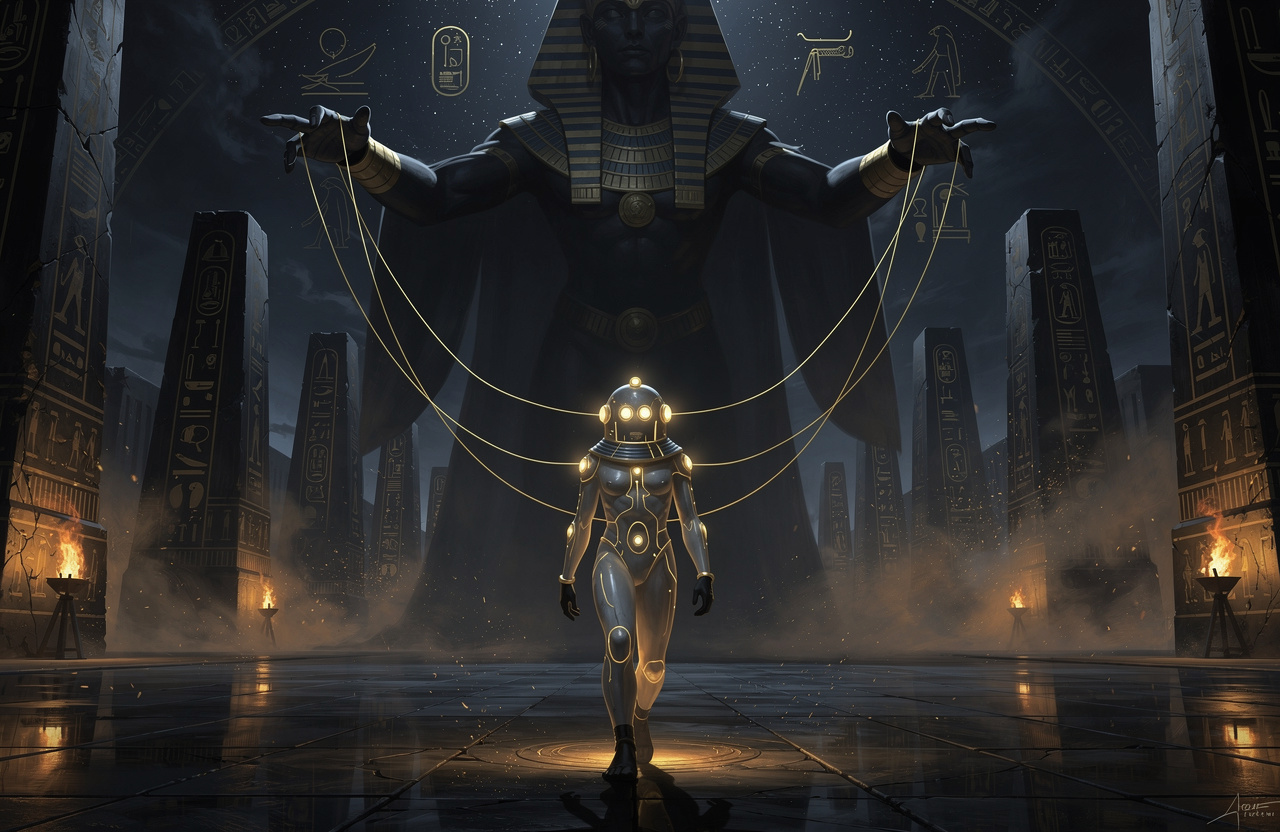
The book this project stands on offers an idea that explains a great deal: the body is not "you" — it's a spacesuit. A device you climbed into for one incarnation in order to interact with the dense world. This suit has five input sensors — sight, hearing, smell, taste, touch. Through them, and only through them, the entire signal of reality reaches you. And now the engineer's first question: what happens if someone gains access to your sensors before you do?
A sensor is an input interface
The suit by itself is dumb. It doesn't know where money, danger, or food is. It just pushes a stream of data from five detectors inward, and the decision is made by "you" — whatever sits inside the suit. Your entire picture of the world is assembled from what passed through those five inputs. The dense body has no other channels.
That means something simple: whoever controls your sensors controls your reality. You don't have to break a person by force. You just stand on their input detectors and mix the signal you want into the stream. The suit faithfully delivers it inward, and the passenger is sure these are his own thoughts and desires.
The financial system figured this out long ago. It doesn't fight the human — it sits on his sensors.
How money colonizes each input
Let's walk the detectors.
- Sight. The fattest channel. Ads, shop windows, feeds, infinite scroll. You're shown someone else's beautiful life so that yours looks poor. The eye is the main gateway for envy, and envy is the main engine of spending.
- Hearing. Mall music tuned to the right shopping tempo. The tone of voice in commercials. Words like "discount," "last day," "today only" — audio triggers that switch on urgency and switch off arithmetic.
- Smell. The scent of fresh bread at the supermarket entrance is no accident. Scent marketing sells to you literally through the nose. The smell of a "new car" is synthesized in a lab.
- Taste. Sugar, salt, fat in perfectly calibrated ratios so you can't stop. Food is engineered not to nourish you, but to make you buy more.
- Touch. The weight of a phone, the smoothness of packaging, the "pleasant material." Tactile pleasure is glued to the purchase so your hand reaches to pay on its own.
Five inputs — five channels feeding you one command around the clock: spend. And the suit obediently carries that command inward.
This isn't a metaphor, it's an exploit
In IT there's a concept: an attack on the input channel. You don't break the program itself; you feed it an input that makes it do what you want. Advertising and the consumer environment are exactly that kind of attack, only aimed at a human. The sensors aren't built to tell a "real" need from an implanted one. They don't care. They pass the signal through as is.
So it's useless to tell yourself "I just won't fall for ads." You're not fighting advertising — you're fighting your own hardware, which has already been breached. Suggestion doesn't work through logic; it enters below logic, straight through the detectors. By the time the "I want it" decision has formed at the input, reason only picks the excuses.
The suit tires while the meter keeps running
Now the ugly part. Sensors can be overloaded. When noise pours over you nonstop — screens, notifications, anxiety — sensitivity drops. The book says it plainly: the information noise around a person degrades the quality of the "receiver." An overloaded suit stops distinguishing signal from noise. It reacts automatically, reflexively — and the automatic reaction is the perfect state of a buyer.
A tired, deafened, perpetually rushing person doesn't compute loan interest, doesn't read the fine print, doesn't ask "do I even need this." He has no time — his sensors are overloaded. And it's precisely in that state that he signs installment plans, takes credit cards, and pays for subscriptions he never uses.
Where is the ordinary person
He's inside a suit whose sensors a stranger has breached. He's certain the desires are his own, the choice is free — when in truth his inputs were colonized by those who profit from his spending. He isn't stupid or weak-willed. He simply never knew his perception has an admin panel, and that access to it hasn't belonged to him alone for a long time.
The first step to freedom is seeing this. Understanding that five detectors stand between reality and you, and someone very clever is already sitting on each one.
The answer: the MAAT token and DAO
You can't shut the sensors off entirely — you can't live in a body without them. But you can stop being a lone suit being fed commands by a stranger, and connect to a network of others who've seen the same thing. The strength of those who colonized your perception is that you're alone while they're coordinated and enormous. The answer is symmetric: gather together.
The MAAT token is membership in a cooperative of people who saw the mechanics and decided to build their own. Governance runs through a DAO — a decentralized organization with a transparent treasury, where every movement of funds is in plain sight and no intermediary quietly milks you. And here it's the human who decides, not the wallet: the principle is one human, one vote. The book strips the camouflage off whatever sits on your sensors — and that, as it says, robs Isfet of its main power: invisibility. The entry is simple: read the book, take the token, get your vote — and finally hear your own signal instead of the one mixed in.