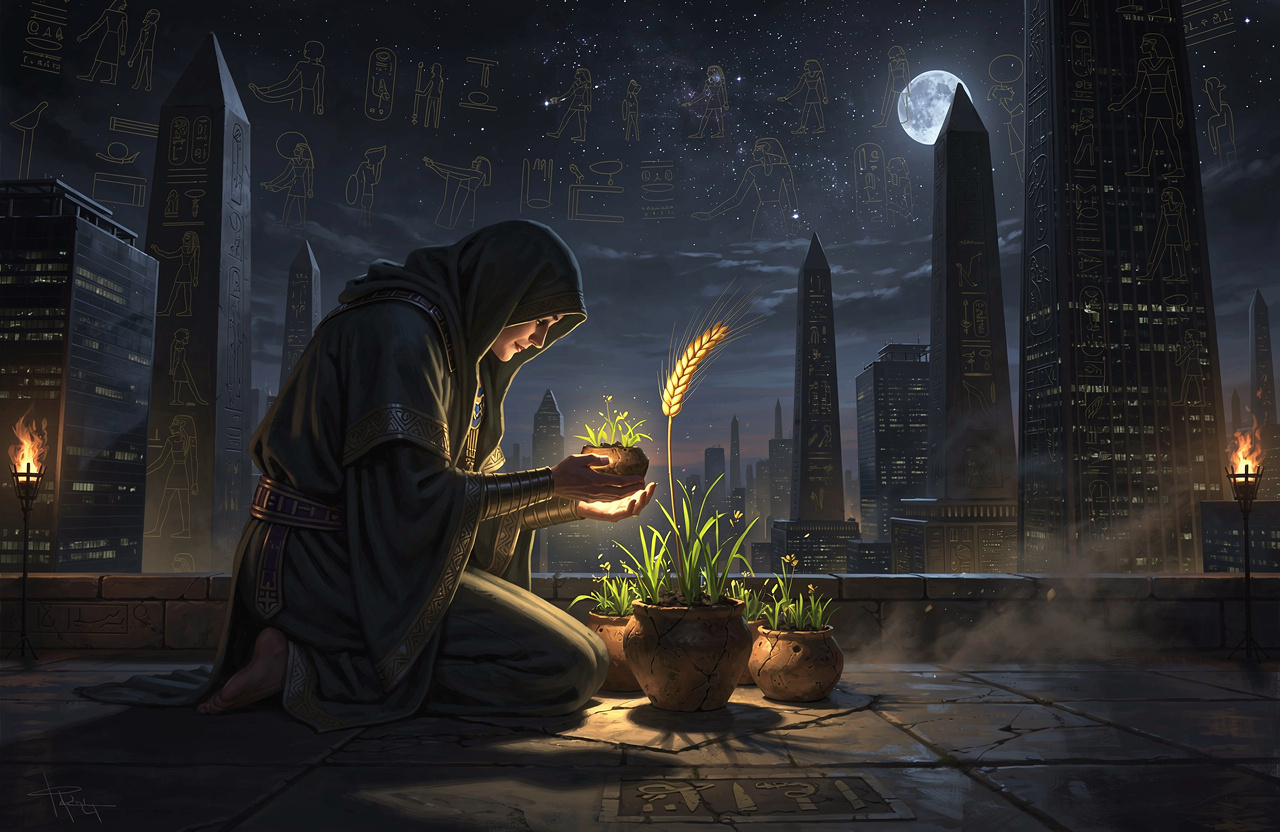
Count the hands between you and your dinner. The seed company. The industrial farm. The processor. The distributor. The logistics network. The retail chain. Six links, minimum, and every one of them can be squeezed by someone above it. You eat at the far end of a chain you don't control, made of companies that answer to funds you've never met.
Look closer at one link. A handful of corporations dominate the global seed and agro-chemical trade — after the mega-mergers of recent years, roughly a few players control the majority of the world's commercial seed. The plant that becomes your food increasingly begins as the patented property of a company you can't name. That's not farming. That's a subscription — and you're the account.
Here's the crack in the wall. The one link in that whole chain you can seize back with your own two hands is the first one. You can grow food. Not all of it — that's not the point. Enough to prove the chain isn't the only way. A pot of herbs on a windowsill is a declaration of independence with roots.
Start Absurdly Small
The mistake people make is treating this like a farm. It's not a farm. It's a rebellion you can fit on a windowsill, and it must start small or it dies of ambition.
The windowsill tier. Herbs. Basil, mint, parsley, green onions, chives. A pot, some soil, a sunny window. Green onions literally regrow from the scraps you'd throw away — put the white root end in water and watch. This tier costs almost nothing and its whole job is to teach you one truth in your own hands: food comes from dirt and light, not from a barcode. Once that lands, something shifts.
The balcony tier. A few containers, a rail planter, a grow bag. Tomatoes, chili, lettuce, radishes, beans. A single tomato plant in a five-gallon bucket yields more than you'd guess. Salad greens are the highest-value thing you can grow in tiny space — they're expensive to buy, fast to grow, and you harvest leaf by leaf for months.
The plot tier. If you have a yard, a community-garden bed, or a patch of ground — potatoes, squash, kale, garlic, berries. Calorie crops enter the picture. Potatoes are the classic survival crop for a reason: enormous yield, dead simple, stores for months in the dark.
Pick the tier your actual life allows today. Don't skip ahead. A basil pot you keep alive beats a garden plan you never dig.
Why This Is Leverage, Not a Hobby
Growing a tomato won't feed you through winter. So why does it matter? Because it does three things the chain can't stop.
It breaks the dependency reflex. The moment you eat something you grew, the spell cracks. Food stops being an unquestionable purchase and becomes a thing you can make. That single shift changes how you see every other "unquestionable purchase" in your life. Sovereignty is a muscle; this is the first rep.
It reconnects you to the Nun — the ground itself. Soil, seed, water, sun. The oldest system, the one that ran for ten thousand years before anyone financialized it. When you put your hands in dirt you're plugging back into a supply chain with zero corporate links — the original open-source protocol, unpatentable at the root no matter how many patents they file at the top.
It builds a node in a resilient mesh. You grow tomatoes, your neighbor grows greens, someone down the street keeps chickens. Seeds get saved and shared — and saved seed is the part they most want you not to do, because a seed you save is a subscription you cancelled. Suddenly a street has a tiny food web that doesn't route through a single distributor. When the long chain hiccups — and long chains hiccup, they're single points of failure by design — the mesh has something. Not everything. Something. And something, held locally, is the whole game.
Our record. The seed patent is Isfet at its most literal — a fence thrown around life itself, a toll booth bolted onto the act of growing. The saved seed is the counter-move: Sekhem returned to the soil that made it, life kept in the circle instead of leased back to you each spring. A hand in the dirt is a small, stubborn act of Maat — order restored at the one link you can actually reach.
Don't Romanticize It
Be honest: you'll kill some plants. Everyone does. The basil will bolt, the tomatoes will get some blight, the slugs will find the lettuce. This is not failure — it's the tuition. Growing food is a skill, and skills are built by killing plants and learning why. The people who feed themselves aren't the ones with green thumbs. They're the ones who kept planting after the first pot died.
And don't fall for the fantasy of total self-sufficiency off a balcony. You won't grow your grain or your cooking oil in a window box. That's fine. The goal isn't to exit the food system this year. It's to own the first link, build the skill, and prove to yourself — in the most physical way there is — that the chain is a choice, not a law of nature.
Do This Today
Go to your kitchen. Find green onions, or a clove of garlic, or a few dried beans — you probably already have one of these. Green onions: cut off the white root end, put it root-down in a glass of water on the windowsill. Garlic: push a clove into a pot of soil. Beans: soak a few overnight, plant tomorrow.
That's it. Five minutes, zero cost, and by next week there's green growth on your windowsill that no corporation owns, that no fund can price, that came from your hand and the ground and the light.
One pot. One seed. The first link, taken back. That's where food sovereignty starts — not on a farm, on your windowsill, today.