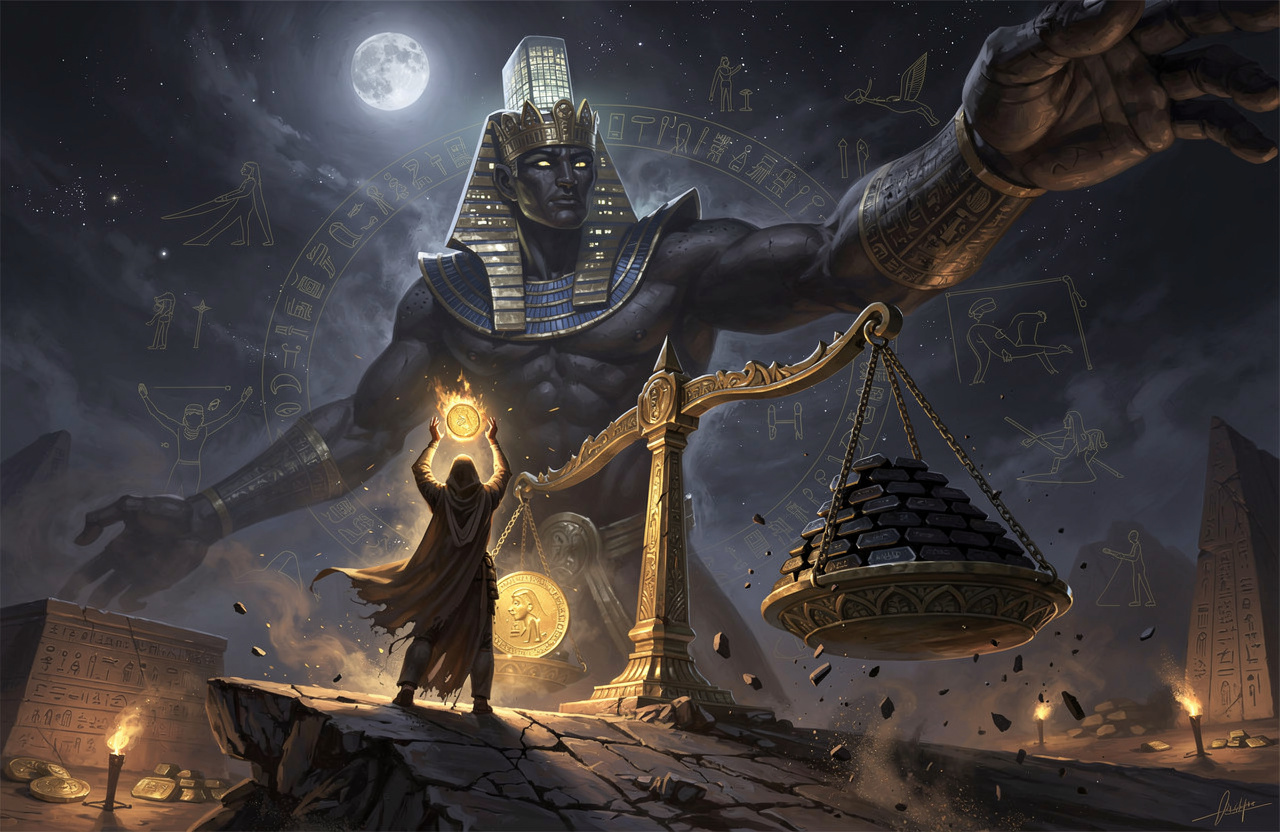
In the previous article we examined the event — the 2011 war in Libya and the gold dinar. Now let's examine the mechanism. Because the question "how could one man in a not-wealthy country threaten the most powerful currency in the world" is not about Gaddafi personally. It is about how the dollar system is built. And once you understand the build, it becomes clear why it reacts so nervously to seemingly local gestures.
The dollar is not the U.S. currency. It is a world protocol
The first thing to get straight: the dollar long ago stopped being merely America's national currency. It became the world's settlement protocol. International trade is counted in it, central banks hold reserves in it, most of the world's debts are denominated in it.
The main pillar of this construction is oil. Historically, oil trades predominantly in dollars — the petrodollar. The logic is circular and sturdy: every country needs oil → to buy oil you need dollars → so everyone is forced to hold and want dollars → so the dollar is always in demand, even when the U.S. prints it in enormous quantities.
An engineer would call it a network effect. The dollar is strong not because of gold behind it (there has been none since 1971), but because everyone uses it. Like a popular social network: you stay not because it is best, but because everyone else is there. To leave alone is to be left with no one.
So where is the threat
Now it is clear what the "threat" from Gaddafi was. Libya by itself is a drop in the world economy. But Gaddafi was aiming not at size but at the protocol. He proposed selling Africa's oil and resources not for dollars but for a gold dinar. That is, he was trying to launch an alternative settlement protocol in which the dollar is not needed.
And here is the key thing to understand: it is not one refusenik who is dangerous. It is the precedent that is dangerous. If one exporter successfully moves to another currency and is not punished, others will start thinking. The network effect works both ways: while everyone is in the dollar, leaving is frightening; but let a few large players leave and survive, and an outflow begins that accelerates itself. One leaves, others see it is possible, a second leaves, a third — and the protocol loses its monopoly.
That is why the system reacts so harshly. Not because one Libya would really undermine the dollar, but because it cannot allow a living example that exit is possible and unpunished. Punishment is not for the damage — it is for the precedent.
A pattern, not a chance
Let's add up what we have already seen in this block. Iraq in 2000 moved from the dollar to the euro for oil — after 2003 it was returned to the dollar. Libya in 2011 reached for the gold dinar — the state was destroyed. In the book this project stands on, a long row of leaders removed after trying to exit the debt/dollar logic is listed, and Gaddafi stands right in that row: "gold dinar, destroyed."
This is a pattern, not a chain of coincidences. The rule of the system: you can do almost anything as long as you stay inside the protocol and hold your reserves in its currency. But the moment you try to move large flows to an alternative protocol, you become a threat — not to one country, but to the network effect on which everything rests. And then it is no longer market mechanisms working against you, but everything else.
Where fact ends and myth begins
Let's draw the line honestly. Myth: "One small country starting to trade for gold is enough to make the dollar collapse tomorrow." No, the foundation does not fall that fast and easily: the network effect is monstrously inertial, and the dollar is still very strong. Myth number two: "The dollar is backed by nothing but armies." Also untrue — behind it stand a gigantic economy, liquidity, trust and habit.
Fact: the dollar holds primarily on universal use and the petrodollar pillar, not on gold; attempts by large players to move to another currency have historically coincided with a very harsh reaction; and what threatens the system is not the size of the defector but the precedent of exit itself. This is verifiable logic, confirmed by repeating examples.
And here is the main conclusion. The strength of the dollar system and its vulnerability are the same thing. It is strong because everyone is in it — and for that very reason it is mortally afraid of examples that you can leave. This is the weak point of any system built on coerced loyalty: it holds not because it is trusted, but because there is nowhere else to go.
Where is the ordinary person
He is inside this protocol even if he never held a dollar. His savings melt when the dollar supply is printed for someone else's needs ("exporting inflation"). His country can be punished by a rate raised in a foreign office. And he himself can be sent to a "humanitarian war" against whoever dared to seek an exit. He pays for the sturdiness of someone else's protocol — and has not a single vote in it.
The answer: the MAAT token and DAO
Gaddafi showed both the threat and its limit: to exit the protocol alone is to become a lone target, even with gold in the vault. But he also showed where the system is vulnerable: it holds on the fact that leaving is frightening and there is no one to leave with. So the answer is not a new lone refusenik, but an alternative built by a multitude of people at once, transparently, and with no single point to strike.
That is MAAT. The MAAT token is membership in a cooperative and a single vote, on the principle one human, one vote — not "whoever owns the protocol-currency is the master." Governance runs through a DAO, a decentralized organization with a transparent treasury that has no single palace to bomb and no single leader to remove. The dollar system fears a living example of exit. MAAT is the attempt to build that example — not out of gold and one man's will, but out of a network of ordinary people. The entry is simple: read the book, take the token, get your vote.