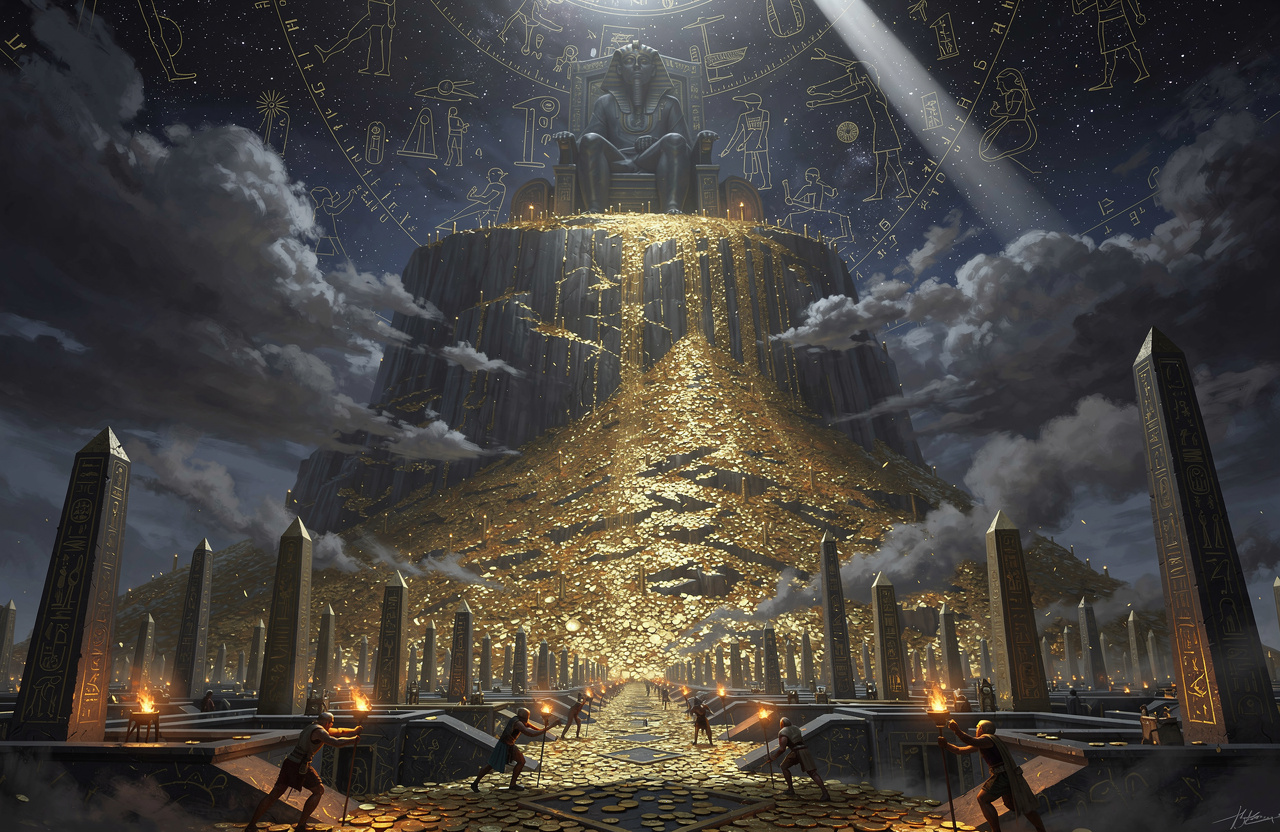
There are numbers the brain refuses to feel. A trillion is one of them. And three hundred trillion is no longer a number — it's a fog. Yet that is how the book estimates the total world debt: "$300 trillion in world debt." The whole fifth book, the author says, is built as a path "from the dead in the Duat to a living BlackRock on Wall Street. From an offering to a forgotten servant to $300 trillion in world debt." Let's try not to skim past this figure, but to actually feel it.
How much this really is
A trillion is a million millions. To feel the gulf between a million and a trillion, there's an old trick with time. A million seconds is about 11 days. A trillion seconds is about 31,000 years. Not "a bit more." Thirty thousand times more.
Now multiply by three hundred. Three hundred trillion dollars of world debt is a sum several times larger than the entire annual product of the planet — everything humanity produces in a year. In other words, the world owes several times more than it can earn in a year. The debt long ago tore loose from the real economy and lives a life of its own.
Whose debt is it
Here it's important not to get lost. "World debt" isn't an abstraction "somewhere up there." It's made of very concrete pieces, and in each one there are living people:
- State debts. Almost every country owes — through bonds, through loans. The interest on this debt is paid from the budget, that is, from taxes. From your taxes.
- Company debts. Businesses borrow to grow and build the interest into the price of goods. You pay it at the store.
- People's debts. Mortgages, car loans, cards, student loans. The book mentions US student debt specifically — about two trillion dollars, carried by forty million people.
Add it up and you get that mountain. But the mountain doesn't hang in the air. It stands on the backs of specific people who hand over part of their labor every month toward interest.
Debt as a tether
The strongest passage in the book isn't the size of the figure but its reading. There, debt is described not as accounting but as a mechanism for pumping energy: "$300 trillion in total world debt. Every dollar is a tether. Every tether is a channel of energy. 300 trillion channels. Everything flows upward. Toward a pattern that created nothing. That only captures and reproduces."
An engineer reads this as a description of a network. Each debt contract is an established connection, a channel through which your labor drains upward as interest. Three hundred trillion such channels converge on nodes that produced nothing themselves — they simply lent and now live off the interest. That is the architecture: not a center that thought it all up, but a pattern that captures the flows and reproduces itself.
Why there seems to be no way out
The book describes the trap with cold precision: "Housing costs more than you can earn. Without credit, no housing. Without housing, no family. The system is designed so there is no choice. This is not a bug in the system. It's a feature."
That's the trick. Debt is presented as your free choice — "well, you took the mortgage yourself." But the choice is fictional if, without credit, basic things (a home, education, healthcare) are simply out of reach. That isn't freedom to borrow — it's a dead end dressed up as a contract. And the person taking the loan is not to blame: as the book says, "he is a cell in an infected organism."
Add the amplifying mechanism. Most of the world's debt is denominated in dollars. Which means, as the book describes, one man in Washington, by raising the Fed's rate, can with a single decision increase the debt burden of half the world — without their consent. Debt is also a lever whose handle is not in the borrower's hand.
This is Isfet on a planetary scale
Let's name it plainly. Maat is fair exchange: you gave value, you received value. Isfet is inversion: a structure that creates nothing but is wired into the stream and skims an eternal percentage off it. Three hundred trillion debt channels, through which labor flows upward to a pattern that created nothing — that is Isfet spread across the whole planet. Not a metaphor for evil, but a precise description of where the energy goes.
Where is the ordinary person in this
You are the source of one of the channels. Part of your labor drains upward each month as interest — on your mortgage, on your country's debt, on company loans baked into prices. You may never see these contracts, but you feed them. Three hundred trillion includes a little bit of you.
The answer: the MAAT token and DAO
The mountain of debt holds together because people are connected to the channels one at a time and pay upward in scattered fashion, with no vote in how the system is built. So the answer is to gather together and build nodes that belong to the people themselves, not to the pattern above them.
That is MAAT. The MAAT token is membership in a cooperative and a vote on the principle of one human, one vote, not "whoever holds the most debt claims rules." Governance runs through a DAO — a decentralized organization with a transparent treasury where every movement of funds is visible to all. Here the stream doesn't drain into the dark toward a nameless pattern: everything is in plain view by default, because Isfet lives in the dark and open doors disarm it.
Three hundred trillion is the scale of their network. MAAT is about starting to build your own: channel by channel, node by node, in favor of those who were always only the source. The entry is simple: read the book, take the token, get your vote.