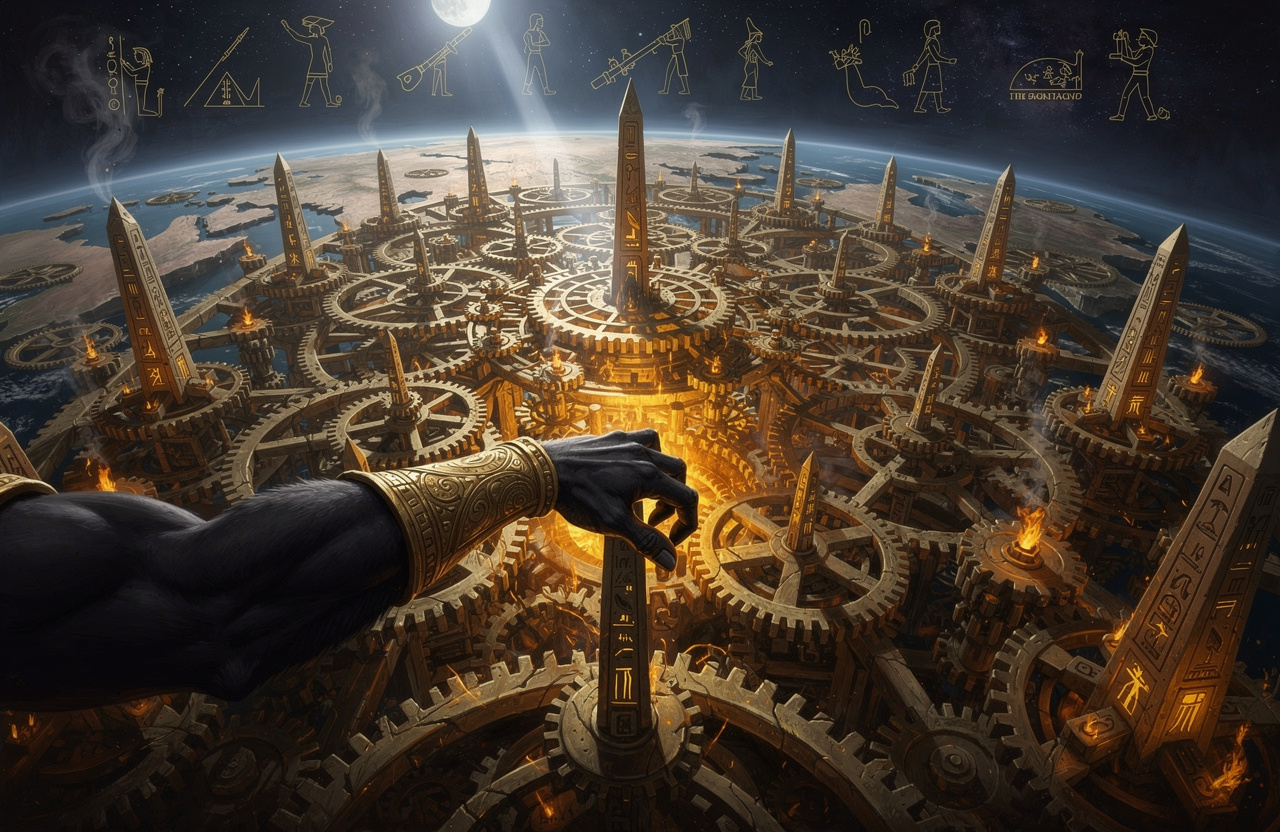
There is a convenient bedtime story for adults: the world economy is an honest market. Millions of people work, companies produce, banks provide services, states regulate, and money simply flows between everyone like blood through the body. Beautiful. Almost like a bank advertisement where a smiling family takes a thirty-year mortgage and somehow looks happy about it.
But if you look not at the interface, but at the architecture, the picture changes. The global financial economy is not a pure market. It is a system of gates, permissions, debts, ratings, liquidity, and control over ledgers. In engineering language: not a free network, but infrastructure with administrators.
And the main question here is not "who is the villain?" That is a childish question. The main question is: who has root access?
Money as an operating system
Money is not paper and not a number in an app. Money is the operating system of society. Through it, the system decides who can build, who can buy, who can wage war, who can receive treatment, who can start a business, and who spends his whole life servicing a loan.
If you control issuance, debt, and access to capital, you do not need to command people directly. You only need to configure the protocol. Some get cheap money at 1 percent. Others get credit at 28 percent. Some get a bailout at public expense. Others get bankruptcy, collectors, and a lecture about personal responsibility.
This is how modern financial power works: not through a crown and a throne, but through the conditions of access. No one forbids you to become rich. It is just that one person's starting server sits in a data center with backup power, while another person's is an old laptop in the kitchen with Wi-Fi through two walls.
Formally, everyone is equal. Architecturally, they are not.
Financial clans: neither myth nor cartoon
When people hear "financial clans," the mind usually runs to one of two extremes.
The first extreme says: "This is all conspiracy theory, there are no clans, the world is ruled by chance and markets." That is naive. Banking dynasties, old foundations, family offices, closed capital clubs, inherited networks of influence — all of this exists quite officially. You can study them through the history of banks, foundations, boards of directors, university endowments, think tanks, and legal structures.
The second extreme says: "There is one family in a basement pressing buttons, and everything happens by its command." That is also a fairy tale, only darker. The world is too complex for one basement. Modern power does not sit in one room. It is distributed. It is a network.
The Rothschilds matter in the nineteenth century not because they "secretly rule everything today." That is primitive. They matter because they showed a principle early: capital distributed across countries is stronger than any single state. The Rockefellers matter not because they personally direct every oil conflict. They matter as an example of industrial capital transforming into financial-foundation architecture: corporations, foundations, universities, medicine, politics, expertise.
So the issue is not the surname. The surname is an old version of the interface. Under it runs a more important mechanism: capital organizes itself into a network, while ordinary people remain single nodes.
Why debt is stronger than an army
In the past, to subdue a country, you had to send troops. Expensive, noisy, bloody, terrible press. The modern system is smarter. It subdues through debt.
A country receives a loan. Then another. Then it is "helped" with restructuring. Then come the conditions: privatization, spending cuts, opening markets, selling infrastructure, dependence on ratings, dependence on the currency of the debt. Outwardly, everything is legal. Nobody occupied anyone. The country simply begins to live in order to service obligations to creditors.
This does not mean every loan is evil. Credit can be a tool for development. But when debt becomes permanent, it stops being a tool and becomes a collar. Especially when the debt currency is foreign, the interest rate is foreign, the ratings are foreign, and the rules of the game are written by those who later buy assets at a discount.
For an ordinary person this is familiar. At first the loan "helps." Then the salary no longer comes to you, but to the bank. You are supposedly free, but your future labor has already been pledged. At the level of states the same pattern works, only the numbers are larger and the suits are more expensive.
Funds as the new form of power
In the twentieth century, the power of capital became more intelligent. It understood that direct ownership creates irritation. It is much cleaner to own through funds, asset managers, indexes, trusts, and legal wrappers.
BlackRock, Vanguard, State Street — these are no longer "clans" in the old family sense. They are the next layer of the architecture. They manage blocks of shares across thousands of companies. Often they do not own the money directly, but they vote, influence, set standards, sit around the governance table, and shape policy through passive investment that has long stopped being passive.
Here is where it gets interesting. An ordinary person may own shares through a pension fund. Formally he is a capitalist. In practice his vote is managed by a structure he did not choose, does not control, and often does not even understand. His future pension becomes part of an enormous voting mass.
So the crowd appears to own capital, but the management interface sits elsewhere.
It is as if millions of people owned computers, but the root password for all machines was held by three administrators. Formally the hardware is yours. In practice, you are not the one executing the commands.
Where fact ends and myth begins
It is important not to slide into cheap paranoia. There is no need to explain every crisis as a "secret order." Most of the time the truth is simpler and more frightening: the system itself produces the required behavior.
If a fund manager must show returns, he will pressure companies for profit. If a bank earns on debt, it will expand credit. If a state depends on the bond market, it will listen to creditors. If a politician depends on donors and media, he will take into account the interests of those who hold capital.
You do not need one unified conspiracy when you have one unified incentive.
It is like a botnet. Not every infected computer knows who owns the network. It simply executes the command embedded in it. In the global economy, many participants sincerely see themselves as independent: banker, official, analyst, journalist, professor, fund manager. But if all of them are connected to the same incentive system, the result becomes coordinated even without a secret Telegram chat.
That is why the conversation about financial clans should not be a hunt for surnames. It should be an audit of architecture.
Why the ordinary person always loses
The ordinary person does not lose because he is stupid. He loses because he plays alone.
He has one vote, one salary, one deposit, one apartment under mortgage, one pension account. Against him stand structures that unite the capital of thousands, millions, sometimes billions of people, but manage it centrally. They act as a network. He acts as a single user.
The system tells him: "Be individual. Take responsibility for yourself. Invest by yourself. Understand everything by yourself. Vote by yourself. Defend yourself by yourself." Very convenient. The scattered are always easier to weigh, buy, frighten, or ignore.
Financial elites understood the main law long ago: organized capital always beats scattered labor.
And as long as ordinary people answer this with personal morality, outrage, or comments on the internet, nothing changes. A comment does not compete with a fund. Outrage does not compete with a treasury. A good person without a structure almost always loses to a bad structure.
What to do with it
The answer is not to hate the rich. Hatred is a poor strategy; it eats energy and builds nothing. The answer is to understand the principle and turn it around.
If their strength is the network, then there must be our own network. If their strength is the fund, then there must be our own transparent treasury. If their strength is voting with capital, then there must be the vote of people. If their system works by the principle "one dollar, one vote," then ours must work the other way around: one human, one vote.
That is why the topic of financial clans should not end in fear. Fear is when you see the monster and sit down on the floor. Maat begins where you see the monster's architecture and start designing the counter-architecture.
Not a new pyramid. Not a new king. Not "our good bankers instead of their bad bankers." A system where the treasury is transparent, the rules are visible, the vote cannot be bought with a sack of money, and the human being stops being a lonely arrow.
The old clans proved one thing: the network beats the loners.
Good. Lesson accepted.
The only question now is who builds the next network — them again, or us at last.