Flip the switch. The light comes on. You never think about the mile of copper, the substation, the transformer, the transmission line stretched across a hundred kilometers of nothing between the power and your hand. You think about the switch. That's the trick of infrastructure — it becomes invisible the moment it works.
Which makes it the perfect thing to own. Nobody guards a treasure they can't see.
While everyone argued about solar panels versus coal, a quieter accumulation happened one layer down. The interesting money didn't go into the debate. It went into the wires. The generation source changes — sun, wind, gas, whatever wins the decade. The grid that carries it does not. And the grid is a natural monopoly: you don't build a second competing set of power lines to a house. Whoever owns the wires collects a toll on every electron, forever, regardless of who generated it.
The names buying the current
NextEra Energy became one of the most valuable utilities on Earth by pairing a regulated grid business with the largest fleet of wind and solar generation in America. Iberdrola did the parallel move across Europe and Latin America. Enel, National Grid, Duke, Southern — the big regulated and renewable operators are among the most sought-after assets of the transition.
And behind them? The register you now recognize. Vanguard and BlackRock sit among the top shareholders of NextEra and the other US utilities — the same institutions that top pharma and agriculture. But here a second layer appears, and it's the important one: the infrastructure funds.
BlackRock didn't just buy utility shares. It bought Global Infrastructure Partners for roughly 12.5 billion — a firm whose whole business is owning the physical bones of energy and transport: pipelines, terminals, grids. Brookfield runs a vast infrastructure arm doing the same. Macquarie, KKR, and the sovereign funds are all in the scrum. The transition isn't just being invested in. It's being enclosed — the essential, un-substitutable, monopoly-shaped middle of it is being bought outright, off the public market where you could at least glimpse it.
Why the "transition" is the enclosure
Here's the sleight of hand. A transition is disruptive — old assets die, new ones rise, trillions move. Disruption looks like chaos, like risk, like the opposite of a ring. So while your attention is on the drama — which technology, which subsidy, which culture-war framing — the boring monopoly layer underneath is being consolidated by the patient, enormous, diversified owners who thrive on exactly this.
They don't care which generation source wins. They own the wires either way. They don't care if it's a green transition or a slow one. They collect the toll on the current regardless. The transition is the noise. The grid is the signal. And the signal is being bought.
Our record
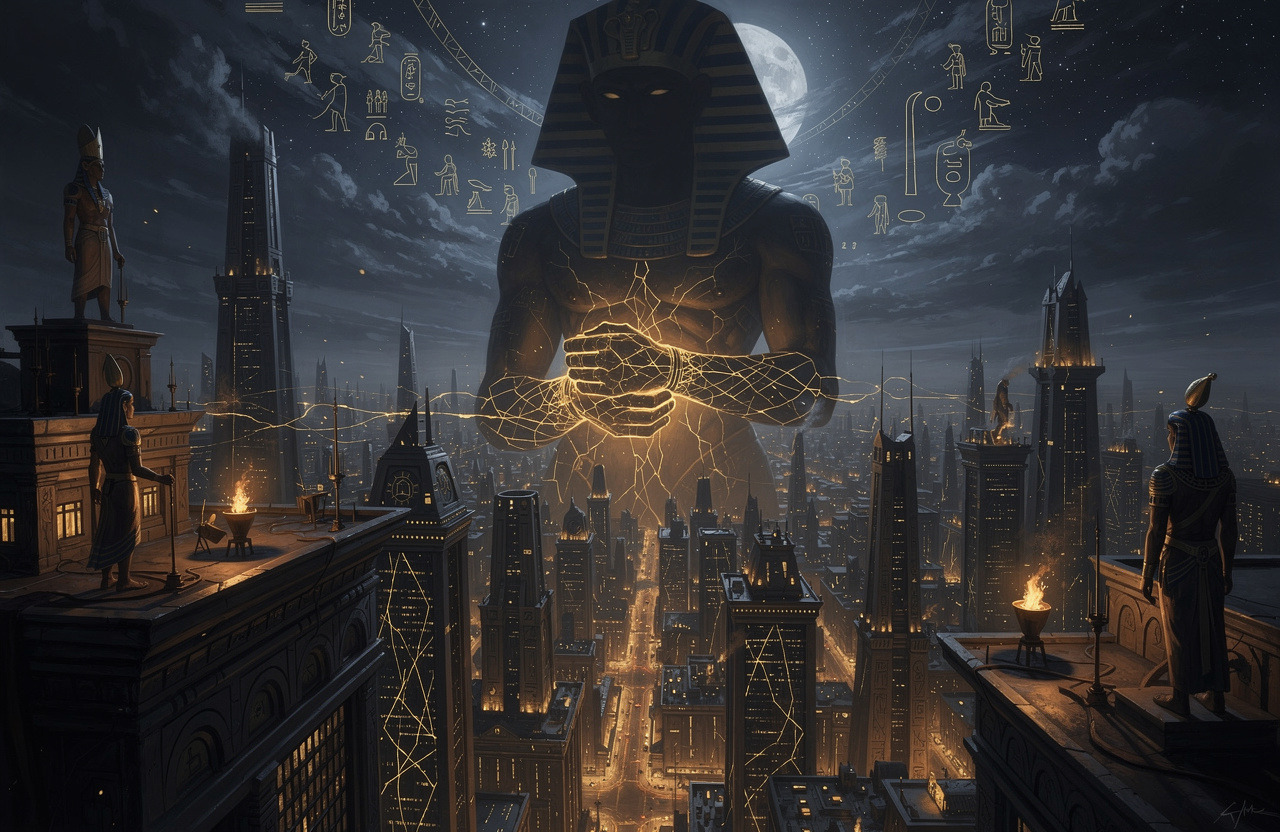
On the Scales, energy is Sekhem made civilizational — the raw life-force of a society, the difference between a warm lit home and cold dark. Whoever controls the flow of Sekhem controls the conditions of every life downstream of it. That's not metaphor. That is literally what a grid is: the channel through which the vitality of a whole society moves.
A Ring around the grid is Apep coiled around the artery. It doesn't need to stop the flow — stopping it would be noticed, resisted, cut out. It needs only to own the channel, so that all Sekhem passes through its coil and pays as it passes. The Shadow Neteru — the inverted powers that mimic order while feeding on it — love the grid precisely because it is invisible when healthy. You only see the coil when the lights go out. By then it owns the artery.
Name it, though, and you can see it while the lights are still on. That's the whole point of naming — it makes the invisible ring visible before the blackout, not after.
The single point of failure
Any engineer feels the alarm here. A society whose essential energy channel is owned by a handful of concentrated funds, off-market, opaque, is running its most critical system with a single point of failure baked in. Centralize the ownership of the artery and you centralize the risk of the artery. That's not just unjust — it's fragile. Legacy architecture, one master node, no redundancy at the ownership layer. Every DevOps instinct screams at that design.
Which is also the clue to the exit. You don't fix a single-point-of-failure system by asking the single point to be nicer. You fix it by distributing.
The lever
The grid feels like the one thing you truly can't route around — it's a physical monopoly, after all. But look closer. The monopoly is on the transmission wires. It was never total on generation, and it's cracking on storage and control.
Distributed generation is the fork. Rooftop solar, community solar, local microgrids — every kilowatt you generate near where you use it is a kilowatt that doesn't pay the toll on the long wires. The centralized grid was built for an era when generation had to be huge and far away. That era is technically over. The physics now favor the edge.
Storage breaks the timing lock. Batteries, local storage, and smart control let a home or a neighborhood ride through the moments the grid used to own completely. Own the storage, own your resilience.
Community and cooperative energy is the ownership answer. Energy co-ops, municipal utilities, community-owned renewables — these put the wires and the generation back into the hands of the people downstream of them. Same principle as every ring in this series: pull ownership back down to where the need actually lives. With energy, "down" means to your own roof, your own street, your own co-op.
Own the storage of value too. Self-custodied crypto, a DAO treasury, open infrastructure — value that flows through channels you hold rather than channels a fund holds. The grid taught the funds the whole playbook: own the channel, tax the flow. Answer with channels they don't own.
The funds are buying the wires because the wires are the future's toll booth. Fine. Build enough generation, storage, and community ownership at the edge, and the toll booth ends up on a road fewer and fewer people have to take.
Own the current where you stand. Distribute the artery. Keep your light on your own keys.